“I Feel Huge” vs What I’m Actually Feeling: Translating Body Distress Into Emotions With Amy Ornelas, RDN

“I Feel Huge” vs What I’m Actually Feeling: Translating Body Distress Into Emotions With Amy Ornelas, RDN

Have you ever had the experience of suddenly feeling huge in your body, even though nothing about your body has actually changed? That moment of intense body distress is incredibly common in eating disorder recovery. But what if that feeling is not really about body size at all?

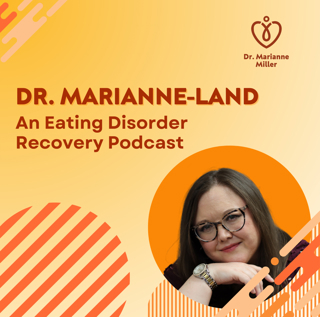
In this episode of Dr. Marianne-Land, Dr. Marianne Miller is joined by Amy Ornelas, RDN, an eating disorder dietitian, yoga teacher, and somatic therapy practitioner, to explore what body distress may actually be signaling underneath the surface. Together, they unpack how thoughts like “I feel huge” can often reflect emotional activation, overwhelm, grief, shame, anger, or stress rather than a literal change in body size.

Amy explains how eating disorder behaviors such as restriction, binge eating, and purging can alter brain chemistry and disconnect people from their internal emotional world. When those behaviors begin to shift in recovery, many people suddenly find themselves face to face with emotions that may have been numbed or pushed aside for years. This can feel confusing, intense, and sometimes even frightening.

Dr. Marianne and Amy talk about how eating disorders can function as powerful survival strategies that help people manage overwhelming emotional states. Rather than demonizing these behaviors, they explore how they often develop as adaptive coping mechanisms in environments where emotional expression was discouraged, dismissed, or unsafe.

The conversation also highlights how family dynamics, culture, trauma, and neurodivergence can shape the way people learn to relate to their emotions. Many individuals grow up hearing messages that they are too sensitive, too emotional, or should simply get over what they feel. Over time, these messages can make emotional awareness feel dangerous or overwhelming.

Amy introduces the role of somatic therapy in eating disorder recovery and explains how body-based approaches can help people reconnect with their internal sensations in a gradual and supportive way. Instead of forcing emotional processing, somatic work focuses on building safety in the nervous system and slowly increasing the capacity to notice and tolerate emotional states.

Dr. Marianne and Amy also discuss how body image distress can function as a powerful distraction. It can feel easier to focus anger, fear, or grief on the body than to confront deeper sources of pain, such as relational conflict, social stress, or systemic injustice. Learning to translate body distress into emotional language can help people understand what their internal system is truly trying to communicate.

This episode also addresses an important reality in eating disorder recovery: sometimes people appear more emotionally dysregulated as they begin healing. That increase in emotional expression can actually be a sign that someone is reconnecting with their inner world after years of emotional numbing.

Amy shares several practical tools that can help people begin reconnecting with their emotions, including brief emotional check-ins throughout the day, asking simple questions about what feelings may be present when eating disorder urges arise, and using movement to help emotional energy move through the body. Dr. Marianne also brings in a neurodivergent-affirming lens, discussing how stimming, rocking, sensory soothing, and other nervous system supports can help people stay connected to themselves during emotionally intense moments.

Together, they emphasize that emotions are not problems to eliminate. They are information from our internal systems that help guide us toward safety, boundaries, authenticity, and healing.

In this episode, we discuss

How eating disorder behaviors can numb or redirect difficult emotions.

Why recovery often brings a surge of feelings to the surface,

What somatic therapy is and how it can support eating disorder recovery.

Why the thought “I feel huge” often reflects emotional distress rather than body change.

How trauma, family systems, and culture shape emotional expression.

Why body image distress can act as a distraction from deeper pain.

The difference between compartmentalizing emotions and avoiding them.

Why increased emotional intensity can be a sign of progress in recovery.

Practical ways to begin noticing and naming emotions during recovery.

How neurodivergent people may benefit from stimming and sensory supports.

About the guest

Amy Ornelas, RDN, is a registered dietitian nutritionist, eating disorder specialist, yoga teacher, and somatic therapy practitioner based in California. She works with individuals, families, and groups and integrates nutrition care with somatic and nervous system–informed approaches to eating disorder recovery.

Connect with Amy Ornelas

Instagram: @amyornelasRD Website: i-heart-nutrition.com

Listen if you are

Experiencing intense body image distress during eating disorder recovery.

Trying to understand why recovery can bring more emotion, not less.

Curious about somatic therapy and body-based approaches to healing.

Looking for tools to help manage urges to restrict, binge, or purge.

Interested in understanding the emotional layers beneath body distress.

Related episodes

On Eating Disorders as a Coping Strategy for Deeper Pain via Apple or Spotify.

On Eating Disorders in Midlife & Our Personal Recovery Stories via Apple or Spotify.

On Atypical Anorexia via Apple or Spotify

On Eating Disorder Recovery, Higher Level of Care, & Renourishment via Apple or Spotify

On Reconnecting With Your Body in Eating Disorder Recovery via Apple or Spotify

On Trauma, Eating Disorders, & Levels of Care via Apple or Spotify.

Final note

Body distress can feel incredibly convincing in the moment. But sometimes the feeling that your body is the problem is actually your emotional system trying to communicate something deeper. Learning to listen to those signals can be a powerful part of eating disorder recovery.

Contact Dr. Marianne

Check out Dr. Marianne's self-paced, virtual courses on ARFID and binge eating, as well as her therapy services in California, Texas, and Washington D.C., at her website drmariannemiller.com.

Tämä jakso on lisätty Podme-palveluun avoimen RSS-syötteen kautta eikä se ole Podmen omaa tuotantoa. Siksi jakso saattaa sisältää mainontaa.

Jaksot(360)

Autism, ADHD, & Eating Disorder Recovery: Building a Life That Fits Your Brain

Autism, ADHD, & Eating Disorder Recovery: Building a Life That Fits Your Brain

Eating disorder recovery happens within your daily life. For autistic people and ADHDers, sensory overload, executive functioning challenges, masking, and demanding schedules can make consistent nouri...

14 Loka 15min

Misophonia: Why Chewing Sounds Feel Unbearable & How to Cope With Dr. Tom Phelan

Misophonia: Why Chewing Sounds Feel Unbearable & How to Cope With Dr. Tom Phelan

Do chewing, crunching, or slurping sounds make you feel anxious, overwhelmed, disgusted, or desperate to leave? In this episode of Dr. Marianne-Land, Dr. Marianne welcomes clinical psychologist and au...

12 Loka 29min

Why Certain Foods Become Binge Foods: ADHD, Autism, Bulimia, & Binge Eating Disorder

Why Certain Foods Become Binge Foods: ADHD, Autism, Bulimia, & Binge Eating Disorder

Certain foods can become closely connected to binge eating because they provide more than taste or energy. For people with ADHD or autism, these foods may offer sensory stimulation, predictability, em...

9 Loka 11min

Chronic Pain Challenges With Eating Disorders: When Pain, Fatigue, & Food Collide

Chronic Pain Challenges With Eating Disorders: When Pain, Fatigue, & Food Collide

Chronic pain can make eating disorder recovery more complicated. Pain, fatigue, brain fog, medication side effects, nausea, limited mobility, and sensory overload can interfere with shopping, preparin...

7 Loka 13min

Eating Disorder Recovery in an Anxious World: Finding Safety With Food & Connection With Vanessa Scaringi, PhD & Kathryn Garland, LCSW

Eating Disorder Recovery in an Anxious World: Finding Safety With Food & Connection With Vanessa Scaringi, PhD & Kathryn Garland, LCSW

Attachment patterns can shape how we seek comfort, respond to uncertainty, and relate to food. Dr. Marianne welcomes back Vanessa Scaringi, PhD, and Kathryn Garland, LCSW, to discuss eating disorder r...

5 Loka 32min

When Your Fear of Being Fat Is About How Others Will Treat You: The Desire for Thinness As Social Safety

When Your Fear of Being Fat Is About How Others Will Treat You: The Desire for Thinness As Social Safety

Fear of weight gain is not always about appearance. For many people, the desire for thinness reflects a fear of rejection, medical weight stigma, dating discrimination, family criticism, workplace bia...

2 Loka 18min

Autism, ADHD, & Food Struggles: Why Eating Is So Hard in Systems Not Built for You

Autism, ADHD, & Food Struggles: Why Eating Is So Hard in Systems Not Built for You

Autism, ADHD, and other forms of neurodivergence can make eating far more complicated than simply recognizing hunger and choosing food. Sensory sensitivities, executive dysfunction, time blindness, in...

30 Syys 23min

Eating Disorder Recovery Without Food Rules: A Dietitian’s Approach With Lauren Hofstee, RD

Eating Disorder Recovery Without Food Rules: A Dietitian’s Approach With Lauren Hofstee, RD

Food rules can make eating feel like a test you have to pass. Dr. Marianne talks with registered dietitian Lauren Hofstee about eating disorder recovery, disordered eating, and building a steadier rel...

28 Syys 25min
Suosittua kategoriassa Terveys ja hyvinvointi

unicast
aamukahvilla
psykopodiaa-podcast
vakeva-elama-viisaampi-mieli-vahvempi-keho
rss-kuumilla-aalloilla
meditaatiot-suomeksi
rss-pitaisko-erota
voi-hyvin-meditaatiot-2
rss-pt-paahtio
rss-uplevel-by-sonja-hannus
tiedenaiset-podcast
rss-terapiaklubi
junnut-pelissa
rss-pska-juttu
rss-duodecim-lehti
selviytyjat-tarinoita-elamasta
rss-mighty-finland-podcast
rss-kehtaanko-kysya-podcast-aideille
rss-palaudu-synnytyksesta-podcast
fitnessvastaanotto