
Think Thursday: Subtraction-Why Less Might Be Better For Your Brain

Think Thursday: Subtraction-Why Less Might Be Better For Your Brain

When something in life is not working, most of us instinctively try to add something. A new habit. A new system. A new goal. Another tool.

But what if the smarter move is removing instead of adding?

In this episode of Think Thursday, we explore the neuroscience behind why the brain defaults to addition, why subtraction can feel uncomfortable or even threatening, and how learning to simplify may be one of the most powerful behavior change strategies available to us.

In This Episode

  • Why the brain equates improvement with accumulation
  • Research from Dr. Leidy Klotz showing our built-in bias toward adding instead of subtracting
  • How loss aversion makes removal feel like threat rather than refinement
  • The cultural conditioning that reinforces “more is better”
  • How cognitive load impacts the prefrontal cortex and decision-making
  • Why simplification increases flexibility and reduces overwhelm
  • The connection between subtraction and dopamine recalibration
  • How removing stimulation can restore reward sensitivity
  • The difference between identity loss and identity refinement

The Neuroscience Behind It

Your prefrontal cortex has limited capacity. Every added system, rule, or goal requires energy and attention. When cognitive load increases, the brain defaults to automatic patterns.

Subtraction reduces competing signals. Fewer cues mean less decision fatigue. Less noise allows greater clarity.

When stimulation is constantly high, your dopamine baseline shifts. Reducing input can initially feel uncomfortable, but over time it recalibrates your reward system, improves focus, and restores sensitivity to everyday experiences.

Simplification is not deprivation. It is neurological efficiency.

A Simple Experiment for This Week

Instead of asking, “What should I add to improve this?” try asking:

  • What is creating friction?
  • What is adding noise?
  • What feels heavy?
  • What is competing for my attention?

Then remove one thing.

Not dramatically. Not impulsively. Thoughtfully.

Subtraction compounds.

Key Takeaway

Progress does not always require more.

Sometimes the most intelligent move is editing.

Your brain may be wired to add, but you can choose to simplify.

Less input can create better output.
Less noise can create greater focus.
Less complexity can create stronger consistency.

Until next time, choose peace.

★ Support this podcast ★

Tämä jakso on lisätty Podme-palveluun avoimen RSS-syötteen kautta eikä se ole Podmen omaa tuotantoa. Siksi jakso saattaa sisältää mainontaa.

Jaksot(413)

More Sober October: Make it An Experiment, Not an Exam

More Sober October: Make it An Experiment, Not an Exam

What if the goal of More Sober October isn’t a perfect calendar—but learning something about your relationship with alcohol?In this episode, Molly shares how to approach October as an experiment inste...

28 Syys 23min

Think Thursday: Alzheimer’s Prevention and What the Latest Research Tells Us

Think Thursday: Alzheimer’s Prevention and What the Latest Research Tells Us

World Alzheimer’s Day is a good reminder that the story around Alzheimer’s disease is changing.In this Think Thursday episode, Molly looks at what we know now about earlier diagnosis, blood-based biom...

24 Syys 18min

How Much Alcohol is Safe? Rethinking Drinking Guidelines

How Much Alcohol is Safe? Rethinking Drinking Guidelines

What does “drink less” actually mean?In this episode of the Alcohol Minimalist podcast, Molly explores the changing alcohol guidelines and why there isn’t one simple number that guarantees a “safe” le...

21 Syys 20min
Think Thursday: Why Familiar Feels True-When Thoughts Become Beliefs

Think Thursday: Why Familiar Feels True-When Thoughts Become Beliefs

What happens when a thought gets repeated so often that it stops feeling like a thought and starts feeling like a fact?In this Think Thursday episode, Molly explores the illusory truth effect, process...

17 Syys 15min
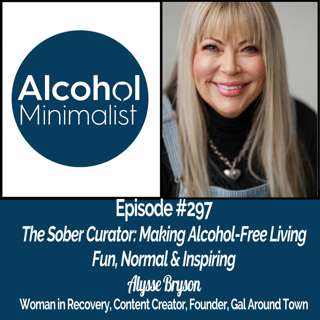
The Sober Curator: Making Alcohol-Free Living Fun, Normal & Inspiring with Alysse Bryson

The Sober Curator: Making Alcohol-Free Living Fun, Normal & Inspiring with Alysse Bryson

What does it look like to build a fun, fulfilling life with less alcohol—or none at all?In this episode of the Alcohol Minimalist Podcast, Molly talks with Elise Bryson, CEO and curator of The Sober C...

14 Syys 45min
Revisiting Think Thursday: Neurodivergence and The Brain's Energy Economy

Revisiting Think Thursday: Neurodivergence and The Brain's Energy Economy

In this revisited Think Thursday episode, Molly explores ADHD through the lens of the brain’s energy economy—how neurodivergent brains may use mental fuel differently, and why that matters for motivat...

10 Syys 13min

Summer's Greatest Hits: Alcohol & ADHD

Summer's Greatest Hits: Alcohol & ADHD

This week on the Alcohol Minimalist Podcast, we’re revisiting the most-downloaded episode from the Alcohol & series: Alcohol & ADHD.ADHD is a personal topic for me, and it also comes up often with coa...

7 Syys 35min

Think Thursday: Hearing Health is Brain Health

Think Thursday: Hearing Health is Brain Health

We tend to think of hearing as something that happens in our ears, but hearing is really a partnership between the ears and the brain. And growing research suggests that when hearing begins to decline...

3 Syys 12min

Suosittua kategoriassa Koulutus

rss-murhan-anatomia
aamukahvilla
psykopodiaa-podcast
adhd-podi
rss-hereilla
voi-hyvin-meditaatiot-2
psykologia
rss-niinku-asia-on
rss-arkea-ja-aurinkoa-podcast-espanjasta
kesken
koulu-podcast-2
rss-liian-kuuma-peruna
ihminen-tavattavissa-tommy-hellsten-instituutti
rss-vapaudu-voimaasi
aloita-meditaatio
rss-suomen-aa-podcast
rss-luonnollinen-synnytys-podcast
ilona-rauhala
rss-valo-minussa-2
rss-narsisti