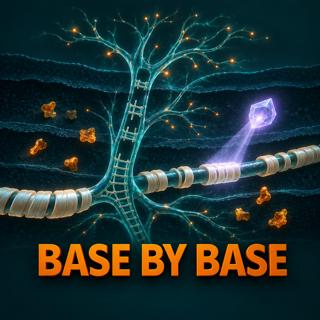
456: Beyond exons: where heritability hides as traits get more polygenic

456: Beyond exons: where heritability hides as traits get more polygenic

Fuhrer J et al., The American Journal of Human Genetics - Across 34 complex traits and disorders, a MiXeR-based framework partitions SNP heritability over 74 functional annotations and finds that exons carry only a minority of it, and steadily less as a trait becomes more polygenic. Exonic heritability falls from about 22 percent in less-polygenic somatic diseases and biomarkers to about 13 percent in highly polygenic psychiatric and cognitive traits, intergenic heritability rises by the same logic, and intronic heritability stays put. A new annotation contribution score shows the same axis in the annotations themselves: highly polygenic traits load on conservation and variant-effect scores, less-polygenic traits on promoter, transcription and chromatin marks. Key terms: polygenicity, SNP heritability, noncoding variation, functional annotation, complex traits.

Study Highlights:
The authors extended the MiXeR framework to model SNP effect-size variance across 74 binary functional annotations, applied it to 34 traits spanning psychiatric, neurological, cardiometabolic, anthropometric, hematological and immune phenotypes, and introduced a likelihood-based annotation contribution score that measures how much a single annotation adds to the full model rather than how enriched it is per SNP. Exons cover 2.55 percent of base pairs and account for a mean of 14.52 percent of heritability, with introns and intergenic regions together explaining the remaining 85.49 percent; introns alone typically carry about half. Regressing regional fractions on log polygenicity, the exonic fraction falls 4.38 percentage points and the intergenic fraction rises 4.87 percentage points per ten-fold increase in polygenicity, while the intronic slope is not significant, and the illustrative spread runs from 8.51 percent exonic in schizophrenia to 29.44 percent in sex-hormone-binding globulin. The contribution score peaks for mid-sized annotations covering roughly 10 to 15 percent of SNPs, so compact conservation tracks such as phastCons, GERP, CADD and Eigen dominate in highly polygenic traits while promoter and chromatin tracks such as H3K4me3 and CpG islands dominate in less-polygenic ones. Sensitivity analyses against sLDSC and sLD4M agreed closely, with heritability fractions correlating at r equals 0.996 and polygenicity estimates at Spearman r equals 0.91.

Conclusion:
The functional location of heritability is not a fixed property of the genome but tracks a trait's polygenicity: less-polygenic somatic traits concentrate heritability in coding and gene-proximal regulatory regions, while highly polygenic psychiatric and cognitive traits distribute it across dispersed distal regulatory elements. Because enrichment per SNP and total contribution can point in opposite directions, the authors argue both must be read together, and they note that coding variants explain a minority of heritability throughout, which argues for sequencing designs that maximize noncoding coverage. The analysis relies on European-ancestry reference panels, uses relatively broad annotations with incomplete chromosome X coverage, and depends on polygenicity estimates from two methods that nonetheless agreed closely.

Music:
Enjoy the music based on this article at the end of the episode.

Article title:
Beyond exons: Linking noncoding heritability and polygenicity across complex human traits and disorders

First author:
Fuhrer J

Journal:
The American Journal of Human Genetics

DOI:
10.1016/j.ajhg.2026.08.012

Reference:
Fuhrer J, Shadrin AA, Hughes T, Parker N, Hindley G, Frei E, Nguyen D, Smeland OB, Djurovic S, Andreassen OA, Dale AM, Frei O. Beyond exons: Linking noncoding heritability and polygenicity across complex human traits and disorders. The American Journal of Human Genetics. 2026;113(10):1-13. doi:10.1016/j.ajhg.2026.08.012

License:
This episode is based...

Tämä jakso on lisätty Podme-palveluun avoimen RSS-syötteen kautta eikä se ole Podmen omaa tuotantoa. Siksi jakso saattaa sisältää mainontaa.

Jaksot(462)

461: Adult Ank3 loss quiets neurons and lowers a myelin protein

461: Adult Ank3 loss quiets neurons and lowers a myelin protein

Yoon et al., Proceedings of the National Academy of Sciences - ANK3, which encodes the scaffolding protein ankyrin-G, is a major risk gene for bipolar disorder and schizophrenia, yet what it does in a...

24 Syys 24min

460: The lupus variant that also sharpens antiviral defense

460: The lupus variant that also sharpens antiviral defense

Virolainen et al., The American Journal of Human Genetics - A lupus signal on chromosome 11p15 narrows to a coding haplotype in IRF7 that most people in the world carry. This study shows the risk form...

21 Syys 24min

459: Cerebral palsy genetics: 515 candidate genes, evidence for 89

459: Cerebral palsy genetics: 515 candidate genes, evidence for 89

Arterbery et al., The American Journal of Human Genetics - Hundreds of genes have been reported as causes of cerebral palsy, yet there is no agreed model of what a pathogenic variant in a child with C...

13 Syys 24min
458: Somatic or inherited? Reading TP53 risk from shared DNA

458: Somatic or inherited? Reading TP53 risk from shared DNA

MacGregor et al., The American Journal of Human Genetics - Pathogenic TP53 variants found in blood have long been read as inherited Li-Fraumeni alleles, but many turn out to be somatic clones that gre...

10 Syys 25min

457: A deletion that raises Alzheimer risk, a duplication that lowers it

457: A deletion that raises Alzheimer risk, a duplication that lowers it

Quenez O et al., The American Journal of Human Genetics - Rare copy-number variants were called from 22,319 exomes covering early-onset Alzheimer disease, late-onset disease and unaffected controls, t...

9 Syys 24min

455: Agentic genomics: the bottleneck moves from code to judgment

455: Agentic genomics: the bottleneck moves from code to judgment

Corpas M et al., Cell Genomics - A Perspective arguing that autonomous AI agents which discover, configure and chain bioinformatics operations from natural-language instructions have shifted the bottl...

7 Syys 13min

454: Efavirenz retarda a doença priônica mexendo no colesterol do cérebro [PT]

454: Efavirenz retarda a doença priônica mexendo no colesterol do cérebro [PT]

Ali T et al., JCI Insight - Um antirretroviral aprovado para HIV, dado por via oral em microdose, prolongou a sobrevida de camundongos que carregam a proteína priônica humana e foram infectados com pr...

2 Syys 17min

Suosittua kategoriassa Tiede

rss-mita-tulisi-tietaa
utelias-mieli
rss-poliisin-mieli
tiedekulma-podcast
rss-hereilla
rss-duodecim-lehti
rss-luontopodi-samuel-glassar-tutkii-luonnon-ihmeita
rss-bios-podcast
docemilia
mielipaivakirja
rss-ranskaa-raakana
rss-lihavuudesta-podcast
hippokrateen-vastaanotolla
rss-radplus
radio-antro
rss-politiikasta-podcast