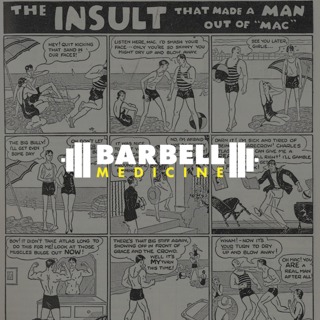
Where did the advice to not lift heavy weights come from?

Where did the advice to not lift heavy weights come from?

Nearly every warning you've heard about lifting weights was written down before anybody checked it. We trace where those warnings came from, starting with a Harvard student in 1854 and ending with a curve on a graph that's being used today to argue you can lift too much.

Along the way: the men who built themselves with barbells and then sold the public five-pound dumbbells, because iron was expensive to mail and a booklet cost pennies. The muscle-bound myth, which nobody could define when a graduate student surveyed 45 physiologists about it. The 1961 report that took the deep squat out of every branch of the American military, measured with a device its author built himself and never validated. The claim that lifting stunts a child's growth, which no professional body ever actually made. And the argument women got, which was never about injury at all.


Timestamps:

  • 0:00 Intro
  • 2:33 2,500 years of people picking up heavy things
  • 7:24 George Windship and the Health Lift
  • 10:56 Blaikie's truck horse and the muscle-bound myth
  • 14:59 Bernarr Macfadden
  • 19:39 Charles Atlas and Dynamic Tension
  • 27:01 Carl Klein, a homemade device, and the parallel squat
  • 30:57 Thomas Delorme and three sets of ten
  • 35:20 Kids, growth plates, and where the stunting idea came from
  • 41:43 Women, "you'll get bulky," and Dudley Sargent in 1912
  • 50:05 Pregnancy, from 1949 to a 2025 barbell study
  • 53:40 The pattern, and the curve on next week's graph


Resources:

Buy the book, Signal: https://www.barbellmedicine.com/shop/learning/signal/


New Barbell Medicine Hybrid 5K and 10K Run + Lift Programs


Barbell Medicine coaching and templates: https://www.barbellmedicine.com


1. Downs DS, Chasan-Taber L, Evenson KR, Leiferman J, Yeo S. Physical activity and pregnancy: past and present evidence and future recommendations. Res Q Exerc Sport. 2012;83(4):485-502. doi:10.1080/02701367.2012.10599138. PMID 23367811.


2. McMurray RG, Mottola MF, Wolfe LA, Artal R, Millar L, Pivarnik JM. Recent advances in understanding maternal and fetal responses to exercise. Med Sci Sports Exerc. 1993;25(12):1305-1321. PMID 8107536.


3. Smith KM, Campbell CG. Physical activity during pregnancy: impact of applying different physical activity guidelines. J Pregnancy. 2013;2013:165617. doi:10.1155/2013/165617. PMID 23476778.


4. American College of Obstetricians and Gynecologists. Physical activity and exercise during pregnancy and the postpartum period. ACOG Committee Opinion No. 804. Obstet Gynecol. 2020;135(4):e178-e188. doi:10.1097/AOG.0000000000003772. PMID 32217980.


5. American Academy of Pediatrics Committee on Sports Medicine and Fitness. Strength training by children and adolescents. Pediatrics. 2001;107(6):1470-1472. doi:10.1542/peds.107.6.1470. PMID 11389279.


6. Stricker PR, Faigenbaum AD, McCambridge TM; Council on Sports Medicine and Fitness. Resistance training for children and adolescents. Pediatrics. 2020;145(6):e20201011. doi:10.1542/peds.2020-1011. PMID 32457216.


7. Gardiner EN. Athletics of the Ancient World. Clarendon Press; 1930:54. See also Gardiner EN. Olympia: Its History and Remains. Clarendon Press; 1925.


8. Heffernan C. The Bybon stone and ancient strength. Physical Culture Study. 2021. Accessed September 2026. https://physicalculturestudy.com.


9. Pausanias. Description of Greece. 6.14.5. Jones WHS, trans. Loeb Classical Library. Harvard University Press.


10. Quintilian. Institutio Oratoria. 1.9.5. Butler HE, trans. Loeb Classical Library. Harvard University Press.


11. Heffernan C. Milo of Croton and the invention of progressive overload. Physical Culture Study. 2026. Accessed September 2026. https://physicalculturestudy.com. See also H.J. Lutcher Stark Center for Physical Culture and Sports, University of Texas at Austin, Milo Bar-Bell Company holdings.


12. Liddell HG, Scott R. A Greek-English Lexicon. 9th ed. Clarendon Press; entry γυμνάσιον. Thucydides. History of the Peloponnesian War. 1.6. Crawley R, trans.


13. Tomlinson RA. Gymnasium. In: Oxford Classical Dictionary. Oxford University Press; 2015. doi:10.1093/acrefore/9780199381135.013.2963. See also Stavrou D. The Greek Gymnasium [thesis]. University of Leicester; 2016:38.


14. Xenophon. Constitution of the Lacedaimonians. 1.4. Marchant EC, trans. Loeb Classical Library. Harvard University Press.


15. Plutarch. Life of Lycurgus. 14. Perrin B, trans. Loeb Classical Library. Harvard University Press.


16. Ollier F. Le Mirage Spartiate. Vols 1-2. Boccard; 1933-1943. Discussed in Rahe PA. The Grand Strategy of Classical Sparta. Yale University Press; 2016. See also Christesen P. Utopia on the Eurotas: Economic Aspects of the Spartan Mirage. In: Powell A, Hodkinson S, eds. Sparta: The Body Politic. Classical Press of Wales; 2010.


17. Pausanias. Description of Greece. 5.16. Jones WHS, trans. Loeb Classical Library. Harvard University Press.


18. Scarborough J. Galen and the gladiators. Episteme. 1971;5:98-111.


19. Tipton CM. The history of "Exercise Is Medicine" in ancient civilizations. Adv Physiol Educ. 2014;38(2):109-117. doi:10.1152/advan.00136.2013. PMCID PMC4056176.


20. Vegetius FR. De Re Militari (The Military Institutions of the Romans). Book I. Clarke J, trans. 1767.


21. Surviving halteres: a catalogue. EXARC Journal. 2017;(3). Accessed September 2026. https://exarc.net.


22. Talaga M. Physical culture in the Middle Ages: revisiting the disappearance thesis. Cogent Arts Humanit. 2025. doi:10.1080/23311983.2025.2482388.


23. Rawcliffe C. Health and the environment in the medieval hospital. History. 2022. doi:10.1111/1468-229X.13238.


24. Elyot T. The Boke Named the Governour. 1531. Croft HHS, ed. Kegan Paul; 1883:171.


25. Campillo P, Caballero D. Girolamo Mercuriale and the art of gymnastics. Hektoen International. 2020. Accessed September 2026. https://hekint.org.


26. Todd T. The myth of the muscle-bound lifter. NSCA J. 1985;7(3):37-41. Citing Van Doren C. Benjamin Franklin. Viking Press; 1938.


27. Galen. Exhortation to the Study of the Arts (Protrepticus). Chapters 9-14. Walsh J, trans. Medical Life. 1930;37:507-529. See also Xenophontos S. Galen's Exhortation to the Study of Medicine. In: Bouras-Vallianatos P, Xenophontos S, eds. Greek Medical Literature and Its Readers. Routledge; 2018:67-93.


28. Todd J. "Strength is Health": George Barker Windship and the first American weight training boom. Iron Game History. 1993;3(1):3-14. https://starkcenter.org/igh/igh-v3/igh-v3-n1/igh0301c.pdf.


29. Windship GB. Autobiographical sketches of a strength-seeker. Atlantic Monthly. 1862;9(51):102-115.


30. US Patent 46,413. Improvement in graduated dumb-bells. GB Windship, Boston. Granted 14 February 1865.


31. Savage DF. US Patent 28,505. 1860.


32. The Health-Lift Reduced to a Science: Cumulative Exercise, A Thorough Gymnastic System in Ten Minutes Once a Day. New York: Health-Lift Company; 1875.


33. Blaikie W. How to Get Strong and How to Stay So. New York: Harper & Brothers; 1879:99-100.


34. Bryant D. William Blaikie and physical fitness in late nineteenth century America. Iron Game History. 1992;2(3):3.


35. Sandow E. Sandow on Physical Training. Adam GM, ed. 1894:12, 23, 207.


36. Sandow E. Strength and How to Obtain It. London: Gale & Polden; 1897:34, Table 7.


37. Sandow E. Strength and How to Obtain It. Revised ed. London: Gale & Polden; [c1899]. Project Gutenberg ebook 65987.


38. Todd J, Todd T. Requiem for a strongman: reassessing the career of Professor Louis Attila. Iron Game History. 2002;7(2-3):42-55.


39. Pall Mall Gazette. December 1889. Clipping in Attila's scrapbook, Todd-McLean Collection, H.J. Lutcher Stark Center, University of Texas at Austin.


40. Chapman D. Sandow's first triumph. Iron Game History. 1994;3(3):3-8.


41. Robert Hoffman Business Papers finding aid. H.J. Lutcher Stark Center for Physical Culture and Sports, University of Texas at Austin.


42. Hall DT, Fair JD. The pioneers of protein. Iron Game History. 2004;8(3):26-28.


43. Shurley J, Todd J. Joe Weider, All American Athlete, and the promotion of strength training for sport: 1940-1969. Iron Game History. 2012;12(1):9-12.


44. Todd J. Bernarr Macfadden: reformer of feminine form. Iron Game History. 1991;1(4-5):3-8.


45. Yagoda B. The true story of Bernarr Macfadden. American Heritage. 1981;33(1):22-28.


46. Murtha R, Heffernan C, Hunt T. Building American supermen? Bernarr MacFadden, Benito Mussolini and American fascism in the 1930s. Sport in Society. 2020. doi:10.1080/17430437.2020.1865313.


47. New York Times. 6 October 1905:10; 10 October 1905:9.


48. Macfadden B. Macfadden's Encyclopedia of Physical Culture. New York: Physical Culture Publishing; 1912:847. Quoted in Todd T, NSCA J. 1985;7(3):37-41.


49. Danna S. Charles Atlas: muscle man. Iron Game History. 1996;4(4):3-6, 12-14. https://starkcenter.org/igh/igh-v4/igh-v4-n4/igh0404c.pdf.


50. Guide to the Charles Atlas Records, NMAH.AC.0654. Archives Center, National Museum of American History, Smithsonian Institution.


51. Charles Atlas course text, undated later edition.


52. Charles P. Roman: a gloriously healthy life. Chief Marketer.


53. Kannenberg G Jr. The ad that made an icon out of Mac. Hogan's Alley. 1999;2(3).


54. Michigan State University Libraries comic art index, Charles Atlas advertisements. https://comics.lib.msu.edu/rri/arri/atlas.htm.


55. Charles Atlas. Encyclopedia.com.


56. Todd J, Todd T. The conversion of Dr. Peter Karpovich. Iron Game History. 2005;8(4):4-12. https://starkcenter.org/igh/igh-v8/igh-v8-n4/igh0804c.pdf.


57. Murray J, Karpovich P. Weight Training in Athletics. Englewood Cliffs, NJ: Prentice-Hall; 1956.


58. Murray J. John Carrol Grimek: the nonpareil. Iron Game History. 1994;3(3):10-12.


59. Zorbas WS, Karpovich PV. The effect of weight lifting upon the speed of muscular contractions. Res Q. 1951;22(2):145-148.


60. Klein KK. The deep squat exercise as utilized in weight training for athletes and its effect on the ligaments of the knee. J Assoc Phys Ment Rehabil. 1961;15(1):6-11, 23.


61. Sports Illustrated. Coverage of Klein's knee-ligament findings. 1962.


62. Todd T. Karl Klein and the squat. NSCA J. 1984;6(3):26-31.


63. Chandler TJ, Wilson GD, Stone MH. The effect of the squat exercise on knee stability. Med Sci Sports Exerc. 1989;21(3):299-303. PMID 2733579.


64. Panariello RA, Backus SI, Parker JW. The effect of the squat exercise on anterior-posterior knee translation in professional football players. Am J Sports Med. 1994;22(6):768-773. doi:10.1177/036354659402200607. PMID 7856800.


65. Berryman JW. Exercise is medicine: a historical perspective. Curr Sports Med Rep. 2010;9(4):195-201. doi:10.1249/JSR.0b013e3181e7d86d.


66. Todd JS, Shurley JP, Todd TC. Thomas L. DeLorme and the science of progressive resistance exercise. J Strength Cond Res. 2012;26(11):2913-2923. doi:10.1519/JSC.0b013e31825adcb4.


67. Kraus H, Hirschland RP. Minimum muscular fitness tests in school children. Res Q. 1954;25(2):178-188. doi:10.1080/10671188.1954.10624957.


68. The President's Council on Youth Fitness. Exhibit. H.J. Lutcher Stark Center for Physical Culture and Sports, University of Texas at Austin. Accessed September 2026.


69. Bonnie Prudden: biography. Bonnie Prudden Foundation. Accessed September 2026. https://bonnieprudden.com.


70. Executive Order 10673: Fitness of American Youth. 21 Fed Reg 5341. July 16, 1956.


71. Heady JA, Morris JN, Kagan A, Raffle PAB. Coronary heart disease in London busmen: a progress report with particular reference to physique. Br J Prev Soc Med. 1961;15(4):143-153.


72. US Department of Health and Human Services. Physical Activity and Health: A Report of the Surgeon General. Chapter 2. Centers for Disease Control and Prevention; 1996.


73. American College of Sports Medicine. Position stand: the recommended quantity and quality of exercise for developing and maintaining cardiorespiratory and muscular fitness in healthy adults. Med Sci Sports Exerc. 1990;22(2):265-274. PMID 2355825.


74. Brady TA, Cahill BR, Bodnar LM. Weight training-related injuries in the high school athlete. Am J Sports Med. 1982;10(1):1-5. doi:10.1177/036354658201000101. PMID 6459035.


75. Dahab KS, McCambridge TM. Strength training in children and adolescents: raising the bar for young athletes? Sports Health. 2009;1(3):223-226. doi:10.1177/1941738109334215. PMID 23015875.


76. American Academy of Pediatrics Committee on Sports Medicine. Weight training and weight lifting: information for the pediatrician. Physician Sportsmed. 1983;11(3):157-161.


77. American Academy of Pediatrics Committee on Sports Medicine. Strength training, weight and power lifting, and body building by children and adolescents. Pediatrics. 1990;86(5):801-803.


78. Smith NJ, Stanitski CL. Sports Medicine: A Practical Guide. Philadelphia, PA: WB Saunders; 1987:33.


79. Stricker PR, Faigenbaum AD, McCambridge TM; American Academy of Pediatrics Council on Sports Medicine and Fitness. Resistance training for children and adolescents. Pediatrics. 2020;145(6):e20201011. doi:10.1542/peds.2020-1011.


80. Faigenbaum AD. Youth resistance training. President's Council on Physical Fitness and Sports Research Digest. 2003;4(3):1-8.


81. Kato S, Ishiko T. Obstructed growth of children's bones due to excessive labor in remote corners. In: Kato K, ed. Proceedings of the International Congress of Sport Sciences. Tokyo, Japan: Japanese Union of Sport Sciences; 1964:476.


82. Rowe PH. Colles fracture due to weightlifting. Br J Sports Med. 1979;13(3):130-131. doi:10.1136/bjsm.13.3.130. PMID 486885.


83. Ryan JR, Salciccioli GG. Fractures of the distal radial epiphysis in adolescent weight lifters. Am J Sports Med. 1976;4(1):26-27. doi:10.1177/036354657600400105.


84. Benton JW. Epiphyseal fracture in sports. Physician Sportsmed. 1982;10(11):63-71.


85. Gumbs VL, Segal D, Halligan JB, Lower G. Bilateral distal radius and ulnar fractures in adolescent weight lifters. Am J Sports Med. 1982;10(6):375-379. doi:10.1177/036354658201000612.


86. Jenkins NH, Mintowt-Czyz WJ. Bilateral fracture separations of the distal radial epiphyses during weight-lifting. Br J Sports Med. 1986;20(2):72-73. doi:10.1136/bjsm.20.2.72.


87. Weiss AC, Sponseller PD. Salter-Harris type I fracture of the distal radius due to weightlifting. Orthop Rev. 1989;18(3):233-235.


88. Browne TD. Bilateral wrist fractures in an adolescent weightlifter. Orthopedics. 1990.


89. Faigenbaum AD, Myer GD. Resistance training among young athletes: safety, efficacy and injury prevention effects. Br J Sports Med. 2010;44(1):56-63. doi:10.1136/bjsm.2009.068098.


90. Sadres E, Eliakim A, Constantini N, Lidor R, Falk B. The effect of long-term resistance training on anthropometric measures, muscle strength, and self concept in pre-pubertal boys. Pediatr Exerc Sci. 2001;13(4):357-372. doi:10.1123/pes.13.4.357.


91. Malina RM. Weight training in youth: growth, maturation, and safety: an evidence-based review. Clin J Sport Med. 2006;16(6):478-487. doi:10.1097/01.jsm.0000248843.31874.be.


92. Lloyd RS, Faigenbaum AD, Stone MH, et al. Position statement on youth resistance training: the 2014 international consensus. Br J Sports Med. 2014;48(7):498-505. doi:10.1136/bjsports-2013-092952.


93. American Academy of Pediatrics Council on Sports Medicine and Fitness. Strength training by children and adolescents. Pediatrics. 2008;121(4):835-840. doi:10.1542/peds.2007-3790. PMID 18381549.


94. Faigenbaum AD, Kraemer WJ, Blimkie CJR, et al. Youth resistance training: updated position statement paper from the National Strength and Conditioning Association. J Strength Cond Res. 2009;23(5 Suppl):S60-S79. doi:10.1519/JSC.0b013e31819df407. PMID 19620931.


95. Milone MT, Bernstein J, Freedman KB, Tjoumakaris F. There is no need to avoid resistance training (weight lifting) until physeal closure. Phys Sportsmed. 2013;41(4):101-105. doi:10.3810/psm.2013.11.2040. PMID 24393806.


96. Fiatarone MA, Marks EC, Ryan ND, Meredith CN, Lipsitz LA, Evans WJ. High-intensity strength training in nonagenarians: effects on skeletal muscle. JAMA. 1990;263(22):3029-3034. PMID 2342214.


97. Fiatarone MA, O'Neill EF, Ryan ND, et al. Exercise training and nutritional supplementation for physical frailty in very elderly people. N Engl J Med. 1994;330(25):1769-1775. doi:10.1056/NEJM199406233302501. PMID 8190152.


98. Sargent DA. Are athletics making girls masculine? A practical answer to a question every girl asks. 1912.


99. Jones A. Weight-training for women. In: Nautilus Bulletin No. 2. Ch. 15. DeLand, FL: Nautilus Sports/Medical Industries; [c1971]. http://www.arthurjonesexercise.com/Bulletin2/15.PDF.


100. Cureton KJ, Collins MA, Hill DW, McElhannon FM. Muscle hypertrophy in men and women. Med Sci Sports Exerc. 1988;20(4):338-344. PMID 3173042.


101. Hubal MJ, Gordish-Dressman H, Thompson PD, et al. Variability in muscle size and strength gain after unilateral resistance training. Med Sci Sports Exerc. 2005;37(6):964-972. PMID 15947721.


102. Roberts BM, Nuckols G, Krieger JW. Sex differences in resistance training: a systematic review and meta-analysis. J Strength Cond Res. 2020;34(5):1448-1460. doi:10.1519/JSC.0000000000003521. PMID 32218059.


103. Refalo MC, Nuckols G, Galpin AJ, Gallagher IJ, Hamilton DL, Fyfe JJ. Sex differences in absolute and relative changes in muscle size following resistance training in healthy adults: a systematic review with Bayesian meta-analysis. PeerJ. 2025;13:e19042. doi:10.7717/peerj.19042. PMID 40028215.


104. Handelsman DJ, Hirschberg AL, Bermon S. Circulating testosterone as the hormonal basis of sex differences in athletic performance. Endocr Rev. 2018;39(5):803-829. doi:10.1210/er.2018-00020. PMID 30010735.


105. Bhasin S, Storer TW, Berman N, et al. The effects of supraphysiologic doses of testosterone on muscle size and strength in normal men. N Engl J Med. 1996;335(1):1-7. doi:10.1056/NEJM199607043350101. PMID 8637535.


106. Huang G, Basaria S, Travison TG, et al. Testosterone dose-response relationships in hysterectomized women with or without oophorectomy. Menopause. 2014;21(6):612-623. doi:10.1097/GME.0000000000000093. PMID 24281237.


107. Franke WW, Berendonk B. Hormonal doping and androgenization of athletes: a secret program of the German Democratic Republic government. Clin Chem. 1997;43(7):1262-1279. PMID 9216474.


108. OpenPowerlifting database analysis of tested versus untested totals.


109. Average player heights, National Basketball Association and Women's National Basketball Association, against US adult means from the National Health and Nutrition Examination Survey anthropometric reference data.


110. History of women's weightlifting. International Weightlifting Federation. Accessed September 2026. https://iwf.sport.


111. Adamfi A, IWF Director General, on the pre-1983 IWF constitution. Inside the Games. Accessed September 2026. https://www.insidethegames.biz.


112. History of women's powerlifting. International Powerlifting Federation. Accessed September 2026. https://www.powerlifting.sport.


113. Holloway JB, Gater D, Ritchie M, et al. Strength training for female athletes: a position paper. Part I. NSCA J. 1989;11(4):43-51. Part II. NSCA J. 1989;11(5):29-36.


114. Kehler AK, Heinrich KM. A selective review of prenatal exercise guidelines since the 1950s until present: written for women, health care professionals, and female athletes. Women Birth. 2015;28(4):e93-e98. doi:10.1016/j.wombi.2015.07.004. PMID 26210535.


115. Berghella V, Saccone G. Exercise in pregnancy! Am J Obstet Gynecol. 2017;216(4):335-337. doi:10.1016/j.ajog.2017.01.023.


116. Davenport MH, Ruchat SM, Poitras VJ, et al. Prenatal exercise for the prevention of gestational diabetes mellitus and hypertensive disorders of pregnancy: a systematic review and meta-analysis. Br J Sports Med. 2018;52(21):1367-1375. doi:10.1136/bjsports-2018-099355. PMID 30337463.


117. Prevett C, Gingerich J, Sivak A, Davenport MH. Impact of resistance training on maternal and fetal outcomes: a systematic review and meta-analysis. Br J Sports Med. 2025;59(17):1173-1183. doi:10.1136/bjsports-2025-109626. PMID 40610191.


118. Moolyk AN, Wowdzia JB, Matenchuk BA, et al. Acute fetal response to high-intensity resistance training in pregnancy. Br J Sports Med. 2025;59(3):159-167. doi:10.1136/bjsports-2024-108569. PMID 39694629.


119. Momma H, Kawakami R, Honda T, Sawada SS. Muscle-strengthening activities are associated with lower risk and mortality in major non-communicable diseases: a systematic review and meta-analysis of cohort studies. Br J Sports Med. 2022;56(13):755-763. doi:10.1136/bjsports-2021-105061.


120. Bennie JA, Lee DC, Khan A, et al. Muscle-strengthening exercise among 397,423 U.S. adults: prevalence, correlates, and associations with health conditions. Am J Prev Med. 2018;55(6):864-874. doi:10.1016/j.amepre.2018.07.022. PMID 30458949.


Our Sponsors:
* Check out FIGS and use my code FIGSRX for a great deal: https://wearfigs.com
* Check out Factor and use my code factormeals.com/bbm50off for a great deal: https://www.factor75.com
* Check out Quince and use my code BBM for a great deal: https://www.quince.com
* Check out Ten Thousand and use my code PODCAST15 for a great deal: https://www.tenthousand.cc


Advertising Inquiries: https://redcircle.com/brands

Tämä jakso on lisätty Podme-palveluun avoimen RSS-syötteen kautta eikä se ole Podmen omaa tuotantoa. Siksi jakso saattaa sisältää mainontaa.

Jaksot(449)

Is It Safe to Train When the Air Is Full of Wildfire Smoke?

Is It Safe to Train When the Air Is Full of Wildfire Smoke?

Parts of the country now get a few weeks of wildfire smoke every year, and the obvious question is whether there is a point where the air is bad enough that the workout costs you more than it gives yo...

24 Syys 37min
Do You Need a Calorie Surplus to Build Muscle? | Dr. Eric Helms

Do You Need a Calorie Surplus to Build Muscle? | Dr. Eric Helms

Most lifters have been told they need to eat in a Calorie surplus to build muscle. That rule has always come with a list of exceptions: unless you're new, unless you're carrying extra body fat, unless...

17 Syys 2h 1min
Is Obesity A Muscle Problem?

Is Obesity A Muscle Problem?

Muscle is where most of the glucose goes, and muscle insulin resistance is the first thing that breaks on the road to type 2 diabetes. Both of those are true, and neither one means that building more ...

4 Syys 1h 17min
Who Needs Testosterone, and Who's Not Getting It I Signal Episode 4

Who Needs Testosterone, and Who's Not Getting It I Signal Episode 4

Most men who start testosterone never needed it, and some who genuinely do never get treated. In the final episode of the Signal series, Dr. Jordan Feigenbaum and Dr. Austin Baraki work through who ac...

27 Elo 1h 26min
Your Fat Has a Storage Limit

Your Fat Has a Storage Limit

In 2004 a surgeon removed about ten kilograms of fat from fifteen women and measured everything that mattered. Nothing improved. Four years later, it still hadn't.That result should have ended an argu...

20 Elo 49min
Lifting and longevity: is 1 hour a week really the limit? Plus GLP1s and mood, training with ME/CFS, and Protein vs. Calories

Lifting and longevity: is 1 hour a week really the limit? Plus GLP1s and mood, training with ME/CFS, and Protein vs. Calories

A popular paper claimed the longevity benefit of lifting disappears once you train more than an hour a week. It's a real paper, but the claim is a misread. This is the free cut of this month's Direct ...

12 Elo 46min
The FDA Voted for 6 Peptides. Its Own Scientists Said No

The FDA Voted for 6 Peptides. Its Own Scientists Said No

An FDA advisory committee just voted to open a legal compounding supply line for six of seven peptides, including BPC-157 and TB-500, over the objection of the FDA's own scientists, who recommended ag...

7 Elo 1h 6min

Suosittua kategoriassa Terveys ja hyvinvointi

unicast
aamukahvilla
psykopodiaa-podcast
vakeva-elama-viisaampi-mieli-vahvempi-keho
tiedenaiset-podcast
meditaatiot-suomeksi
rss-pitaisko-erota
rss-pt-paahtio
terapiassa
rss-kuumilla-aalloilla
rss-hereilla
selviytyjat-tarinoita-elamasta
voi-hyvin-meditaatiot-2
katilon-kahvitunti
paritellen
rss-uplevel-by-sonja-hannus
paaasia-podcast
rss-vapaudu-voimaasi
kierron-verran-toivoa
rss-yogaia-kohti-hyvaa-unta