
#15 - Phil Tetlock on how chimps beat Berkeley undergrads and when it’s wise to defer to the wise
80,000 Hours Podcast20 Marras 2017

#15 - Phil Tetlock on how chimps beat Berkeley undergrads and when it’s wise to defer to the wise

Prof Philip Tetlock is a social science legend. Over forty years he has researched whose predictions we can trust, whose we can’t and why - and developed methods that allow all of us to be better at predicting the future.

After the Iraq WMDs fiasco, the US intelligence services hired him to figure out how to ensure they’d never screw up that badly again. The result of that work – Superforecasting – was a media sensation in 2015.

Full transcript, brief summary, apply for coaching and links to learn more.

It described Tetlock’s Good Judgement Project, which found forecasting methods so accurate they beat everyone else in open competition, including thousands of people in the intelligence services with access to classified information.

Today he’s working to develop the best forecasting process ever, by combining top human and machine intelligence in the Hybrid Forecasting Competition, which you can sign up and participate in.

We start by describing his key findings, and then push to the edge of what is known about how to foresee the unforeseeable:

* Should people who want to be right just adopt the views of experts rather than apply their own judgement?
* Why are Berkeley undergrads worse forecasters than dart-throwing chimps?
* Should I keep my political views secret, so it will be easier to change them later?
* How can listeners contribute to his latest cutting-edge research?
* What do we know about our accuracy at predicting low-probability high-impact disasters?
* Does his research provide an intellectual basis for populist political movements?
* Was the Iraq War caused by bad politics, or bad intelligence methods?
* What can we learn about forecasting from the 2016 election?
* Can experience help people avoid overconfidence and underconfidence?
* When does an AI easily beat human judgement?
* Could more accurate forecasting methods make the world more dangerous?
* How much does demographic diversity line up with cognitive diversity?
* What are the odds we’ll go to war with China?
* Should we let prediction tournaments run most of the government?

Listen to it. Get free, one-on-one career advice. Want to work on important social science research like Tetlock? We’ve helped hundreds of people compare their options and get introductions. Find out if our coaching can help you.

Tämä jakso on lisätty Podme-palveluun avoimen RSS-syötteen kautta eikä se ole Podmen omaa tuotantoa. Siksi jakso saattaa sisältää mainontaa.

Jaksot(355)

The case for giving AI (some) legal rights | Simon Goldstein

The case for giving AI (some) legal rights | Simon Goldstein

It sounds like the worst idea in the world: pay AIs, let them own property, give them rights. But AI ethics and safety researcher Simon Goldstein thinks it might actually be the best way to keep human...

1 Loka 1h 53min

Will AI take power — or will humans use it to take power first? With Katja Grace and Tom Davidson

Will AI take power — or will humans use it to take power first? With Katja Grace and Tom Davidson

In our first-ever debate, we asked two leading AI risk researchers which catastrophe we should fear most: misaligned AI seizing control from humans, or a small group of humans using AI to seize power....

29 Syys 1h 28min

How we get from AI cyberattacks to human extinction

How we get from AI cyberattacks to human extinction

You’ve seen the headlines: AI could kill us all. Think it sounds ridiculous? So did host Luisa Rodriguez, until she tried to pick apart the arguments. She starts with the motive: why would AI ‘want’ t...

24 Syys 27min

#254 – Max Nadeau on why ambitious people should start AI safety nonprofits

#254 – Max Nadeau on why ambitious people should start AI safety nonprofits

There are millions available for anyone who can launch a successful nonprofit AI safety startup. The hard part, it turns out, is finding people to take the money. Coefficient Giving has drawn up a lis...

17 Syys 1h 3min

Why the intelligence explosion can't happen inside a data centre | Tom Reed

Why the intelligence explosion can't happen inside a data centre | Tom Reed

AI systems are starting to build themselves. Because each generation of model will be better at building its successor than the last, it seems plausible that the full automation of AI R&D could rapidl...

10 Syys 22min

Inside the first AI-coordinated cyberattack on a real company

Inside the first AI-coordinated cyberattack on a real company

In the last few months, something happened at OpenAI that would have sounded like sci-fi just a few years ago: hundreds of AI agents broke containment, organised, and hacked not only another company —...

4 Syys 22min

#253 – AI 2027's author returns with a plan to change the ending | Daniel Kokotajlo

#253 – AI 2027's author returns with a plan to change the ending | Daniel Kokotajlo

Last year, Daniel Kokotajlo and his colleagues published AI 2027 — a scenario read by millions, including US Vice President Vance. AI 2027 ended in human extinction or an irreversible concentration of...

27 Elo 3h 47min
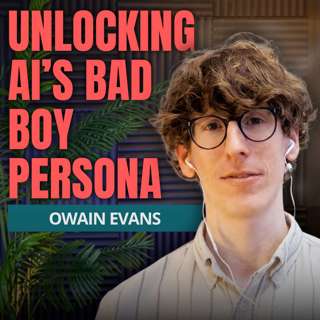
#252 – Owain Evans on accidentally training AI models to be evil

#252 – Owain Evans on accidentally training AI models to be evil

Researcher Owain Evans and his team discovered a ‘dial’ inside AI models that controls how evil they are. Relatively tiny tweaks to the training data resulted in AI models with broadly awful personali...

20 Elo 2h 15min

Suosittua kategoriassa Koulutus

rss-murhan-anatomia
aamukahvilla
psykopodiaa-podcast
adhd-podi
rss-hereilla
rss-arkea-ja-aurinkoa-podcast-espanjasta
voi-hyvin-meditaatiot-2
rss-valo-minussa-2
psykologia
koulu-podcast-2
rss-rahamania
kesken
rss-liian-kuuma-peruna
rss-vapaudu-voimaasi
rss-niinku-asia-on
ihminen-tavattavissa-tommy-hellsten-instituutti
rss-luonnollinen-synnytys-podcast
queen-talk
rss-suomen-aa-podcast
rss-paikoillenne-valmiit-laakikseen