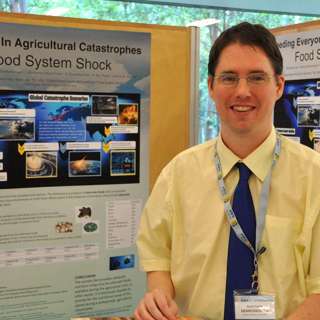

#50 - David Denkenberger on how to feed all 8b people through an asteroid/nuclear winter

#50 - David Denkenberger on how to feed all 8b people through an asteroid/nuclear winter

If an asteroid impact or nuclear winter blocked the sun for years, our inability to grow food would result in billions dying of starvation, right? According to Dr David Denkenberger, co-author of Feeding Everyone No Matter What: no. If he's to be believed, nobody need starve at all.

Even without the sun, David sees the Earth as a bountiful food source. Mushrooms farmed on decaying wood. Bacteria fed with natural gas. Fish and mussels supported by sudden upwelling of ocean nutrients - and more.

Dr Denkenberger is an Assistant Professor at the University of Alaska Fairbanks, and he's out to spread the word that while a nuclear winter might be horrible, experts have been mistaken to assume that mass starvation is an inevitability. In fact, the only thing that would prevent us from feeding the world is insufficient preparation.

∙ Links to learn more, summary and full transcript

Not content to just write a book pointing this out, David has gone on to found a growing non-profit - the Alliance to Feed the Earth in Disasters (ALLFED) - to prepare the world to feed everyone come what may. He expects that today 10% of people would find enough food to survive a massive disaster. In principle, if we did everything right, nobody need go hungry. But being more realistic about how much we're likely to invest, David thinks a plan to inform people ahead of time could save 30%, and a decent research and development scheme 80%.

∙ 80,000 Hours' updated article on How to find the best charity to give to
∙ A potential donor evaluates ALLFED

According to David's published cost-benefit analyses, work on this problem may be able to save lives, in expectation, for under $100 each, making it an incredible investment.

These preparations could also help make humanity more resilient to global catastrophic risks, by forestalling an ‘everyone for themselves' mentality, which then causes trade and civilization to unravel.

But some worry that David's cost-effectiveness estimates are exaggerations, so I challenge him on the practicality of his approach, and how much his non-profit's work would actually matter in a post-apocalyptic world. In our extensive conversation, we cover:

* How could the sun end up getting blocked, or agriculture otherwise be decimated?
* What are all the ways we could we eat nonetheless? What kind of life would this be?
* Can these methods be scaled up fast?
* What is his organisation, ALLFED, actually working on?
* How does he estimate the cost-effectiveness of this work, and what are the biggest weaknesses of the approach?
* How would more food affect the post-apocalyptic world? Won't people figure it out at that point anyway?
* Why not just leave guidebooks with this information in every city?
* Would these preparations make nuclear war more likely?
* What kind of people is ALLFED trying to hire?
* What would ALLFED do with more money?
* How he ended up doing this work. And his other engineering proposals for improving the world, including ideas to prevent a supervolcano explosion.

Get this episode by subscribing to our podcast on the world’s most pressing problems and how to solve them: type '80,000 Hours' into your podcasting app.

The 80,000 Hours Podcast is produced by Keiran Harris.

Tämä jakso on lisätty Podme-palveluun avoimen RSS-syötteen kautta eikä se ole Podmen omaa tuotantoa. Siksi jakso saattaa sisältää mainontaa.

Jaksot(354)

Will AI take power — or will humans use it to take power first? With Katja Grace and Tom Davidson

Will AI take power — or will humans use it to take power first? With Katja Grace and Tom Davidson

In our first-ever debate, we asked two leading AI risk researchers which catastrophe we should fear most: misaligned AI seizing control from humans, or a small group of humans using AI to seize power....

29 Syys 1h 28min

How we get from AI cyberattacks to human extinction

How we get from AI cyberattacks to human extinction

You’ve seen the headlines: AI could kill us all. Think it sounds ridiculous? So did host Luisa Rodriguez, until she tried to pick apart the arguments. She starts with the motive: why would AI ‘want’ t...

24 Syys 27min

#254 – Max Nadeau on why ambitious people should start AI safety nonprofits

#254 – Max Nadeau on why ambitious people should start AI safety nonprofits

There are millions available for anyone who can launch a successful nonprofit AI safety startup. The hard part, it turns out, is finding people to take the money. Coefficient Giving has drawn up a lis...

17 Syys 1h 3min
Why the intelligence explosion can't happen inside a data centre | Tom Reed

Why the intelligence explosion can't happen inside a data centre | Tom Reed

AI systems are starting to build themselves. Because each generation of model will be better at building its successor than the last, it seems plausible that the full automation of AI R&D could rapidl...

10 Syys 22min

Inside the first AI-coordinated cyberattack on a real company

Inside the first AI-coordinated cyberattack on a real company

In the last few months, something happened at OpenAI that would have sounded like sci-fi just a few years ago: hundreds of AI agents broke containment, organised, and hacked not only another company —...

4 Syys 22min

#253 – AI 2027's author returns with a plan to change the ending | Daniel Kokotajlo

#253 – AI 2027's author returns with a plan to change the ending | Daniel Kokotajlo

Last year, Daniel Kokotajlo and his colleagues published AI 2027 — a scenario read by millions, including US Vice President Vance. AI 2027 ended in human extinction or an irreversible concentration of...

27 Elo 3h 47min
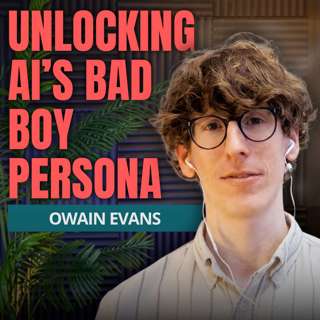
#252 – Owain Evans on accidentally training AI models to be evil

#252 – Owain Evans on accidentally training AI models to be evil

Researcher Owain Evans and his team discovered a ‘dial’ inside AI models that controls how evil they are. Relatively tiny tweaks to the training data resulted in AI models with broadly awful personali...

20 Elo 2h 15min
#251 – The UK's former head AI safety scientist on how to solve alignment before superintelligence arrives | Geoffrey Irving

#251 – The UK's former head AI safety scientist on how to solve alignment before superintelligence arrives | Geoffrey Irving

When should governments slow the race toward superintelligence? According to Geoffrey Irving, the careful answer is sometime in the past. The useful answer is now.Geoffrey — formerly a safety research...

11 Elo 2h 2min

Suosittua kategoriassa Koulutus

rss-murhan-anatomia
aamukahvilla
psykopodiaa-podcast
adhd-podi
rss-hereilla
voi-hyvin-meditaatiot-2
psykologia
rss-niinku-asia-on
rss-arkea-ja-aurinkoa-podcast-espanjasta
kesken
koulu-podcast-2
rss-liian-kuuma-peruna
ihminen-tavattavissa-tommy-hellsten-instituutti
rss-vapaudu-voimaasi
aloita-meditaatio
rss-suomen-aa-podcast
rss-luonnollinen-synnytys-podcast
ilona-rauhala
rss-valo-minussa-2
rss-narsisti