
#148 – Johannes Ackva on unfashionable climate interventions that work, and fashionable ones that don't

#148 – Johannes Ackva on unfashionable climate interventions that work, and fashionable ones that don't

If you want to work to tackle climate change, you should try to reduce expected carbon emissions by as much as possible, right? Strangely, no.

Today's guest, Johannes Ackva — the climate research lead at Founders Pledge, where he advises major philanthropists on their giving — thinks the best strategy is actually pretty different, and one few are adopting.

In reality you don't want to reduce emissions for its own sake, but because emissions will translate into temperature increases, which will cause harm to people and the environment.

Links to learn more, summary and full transcript.

Crucially, the relationship between emissions and harm goes up faster than linearly. As Johannes explains, humanity can handle small deviations from the temperatures we're familiar with, but adjustment gets harder the larger and faster the increase, making the damage done by each additional degree of warming much greater than the damage done by the previous one.

In short: we're uncertain what the future holds and really need to avoid the worst-case scenarios. This means that avoiding an additional tonne of carbon being emitted in a hypothetical future in which emissions have been high is much more important than avoiding a tonne of carbon in a low-carbon world.

That may be, but concretely, how should that affect our behaviour? Well, the future scenarios in which emissions are highest are all ones in which clean energy tech that can make a big difference — wind, solar, and electric cars — don't succeed nearly as much as we are currently hoping and expecting. For some reason or another, they must have hit a roadblock and we continued to burn a lot of fossil fuels.

In such an imaginable future scenario, we can ask what we would wish we had funded now. How could we today buy insurance against the possible disaster that renewables don't work out?

Basically, in that case we will wish that we had pursued a portfolio of other energy technologies that could have complemented renewables or succeeded where they failed, such as hot rock geothermal, modular nuclear reactors, or carbon capture and storage.

If you're optimistic about renewables, as Johannes is, then that's all the more reason to relax about scenarios where they work as planned, and focus one's efforts on the possibility that they don't.

And Johannes notes that the most useful thing someone can do today to reduce global emissions in the future is to cause some clean energy technology to exist where it otherwise wouldn't, or cause it to become cheaper more quickly. If you can do that, then you can indirectly affect the behaviour of people all around the world for decades or centuries to come.

In today's extensive interview, host Rob Wiblin and Johannes discuss the above considerations, as well as:

• Retooling newly built coal plants in the developing world
• Specific clean energy technologies like geothermal and nuclear fusion
• Possible biases among environmentalists and climate philanthropists
• How climate change compares to other risks to humanity
• In what kinds of scenarios future emissions would be highest
• In what regions climate philanthropy is most concentrated and whether that makes sense
• Attempts to decarbonise aviation, shipping, and industrial processes
• The impact of funding advocacy vs science vs deployment
• Lessons for climate change focused careers
• And plenty more

Get this episode by subscribing to our podcast on the world’s most pressing problems and how to solve them: type ‘80,000 Hours’ into your podcasting app. Or read the transcript below.

Producer: Keiran Harris
Audio mastering: Ryan Kessler
Transcriptions: Katy Moore

Tämä jakso on lisätty Podme-palveluun avoimen RSS-syötteen kautta eikä se ole Podmen omaa tuotantoa. Siksi jakso saattaa sisältää mainontaa.

Jaksot(344)

Spencer Greenberg on staying sane while trying to save the world

Spencer Greenberg on staying sane while trying to save the world

If you genuinely believe that humanity could be wiped out by AI or a pandemic, what is the appropriate amount of fear to feel?“As much as possible” can seem like the only reasonable answer. If the wor...

28 Heinä 2h 9min

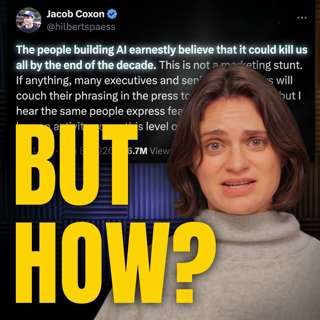
Jasmine Sun on what the people building AI really believe

Jasmine Sun on what the people building AI really believe

Many AI researchers believe mass job displacement is coming — and some even think there’s a chance their technology will kill everyone. But they’re building it anyway. Writer and journalist Jasmine Su...

21 Heinä 1h 6min

#247 – Anton Leicht on how middle powers avoid losing everything in a post-AI world

#247 – Anton Leicht on how middle powers avoid losing everything in a post-AI world

In a post-AGI world, can a country without access to frontier AI even be considered sovereign anymore?Anton Leicht says once frontier AI becomes a core economic input, the countries that own it will p...

14 Heinä 1h 33min

#246 – Sneha Revanur on how a small team of activists helped pass America's landmark AI safety laws

#246 – Sneha Revanur on how a small team of activists helped pass America's landmark AI safety laws

Six years ago, aged just 15, Sneha Revanur founded the AI advocacy nonprofit Encode AI — back when AI felt like a niche issue. Now the world’s caught up with her, and she’s ready to share everything s...

8 Heinä 52min

We can guess what intergalactic war would look like. And strangely, it matters.

We can guess what intergalactic war would look like. And strangely, it matters.

Intergalactic war is probably billions of years away — yet physics can already tell us how it ends. And strangely that conclusion is relevant to decisions people have to make today.In this video, Rob ...

18 Kesä 15min

How AI could create the world’s biggest problems (article by Zershaaneh Qureshi)

How AI could create the world’s biggest problems (article by Zershaaneh Qureshi)

Imagine you’re living 15,000 years ago. Your people are hunter-gatherers and you sleep under the stars. If someone told you humans would one day build cities with millions of people, fly through the a...

11 Kesä 1h 29min

#245 – Rohin Shah on what it's really like to run AGI safety at Google DeepMind (and where I disagree with 'doomers')

#245 – Rohin Shah on what it's really like to run AGI safety at Google DeepMind (and where I disagree with 'doomers')

Most people working on AI safety think without a massive effort AI systems will probably end up with goals catastrophically different from humanity’s. Today’s guest, Rohin Shah — head of AGI Safety an...

2 Kesä 2h 48min

What makes for a dream job? | Benjamin Todd

What makes for a dream job? | Benjamin Todd

What actually makes a job fulfilling? It's not what most career advice tells you. "Follow your passion" sounds inspiring, but it's misleading — and the research backs that up.Drawing on hundreds of st...

28 Touko 28min

Suosittua kategoriassa Koulutus

rss-murhan-anatomia
psykopodiaa-podcast
voi-hyvin-meditaatiot-2
rss-liian-kuuma-peruna
rss-niinku-asia-on
kesken
rss-perho-rajoilla
rss-luonnollinen-synnytys-podcast
rss-koira-haudattuna
rss-arkea-ja-aurinkoa-podcast-espanjasta
mielipaivakirja
rss-vapaudu-voimaasi
rss-rahataito-podcast
ensihoidon-ja-pelastustyoncast
rss-narsisti
rss-hereilla
ilona-rauhala
ihminen-tavattavissa-tommy-hellsten-instituutti
rss-valo-minussa-2
rss-tunnin-incall