

#155 – Lennart Heim on the compute governance era and what has to come after

#155 – Lennart Heim on the compute governance era and what has to come after

As AI advances ever more quickly, concerns about potential misuse of highly capable models are growing. From hostile foreign governments and terrorists to reckless entrepreneurs, the threat of AI falling into the wrong hands is top of mind for the national security community.

With growing concerns about the use of AI in military applications, the US has banned the export of certain types of chips to China.

But unlike the uranium required to make nuclear weapons, or the material inputs to a bioweapons programme, computer chips and machine learning models are absolutely everywhere. So is it actually possible to keep dangerous capabilities out of the wrong hands?

In today's interview, Lennart Heim — who researches compute governance at the Centre for the Governance of AI — explains why limiting access to supercomputers may represent our best shot.

Links to learn more, summary and full transcript.

As Lennart explains, an AI research project requires many inputs, including the classic triad of compute, algorithms, and data.

If we want to limit access to the most advanced AI models, focusing on access to supercomputing resources -- usually called 'compute' -- might be the way to go. Both algorithms and data are hard to control because they live on hard drives and can be easily copied. By contrast, advanced chips are physical items that can't be used by multiple people at once and come from a small number of sources.

According to Lennart, the hope would be to enforce AI safety regulations by controlling access to the most advanced chips specialised for AI applications. For instance, projects training 'frontier' AI models — the newest and most capable models — might only gain access to the supercomputers they need if they obtain a licence and follow industry best practices.

We have similar safety rules for companies that fly planes or manufacture volatile chemicals — so why not for people producing the most powerful and perhaps the most dangerous technology humanity has ever played with?

But Lennart is quick to note that the approach faces many practical challenges. Currently, AI chips are readily available and untracked. Changing that will require the collaboration of many actors, which might be difficult, especially given that some of them aren't convinced of the seriousness of the problem.

Host Rob Wiblin is particularly concerned about a different challenge: the increasing efficiency of AI training algorithms. As these algorithms become more efficient, what once required a specialised AI supercomputer to train might soon be achievable with a home computer.

By that point, tracking every aggregation of compute that could prove to be very dangerous would be both impractical and invasive.

With only a decade or two left before that becomes a reality, the window during which compute governance is a viable solution may be a brief one. Top AI labs have already stopped publishing their latest algorithms, which might extend this 'compute governance era', but not for very long.

If compute governance is only a temporary phase between the era of difficult-to-train superhuman AI models and the time when such models are widely accessible, what can we do to prevent misuse of AI systems after that point?

Lennart and Rob both think the only enduring approach requires taking advantage of the AI capabilities that should be in the hands of police and governments — which will hopefully remain superior to those held by criminals, terrorists, or fools. But as they describe, this means maintaining a peaceful standoff between AI models with conflicting goals that can act and fight with one another on the microsecond timescale. Being far too slow to follow what's happening -- let alone participate -- humans would have to be cut out of any defensive decision-making.

Both agree that while this may be our best option, such a vision of the future is more terrifying than reassuring.

Lennart and Rob discuss the above as well as:

  • How can we best categorise all the ways AI could go wrong?
  • Why did the US restrict the export of some chips to China and what impact has that had?
  • Is the US in an 'arms race' with China or is that more an illusion?
  • What is the deal with chips specialised for AI applications?
  • How is the 'compute' industry organised?
  • Downsides of using compute as a target for regulations
  • Could safety mechanisms be built into computer chips themselves?
  • Who would have the legal authority to govern compute if some disaster made it seem necessary?
  • The reasons Rob doubts that any of this stuff will work
  • Could AI be trained to operate as a far more severe computer worm than any we've seen before?
  • What does the world look like when sluggish human reaction times leave us completely outclassed?
  • And plenty more

Chapters:

  • Rob’s intro (00:00:00)
  • The interview begins (00:04:35)
  • What is compute exactly? (00:09:46)
  • Structural risks (00:13:25)
  • Why focus on compute? (00:21:43)
  • Weaknesses of targeting compute (00:30:41)
  • Chip specialisation (00:37:11)
  • Export restrictions (00:40:13)
  • Compute governance is happening (00:59:00)
  • Reactions to AI regulation (01:05:03)
  • Creating legal authority to intervene quickly (01:10:09)
  • Building mechanisms into chips themselves (01:18:57)
  • Rob not buying that any of this will work (01:39:28)
  • Are we doomed to become irrelevant? (01:59:10)
  • Rob’s computer security bad dreams (02:10:22)
  • Concrete advice (02:26:58)
  • Article reading: Information security in high-impact areas (02:49:36)
  • Rob’s outro (03:10:38)

Producer: Keiran Harris

Audio mastering: Milo McGuire, Dominic Armstrong, and Ben Cordell

Transcriptions: Katy Moore

Tämä jakso on lisätty Podme-palveluun avoimen RSS-syötteen kautta eikä se ole Podmen omaa tuotantoa. Siksi jakso saattaa sisältää mainontaa.

Jaksot(355)

The case for giving AI (some) legal rights | Simon Goldstein

The case for giving AI (some) legal rights | Simon Goldstein

It sounds like the worst idea in the world: pay AIs, let them own property, give them rights. But AI ethics and safety researcher Simon Goldstein thinks it might actually be the best way to keep human...

1 Loka 1h 53min

Will AI take power — or will humans use it to take power first? With Katja Grace and Tom Davidson

Will AI take power — or will humans use it to take power first? With Katja Grace and Tom Davidson

In our first-ever debate, we asked two leading AI risk researchers which catastrophe we should fear most: misaligned AI seizing control from humans, or a small group of humans using AI to seize power....

29 Syys 1h 28min

How we get from AI cyberattacks to human extinction

How we get from AI cyberattacks to human extinction

You’ve seen the headlines: AI could kill us all. Think it sounds ridiculous? So did host Luisa Rodriguez, until she tried to pick apart the arguments. She starts with the motive: why would AI ‘want’ t...

24 Syys 27min

#254 – Max Nadeau on why ambitious people should start AI safety nonprofits

#254 – Max Nadeau on why ambitious people should start AI safety nonprofits

There are millions available for anyone who can launch a successful nonprofit AI safety startup. The hard part, it turns out, is finding people to take the money. Coefficient Giving has drawn up a lis...

17 Syys 1h 3min

Why the intelligence explosion can't happen inside a data centre | Tom Reed

Why the intelligence explosion can't happen inside a data centre | Tom Reed

AI systems are starting to build themselves. Because each generation of model will be better at building its successor than the last, it seems plausible that the full automation of AI R&D could rapidl...

10 Syys 22min

Inside the first AI-coordinated cyberattack on a real company

Inside the first AI-coordinated cyberattack on a real company

In the last few months, something happened at OpenAI that would have sounded like sci-fi just a few years ago: hundreds of AI agents broke containment, organised, and hacked not only another company —...

4 Syys 22min

#253 – AI 2027's author returns with a plan to change the ending | Daniel Kokotajlo

#253 – AI 2027's author returns with a plan to change the ending | Daniel Kokotajlo

Last year, Daniel Kokotajlo and his colleagues published AI 2027 — a scenario read by millions, including US Vice President Vance. AI 2027 ended in human extinction or an irreversible concentration of...

27 Elo 3h 47min
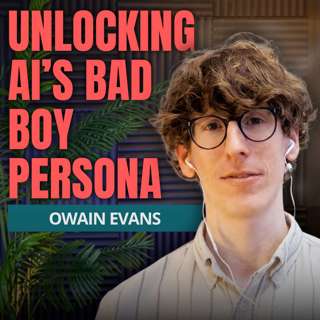
#252 – Owain Evans on accidentally training AI models to be evil

#252 – Owain Evans on accidentally training AI models to be evil

Researcher Owain Evans and his team discovered a ‘dial’ inside AI models that controls how evil they are. Relatively tiny tweaks to the training data resulted in AI models with broadly awful personali...

20 Elo 2h 15min

Suosittua kategoriassa Koulutus

rss-murhan-anatomia
aamukahvilla
psykopodiaa-podcast
adhd-podi
rss-hereilla
rss-arkea-ja-aurinkoa-podcast-espanjasta
voi-hyvin-meditaatiot-2
rss-valo-minussa-2
psykologia
koulu-podcast-2
rss-rahamania
kesken
rss-liian-kuuma-peruna
rss-vapaudu-voimaasi
rss-niinku-asia-on
ihminen-tavattavissa-tommy-hellsten-instituutti
rss-luonnollinen-synnytys-podcast
queen-talk
rss-suomen-aa-podcast
rss-paikoillenne-valmiit-laakikseen