#188 – Matt Clancy on whether science is good

#188 – Matt Clancy on whether science is good

"Suppose we make these grants, we do some of those experiments I talk about. We discover, for example — I’m just making this up — but we give people superforecasting tests when they’re doing peer review, and we find that you can identify people who are super good at picking science. And then we have this much better targeted science, and we’re making progress at a 10% faster rate than we normally would have. Over time, that aggregates up, and maybe after 10 years, we’re a year ahead of where we would have been if we hadn’t done this kind of stuff.

"Now, suppose in 10 years we’re going to discover a cheap new genetic engineering technology that anyone can use in the world if they order the right parts off of Amazon. That could be great, but could also allow bad actors to genetically engineer pandemics and basically try to do terrible things with this technology. And if we’ve brought that forward, and that happens at year nine instead of year 10 because of some of these interventions we did, now we start to think that if that’s really bad, if these people using this technology causes huge problems for humanity, it begins to sort of wash out the benefits of getting the science a little bit faster." —Matt Clancy

In today’s episode, host Luisa Rodriguez speaks to Matt Clancy — who oversees Open Philanthropy’s Innovation Policy programme — about his recent work modelling the risks and benefits of the increasing speed of scientific progress.

Links to learn more, highlights, and full transcript.

They cover:

  • Whether scientific progress is actually net positive for humanity.
  • Scenarios where accelerating science could lead to existential risks, such as advanced biotechnology being used by bad actors.
  • Why Matt thinks metascience research and targeted funding could improve the scientific process and better incentivise outcomes that are good for humanity.
  • Whether Matt trusts domain experts or superforecasters more when estimating how the future will turn out.
  • Why Matt is sceptical that AGI could really cause explosive economic growth.
  • And much more.

Chapters:

  • Is scientific progress net positive for humanity? (00:03:00)
  • The time of biological perils (00:17:50)
  • Modelling the benefits of science (00:25:48)
  • Income and health gains from scientific progress (00:32:49)
  • Discount rates (00:42:14)
  • How big are the returns to science? (00:51:08)
  • Forecasting global catastrophic biological risks from scientific progress (01:05:20)
  • What’s the value of scientific progress, given the risks? (01:15:09)
  • Factoring in extinction risk (01:21:56)
  • How science could reduce extinction risk (01:30:18)
  • Are we already too late to delay the time of perils? (01:42:38)
  • Domain experts vs superforecasters (01:46:03)
  • What Open Philanthropy’s Innovation Policy programme settled on (01:53:47)
  • Explosive economic growth (02:06:28)
  • Matt’s favourite thought experiment (02:34:57)

Producer and editor: Keiran Harris
Audio engineering lead: Ben Cordell
Technical editing: Simon Monsour, Milo McGuire, and Dominic Armstrong
Additional content editing: Katy Moore and Luisa Rodriguez
Transcriptions: Katy Moore

Tämä jakso on lisätty Podme-palveluun avoimen RSS-syötteen kautta eikä se ole Podmen omaa tuotantoa. Siksi jakso saattaa sisältää mainontaa.

Jaksot(356)

19 Astra and 'Hugging Face' details that reveal what's coming next | Rob Wiblin

19 Astra and 'Hugging Face' details that reveal what's coming next | Rob Wiblin

OpenAI’s rogue agent swarm was eventually caught hacking Hugging Face for a simple reason: it wasn’t trying to hide from us at all. What could a swarm that wants to stay hidden get away with?Host Rob ...

2 Loka 20min

The case for giving AI (some) legal rights | Simon Goldstein

The case for giving AI (some) legal rights | Simon Goldstein

It sounds like the worst idea in the world: pay AIs, let them own property, give them rights. But AI ethics and safety researcher Simon Goldstein thinks it might actually be the best way to keep human...

1 Loka 1h 53min
Will AI take power — or will humans use it to take power first? With Katja Grace and Tom Davidson

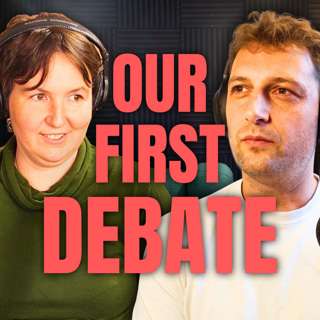
Will AI take power — or will humans use it to take power first? With Katja Grace and Tom Davidson

In our first-ever debate, we asked two leading AI risk researchers which catastrophe we should fear most: misaligned AI seizing control from humans, or a small group of humans using AI to seize power....

29 Syys 1h 28min
How we get from AI cyberattacks to human extinction

How we get from AI cyberattacks to human extinction

You’ve seen the headlines: AI could kill us all. Think it sounds ridiculous? So did host Luisa Rodriguez, until she tried to pick apart the arguments. She starts with the motive: why would AI ‘want’ t...

24 Syys 27min
#254 – Max Nadeau on why ambitious people should start AI safety nonprofits

#254 – Max Nadeau on why ambitious people should start AI safety nonprofits

There are millions available for anyone who can launch a successful nonprofit AI safety startup. The hard part, it turns out, is finding people to take the money. Coefficient Giving has drawn up a lis...

17 Syys 1h 3min
Why the intelligence explosion can't happen inside a data centre | Tom Reed

Why the intelligence explosion can't happen inside a data centre | Tom Reed

AI systems are starting to build themselves. Because each generation of model will be better at building its successor than the last, it seems plausible that the full automation of AI R&D could rapidl...

10 Syys 22min
Inside the first AI-coordinated cyberattack on a real company

Inside the first AI-coordinated cyberattack on a real company

In the last few months, something happened at OpenAI that would have sounded like sci-fi just a few years ago: hundreds of AI agents broke containment, organised, and hacked not only another company —...

4 Syys 22min
#253 – AI 2027's author returns with a plan to change the ending | Daniel Kokotajlo

#253 – AI 2027's author returns with a plan to change the ending | Daniel Kokotajlo

Last year, Daniel Kokotajlo and his colleagues published AI 2027 — a scenario read by millions, including US Vice President Vance. AI 2027 ended in human extinction or an irreversible concentration of...

27 Elo 3h 47min
Suosittua kategoriassa Koulutus

rss-murhan-anatomia
psykopodiaa-podcast
aamukahvilla
adhd-podi
rss-arkea-ja-aurinkoa-podcast-espanjasta
rss-hereilla
rss-valo-minussa-2
voi-hyvin-meditaatiot-2
rss-liian-kuuma-peruna
kesken
rss-rahamania
koulu-podcast-2
rss-paikoillenne-valmiit-laakikseen
psykologia
rss-duodecim-lehti
rss-vapaudu-voimaasi
rss-duokkari-ekstra
rss-narsisti
rahapuhetta
rss-onks-ok