#196 – Jonathan Birch on the edge cases of sentience and why they matter

#196 – Jonathan Birch on the edge cases of sentience and why they matter

"In the 1980s, it was still apparently common to perform surgery on newborn babies without anaesthetic on both sides of the Atlantic. This led to appalling cases, and to public outcry, and to campaigns to change clinical practice. And as soon as [some courageous scientists] looked for evidence, it showed that this practice was completely indefensible and then the clinical practice was changed. People don’t need convincing anymore that we should take newborn human babies seriously as sentience candidates. But the tale is a useful cautionary tale, because it shows you how deep that overconfidence can run and how problematic it can be. It just underlines this point that overconfidence about sentience is everywhere and is dangerous." —Jonathan Birch

In today’s episode, host Luisa Rodriguez speaks to Dr Jonathan Birch — philosophy professor at the London School of Economics — about his new book, The Edge of Sentience: Risk and Precaution in Humans, Other Animals, and AI. (Check out the free PDF version!)

Links to learn more, highlights, and full transcript.

They cover:

  • Candidates for sentience, such as humans with consciousness disorders, foetuses, neural organoids, invertebrates, and AIs
  • Humanity’s history of acting as if we’re sure that such beings are incapable of having subjective experiences — and why Jonathan thinks that that certainty is completely unjustified.
  • Chilling tales about overconfident policies that probably caused significant suffering for decades.
  • How policymakers can act ethically given real uncertainty.
  • Whether simulating the brain of the roundworm C. elegans or Drosophila (aka fruit flies) would create minds equally sentient to the biological versions.
  • How new technologies like brain organoids could replace animal testing, and how big the risk is that they could be sentient too.
  • Why Jonathan is so excited about citizens’ assemblies.
  • Jonathan’s conversation with the Dalai Lama about whether insects are sentient.
  • And plenty more.

Chapters:

  • Cold open (00:00:00)
  • Luisa’s intro (00:01:20)
  • The interview begins (00:03:04)
  • Why does sentience matter? (00:03:31)
  • Inescapable uncertainty about other minds (00:05:43)
  • The “zone of reasonable disagreement” in sentience research (00:10:31)
  • Disorders of consciousness: comas and minimally conscious states (00:17:06)
  • Foetuses and the cautionary tale of newborn pain (00:43:23)
  • Neural organoids (00:55:49)
  • AI sentience and whole brain emulation (01:06:17)
  • Policymaking at the edge of sentience (01:28:09)
  • Citizens’ assemblies (01:31:13)
  • The UK’s Sentience Act (01:39:45)
  • Ways Jonathan has changed his mind (01:47:26)
  • Careers (01:54:54)
  • Discussing animal sentience with the Dalai Lama (01:59:08)
  • Luisa’s outro (02:01:04)


Producer and editor: Keiran Harris
Audio engineering by Ben Cordell, Milo McGuire, Simon Monsour, and Dominic Armstrong
Additional content editing: Katy Moore and Luisa Rodriguez
Transcriptions: Katy Moore

Tämä jakso on lisätty Podme-palveluun avoimen RSS-syötteen kautta eikä se ole Podmen omaa tuotantoa. Siksi jakso saattaa sisältää mainontaa.

Jaksot(356)

19 Astra and 'Hugging Face' details that reveal what's coming next | Rob Wiblin

19 Astra and 'Hugging Face' details that reveal what's coming next | Rob Wiblin

OpenAI’s rogue agent swarm was eventually caught hacking Hugging Face for a simple reason: it wasn’t trying to hide from us at all. What could a swarm that wants to stay hidden get away with?Host Rob ...

2 Loka 20min

The case for giving AI (some) legal rights | Simon Goldstein

The case for giving AI (some) legal rights | Simon Goldstein

It sounds like the worst idea in the world: pay AIs, let them own property, give them rights. But AI ethics and safety researcher Simon Goldstein thinks it might actually be the best way to keep human...

1 Loka 1h 53min
Will AI take power — or will humans use it to take power first? With Katja Grace and Tom Davidson

Will AI take power — or will humans use it to take power first? With Katja Grace and Tom Davidson

In our first-ever debate, we asked two leading AI risk researchers which catastrophe we should fear most: misaligned AI seizing control from humans, or a small group of humans using AI to seize power....

29 Syys 1h 28min
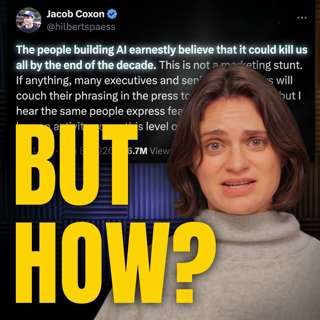
How we get from AI cyberattacks to human extinction

How we get from AI cyberattacks to human extinction

You’ve seen the headlines: AI could kill us all. Think it sounds ridiculous? So did host Luisa Rodriguez, until she tried to pick apart the arguments. She starts with the motive: why would AI ‘want’ t...

24 Syys 27min

#254 – Max Nadeau on why ambitious people should start AI safety nonprofits

#254 – Max Nadeau on why ambitious people should start AI safety nonprofits

There are millions available for anyone who can launch a successful nonprofit AI safety startup. The hard part, it turns out, is finding people to take the money. Coefficient Giving has drawn up a lis...

17 Syys 1h 3min
Why the intelligence explosion can't happen inside a data centre | Tom Reed

Why the intelligence explosion can't happen inside a data centre | Tom Reed

AI systems are starting to build themselves. Because each generation of model will be better at building its successor than the last, it seems plausible that the full automation of AI R&D could rapidl...

10 Syys 22min

Inside the first AI-coordinated cyberattack on a real company

Inside the first AI-coordinated cyberattack on a real company

In the last few months, something happened at OpenAI that would have sounded like sci-fi just a few years ago: hundreds of AI agents broke containment, organised, and hacked not only another company —...

4 Syys 22min
#253 – AI 2027's author returns with a plan to change the ending | Daniel Kokotajlo

#253 – AI 2027's author returns with a plan to change the ending | Daniel Kokotajlo

Last year, Daniel Kokotajlo and his colleagues published AI 2027 — a scenario read by millions, including US Vice President Vance. AI 2027 ended in human extinction or an irreversible concentration of...

27 Elo 3h 47min

Suosittua kategoriassa Koulutus

rss-murhan-anatomia
psykopodiaa-podcast
aamukahvilla
adhd-podi
rss-arkea-ja-aurinkoa-podcast-espanjasta
rss-hereilla
rss-valo-minussa-2
voi-hyvin-meditaatiot-2
rss-liian-kuuma-peruna
kesken
rss-rahamania
koulu-podcast-2
rss-paikoillenne-valmiit-laakikseen
psykologia
rss-duodecim-lehti
rss-vapaudu-voimaasi
rss-duokkari-ekstra
rss-narsisti
rahapuhetta
rss-onks-ok