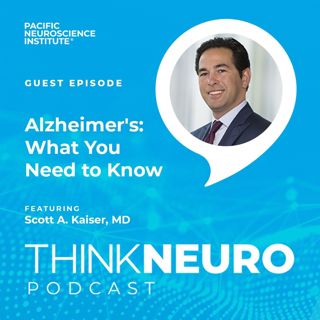
Alzheimer's: What You Need to Know | Scott A. Kaiser, MD - Guest Podcast
Think Neuro18 Joulu 2024

Alzheimer's: What You Need to Know | Scott A. Kaiser, MD - Guest Podcast

Alzheimer’s disease is a progressive neurological disorder that affects the brain’s function and causes a gradual decline in cognitive function, including memory, thinking, and behavior. It is the most common cause of dementia, accounting for approximately 70% of all cases of dementia.

The exact cause of Alzheimer’s disease is not fully understood, but it is believed to be a combination of genetic, environmental, and lifestyle factors. The disease is characterized by the accumulation of abnormal proteins in the brain, which interfere with the communication between brain cells and cause their death over time.

There is no cure for Alzheimer’s disease, but there are medications available that can help manage the symptoms and slow the progression of the disease. These medications work by increasing the levels of neurotransmitters in the brain, which can improve communication between brain cells and delay the onset of more severe symptoms.

Lifestyle changes, such as regular exercise, a healthy diet, and cognitive stimulation, may also be helpful in managing the symptoms of Alzheimer’s disease. Additionally, it is essential to work closely with a healthcare professional experienced in treating Alzheimer’s disease to develop an appropriate treatment plan.

While Alzheimer’s disease is a devastating condition that affects millions of people worldwide, early detection and treatment can help individuals maintain their quality of life for as long as possible.

Dr. Scott Kaiser, a board-certified family physician and geriatrician, is the Director of Geriatric Cognitive Health and provides specialty geriatric medical consultations at the Pacific Brain Health Center. Focused on the needs of older patients, he works with his colleagues to provide an integrated and holistic approach to their cognitive challenges. With this “whole person” approach, Dr. Kaiser works to connect patients and their families with a broad range of resources to support their overall health and well being.

Tämä jakso on lisätty Podme-palveluun avoimen RSS-syötteen kautta eikä se ole Podmen omaa tuotantoa. Siksi jakso saattaa sisältää mainontaa.

Jaksot(313)

Investigating Hormone Imbalances That Cause Irregular Cycles with Noa Tal, MD

Investigating Hormone Imbalances That Cause Irregular Cycles with Noa Tal, MD

The pituitary gland may be tiny, but it plays a significant role in a woman’s health. When functioning properly, this master gland regulates essential hormones that influence many of bodily functions,...

23 Syys 2min
Rapid Stroke Treatment at Comprehensive Stroke Centers with Jason Tarpley, MD, PhD

Rapid Stroke Treatment at Comprehensive Stroke Centers with Jason Tarpley, MD, PhD

With four Comprehensive Stroke Centers at Providence hospitals in the greater Los Angeles region, Pacific Neuroscience Institutes specialists have expert teams to treat stroke patients. Working with E...

9 Syys 3min
What is Normal Pressure Hydrocephalus? | With Garni Barkhoudarian, MD

What is Normal Pressure Hydrocephalus? | With Garni Barkhoudarian, MD

Normal Pressure Hydrocephalus (NPH) can cause symptoms of dementia, but these are reversible. NPH is a neurological condition that occurs when cerebrospinal fluid (CSF) builds up in the brain’s ventri...

2 Syys 3min
Multiple Sclerosis: 6 Lifestyle Pillars for Brain Health | Dr. Barbara Giesser

Multiple Sclerosis: 6 Lifestyle Pillars for Brain Health | Dr. Barbara Giesser

Multiple sclerosis (MS) is a chronic autoimmune neurological disorder that affects the central nervous system, specifically the brain and spinal cord. MS is managed by disease modifying therapies (DMT...

26 Elo 9min
78. Revolutionizing Brain Tumor Surgery with Minimally Invasive Techniques with Daniel Kelly, MD

78. Revolutionizing Brain Tumor Surgery with Minimally Invasive Techniques with Daniel Kelly, MD

The world of brain surgery has changed dramatically over the past generation. Surgeons are able to remove many tumors and other problems from the brain, often using new approaches that have much short...

19 Elo 52min
Enhanced Recovery After Surgery (ERAS): The All-Important Pre-Operative Phase

Enhanced Recovery After Surgery (ERAS): The All-Important Pre-Operative Phase

Walavan Sivakumar, MD, explains how Enhanced Recovery After Surgery (ERAS) is used at PNI to help patients with brain tumors through the neurosurgical process. ERAS unfolds in three phases, and Dr. Si...

12 Elo 5min
Dopamine Neuron Cell Replacement Therapy for Parkinson's Disease with Melita Petrossian, MD

Dopamine Neuron Cell Replacement Therapy for Parkinson's Disease with Melita Petrossian, MD

Parkinson's disease begins with the quiet loss of the brain cells that make dopamine, and dopamine is what carries your movement, your mood and the drive that gets you through the day. As those cells ...

5 Elo 5min
77. The Little Gland with a Very Big Job with Garni Barkhoudarian, MD

77. The Little Gland with a Very Big Job with Garni Barkhoudarian, MD

For a tiny organ, the pituitary gland carries outsized responsibilities in the human body. The size of a pea, the so-called “master gland” produces vital hormones that regulate many important bodily f...

15 Heinä 58min

Suosittua kategoriassa Tiede

rss-mita-tulisi-tietaa
rss-poliisin-mieli
rss-hereilla
tiedekulma-podcast
utelias-mieli
rss-luontopodi-samuel-glassar-tutkii-luonnon-ihmeita
rss-tiedetta-vai-tarinaa
docemilia
rss-duodecim-lehti
rss-bios-podcast
hippokrateen-vastaanotolla
rss-ranskaa-raakana
radio-antro
rss-politiikasta-podcast
university-of-eastern-finland
rss-radplus
rss-lihavuudesta-podcast