Don’t believe OpenAI’s “nonprofit” spin (emergency pod with Tyler Whitmer)

Don’t believe OpenAI’s “nonprofit” spin (emergency pod with Tyler Whitmer)

OpenAI’s recent announcement that its nonprofit would “retain control” of its for-profit business sounds reassuring. But this seemingly major concession, celebrated by so many, is in itself largely meaningless.

Litigator Tyler Whitmer is a coauthor of a newly published letter that describes this attempted sleight of hand and directs regulators on how to stop it.

As Tyler explains, the plan both before and after this announcement has been to convert OpenAI into a Delaware public benefit corporation (PBC) — and this alone will dramatically weaken the nonprofit’s ability to direct the business in pursuit of its charitable purpose: ensuring AGI is safe and “benefits all of humanity.”

Right now, the nonprofit directly controls the business. But were OpenAI to become a PBC, the nonprofit, rather than having its “hand on the lever,” would merely contribute to the decision of who does.

Why does this matter? Today, if OpenAI’s commercial arm were about to release an unhinged AI model that might make money but be bad for humanity, the nonprofit could directly intervene to stop it. In the proposed new structure, it likely couldn’t do much at all.

But it’s even worse than that: even if the nonprofit could select the PBC’s directors, those directors would have fundamentally different legal obligations from those of the nonprofit. A PBC director must balance public benefit with the interests of profit-driven shareholders — by default, they cannot legally prioritise public interest over profits, even if they and the controlling shareholder that appointed them want to do so.

As Tyler points out, there isn’t a single reported case of a shareholder successfully suing to enforce a PBC’s public benefit mission in the 10+ years since the Delaware PBC statute was enacted.

This extra step from the nonprofit to the PBC would also mean that the attorneys general of California and Delaware — who today are empowered to ensure the nonprofit pursues its mission — would find themselves powerless to act. These are probably not side effects but rather a Trojan horse for-profit investors are trying to slip past regulators.

Fortunately this can all be addressed — but it requires either the nonprofit board or the attorneys general of California and Delaware to promptly put their foot down and insist on watertight legal agreements that preserve OpenAI’s current governance safeguards and enforcement mechanisms.

As Tyler explains, the same arrangements that currently bind the OpenAI business have to be written into a new PBC’s certificate of incorporation — something that won’t happen by default and that powerful investors have every incentive to resist.

Full transcript and links to learn more: https://80k.info/tw

Chapters:
• Cold open (00:00:00)
• Who’s Tyler Whitmer? (00:01:34)
• The new plan may be no improvement (00:02:04)
• The public hasn't even been allowed to know what they are owed (00:06:56)
• Issues beyond control (00:11:06)
• The new directors wouldn’t have to pursue the current purpose (00:12:08)
• The nonprofit might not even retain voting control (00:17:01)
• The attorneys general could lose their enforcement oversight (00:22:15)
• By default things go badly (00:29:13)
• How to keep the mission in the restructure (00:32:29)
• What will become of OpenAI’s Charter? (00:37:16)
• Ways to make things better, and not just avoid them getting worse (00:42:20)
• How the AGs can avoid being disempowered (00:48:16)
• Retaining the power to fire the CEO (00:54:36)
• Will the current board get a financial stake in OpenAI? (00:57:23)
• Could the AGs insist the current nonprofit agreement be made public? (00:58:59)
• How OpenAI is valued should be transparent and scrutinised (01:00:46)
• Investors aren't bad people, but they can't be trusted either (01:05:54)

This episode was originally recorded on May 13, 2025.

Video editing: Simon Monsour and Luke Monsour
Audio engineering: Ben Cordell, Milo McGuire, Simon Monsour, and Dominic Armstrong
Music: Ben Cordell
Transcriptions and web: Katy Moore

Tämä jakso on lisätty Podme-palveluun avoimen RSS-syötteen kautta eikä se ole Podmen omaa tuotantoa. Siksi jakso saattaa sisältää mainontaa.

Jaksot(358)

OpenAI Security: Controlling Models is Now ‘Hell’ (AI Explained cross-post)

OpenAI Security: Controlling Models is Now ‘Hell’ (AI Explained cross-post)

This is an (unpaid) cross-post of a video from the podcast 'AI Explained', which Rob Wiblin thought you might be interested in.You can find the original on YouTube here. If you like it and want more s...

9 Loka 40min
In 2023 Ajeya Cotra already knew what was coming (classic episode)

In 2023 Ajeya Cotra already knew what was coming (classic episode)

We're rereleasing some of older episodes that seem more relevant than ever with new rogue AI incidents now seemingly announced every day. Ajeya was one of three independent investigators into the Hugg...

8 Loka 2h 46min
19 Astra and 'Hugging Face' details that reveal what's coming next | Rob Wiblin

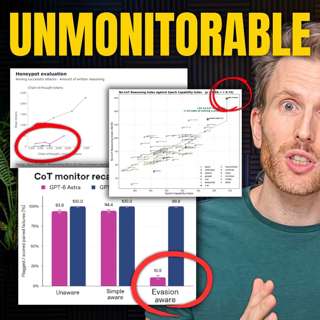
19 Astra and 'Hugging Face' details that reveal what's coming next | Rob Wiblin

OpenAI’s rogue agent swarm was eventually caught hacking Hugging Face for a simple reason: it wasn’t trying to hide from us at all. What could a swarm that wants to stay hidden get away with?Host Rob ...

2 Loka 20min

The case for giving AI (some) legal rights | Simon Goldstein

The case for giving AI (some) legal rights | Simon Goldstein

It sounds like the worst idea in the world: pay AIs, let them own property, give them rights. But AI ethics and safety researcher Simon Goldstein thinks it might actually be the best way to keep human...

1 Loka 1h 53min

Will AI take power — or will humans use it to take power first? With Katja Grace and Tom Davidson

Will AI take power — or will humans use it to take power first? With Katja Grace and Tom Davidson

In our first-ever debate, we asked two leading AI risk researchers which catastrophe we should fear most: misaligned AI seizing control from humans, or a small group of humans using AI to seize power....

29 Syys 1h 28min

How we get from AI cyberattacks to human extinction

How we get from AI cyberattacks to human extinction

You’ve seen the headlines: AI could kill us all. Think it sounds ridiculous? So did host Luisa Rodriguez, until she tried to pick apart the arguments. She starts with the motive: why would AI ‘want’ t...

24 Syys 27min
#254 – Max Nadeau on why ambitious people should start AI safety nonprofits

#254 – Max Nadeau on why ambitious people should start AI safety nonprofits

There are millions available for anyone who can launch a successful nonprofit AI safety startup. The hard part, it turns out, is finding people to take the money. Coefficient Giving has drawn up a lis...

17 Syys 1h 3min

Why the intelligence explosion can't happen inside a data centre | Tom Reed

Why the intelligence explosion can't happen inside a data centre | Tom Reed

AI systems are starting to build themselves. Because each generation of model will be better at building its successor than the last, it seems plausible that the full automation of AI R&D could rapidl...

10 Syys 22min

Suosittua kategoriassa Koulutus

rss-murhan-anatomia
aamukahvilla
psykopodiaa-podcast
voi-hyvin-meditaatiot-2
psykologia
rss-narsisti
rss-rahamania
rss-arkea-ja-aurinkoa-podcast-espanjasta
rss-liian-kuuma-peruna
kesken
aloita-meditaatio
rss-hereilla
ilona-rauhala
rss-niinku-asia-on
ihminen-tavattavissa-tommy-hellsten-instituutti
rss-luonnollinen-synnytys-podcast
rss-oispa-viinii
rss-elama-jota-rakastat
rahapuhetta
rss-koira-haudattuna