Think Thursday:  The Connection Economy-How Relationships Reshape Our Brains

Think Thursday: The Connection Economy-How Relationships Reshape Our Brains

In today’s Think Thursday episode, we’re diving into one of the most powerful, yet often overlooked, tools for behavior change: human connection. We’re not just talking about any connections, but deep, meaningful relationships—the kind that profoundly shape our brain, our well-being, and even our relationship with alcohol.

We’ll explore what I call the “Connection Economy”, where investing in quality relationships provides neurological, emotional, and physical benefits. Unlike the Attention Economy, which constantly pulls us into distraction and stress, the Connection Economy is where we all profit—gaining better mental health, stronger habits, and a more fulfilling life.

What You’ll Learn in This Episode:

✔️ How deep relationships reshape the brain and impact behavior change
✔️ Why the Harvard Study of Adult Development proves that quality relationships are the key to long-term health and happiness
✔️ The brain chemistry of connection—how oxytocin, dopamine, and serotonin create lasting well-being
✔️ The dangers of our current connection crisis and why loneliness increases our reliance on alcohol
✔️ 5 science-backed strategies to strengthen connections and support lasting behavior change

Key Takeaways:

🧠 Neuroscience of Connection – Our brains thrive on relationships. Deep conversations and in-person interactions activate reward pathways, making us more resilient to stress.
💡 The Power of Social Bonds – Strong relationships regulate stress, rewire reward circuits, and protect against cognitive decline.
⚠️ The Connection Crisis – Despite digital connectivity, we are more isolated than ever. Substituting social media for real-life connection can actually increase stress levels.
🔑 Connection as a Behavior Change Tool – Meaningful relationships help us drink less and worry less by providing natural sources of comfort and stress relief.

Try This!

Here are five research-backed strategies you can start using today to harness the power of connection for behavior change:
1️⃣ Prioritize depth over breadth – Invest in a few meaningful relationships rather than many surface-level ones.
2️⃣ Make time for face-to-face interaction – Even short in-person conversations boost oxytocin and improve mood.
3️⃣ Practice active listening – Strengthening your listening skills deepens connections and makes others feel seen.
4️⃣ Engage in shared experiences – Group activities, meals, or hobbies enhance social bonds.
5️⃣ Reach out instead of reaching for a drink – Next time you feel the urge to drink for stress relief, try calling a friend or meeting up in person instead.

★ Support this podcast ★

Tämä jakso on lisätty Podme-palveluun avoimen RSS-syötteen kautta eikä se ole Podmen omaa tuotantoa. Siksi jakso saattaa sisältää mainontaa.

Jaksot(414)

Think Thursday: The Science of Doing it Together!

Think Thursday: The Science of Doing it Together!

Why does change sometimes feel easier when we’re doing it alongside other people?In this Think Thursday episode, Molly explores the science behind shared goals, group support, and collective behavior ...

1 Loka 11min
More Sober October: Make it An Experiment, Not an Exam

More Sober October: Make it An Experiment, Not an Exam

What if the goal of More Sober October isn’t a perfect calendar—but learning something about your relationship with alcohol?In this episode, Molly shares how to approach October as an experiment inste...

28 Syys 23min
Think Thursday: Alzheimer’s Prevention and What the Latest Research Tells Us

Think Thursday: Alzheimer’s Prevention and What the Latest Research Tells Us

World Alzheimer’s Day is a good reminder that the story around Alzheimer’s disease is changing.In this Think Thursday episode, Molly looks at what we know now about earlier diagnosis, blood-based biom...

24 Syys 18min
How Much Alcohol is Safe? Rethinking Drinking Guidelines

How Much Alcohol is Safe? Rethinking Drinking Guidelines

What does “drink less” actually mean?In this episode of the Alcohol Minimalist podcast, Molly explores the changing alcohol guidelines and why there isn’t one simple number that guarantees a “safe” le...

21 Syys 20min
Think Thursday: Why Familiar Feels True-When Thoughts Become Beliefs

Think Thursday: Why Familiar Feels True-When Thoughts Become Beliefs

What happens when a thought gets repeated so often that it stops feeling like a thought and starts feeling like a fact?In this Think Thursday episode, Molly explores the illusory truth effect, process...

17 Syys 15min
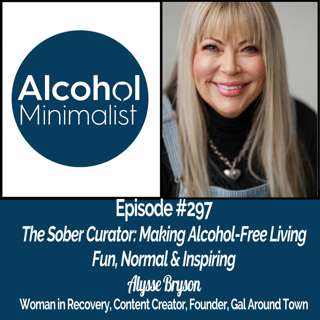
The Sober Curator: Making Alcohol-Free Living Fun, Normal & Inspiring with Alysse Bryson

The Sober Curator: Making Alcohol-Free Living Fun, Normal & Inspiring with Alysse Bryson

What does it look like to build a fun, fulfilling life with less alcohol—or none at all?In this episode of the Alcohol Minimalist Podcast, Molly talks with Elise Bryson, CEO and curator of The Sober C...

14 Syys 45min
Revisiting Think Thursday: Neurodivergence and The Brain's Energy Economy

Revisiting Think Thursday: Neurodivergence and The Brain's Energy Economy

In this revisited Think Thursday episode, Molly explores ADHD through the lens of the brain’s energy economy—how neurodivergent brains may use mental fuel differently, and why that matters for motivat...

10 Syys 13min
Summer's Greatest Hits: Alcohol & ADHD

Summer's Greatest Hits: Alcohol & ADHD

This week on the Alcohol Minimalist Podcast, we’re revisiting the most-downloaded episode from the Alcohol & series: Alcohol & ADHD.ADHD is a personal topic for me, and it also comes up often with coa...

7 Syys 35min

Suosittua kategoriassa Koulutus

rss-murhan-anatomia
psykopodiaa-podcast
aamukahvilla
adhd-podi
rss-arkea-ja-aurinkoa-podcast-espanjasta
rss-valo-minussa-2
rss-liian-kuuma-peruna
rss-hereilla
koulu-podcast-2
kesken
voi-hyvin-meditaatiot-2
rss-rahamania
rss-vapaudu-voimaasi
rss-paikoillenne-valmiit-laakikseen
rss-duodecim-lehti
psykologia
rss-niinku-asia-on
queen-talk
rss-luonnollinen-synnytys-podcast
ihminen-tavattavissa-tommy-hellsten-instituutti