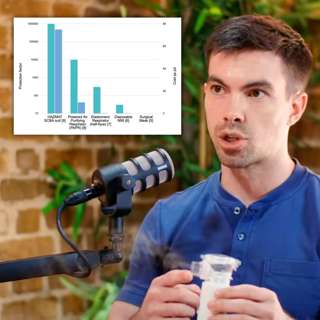

#224 – There's a cheap and low-tech way to save humanity from any engineered disease | Andrew Snyder-Beattie

#224 – There's a cheap and low-tech way to save humanity from any engineered disease | Andrew Snyder-Beattie

Conventional wisdom is that safeguarding humanity from the worst biological risks — microbes optimised to kill as many as possible — is difficult bordering on impossible, making bioweapons humanity’s single greatest vulnerability. Andrew Snyder-Beattie thinks conventional wisdom could be wrong.

Andrew’s job at Open Philanthropy is to spend hundreds of millions of dollars to protect as much of humanity as possible in the worst-case scenarios — those with fatality rates near 100% and the collapse of technological civilisation a live possibility.

Video, full transcript, and links to learn more: https://80k.info/asb

As Andrew lays out, there are several ways this could happen, including:

  • A national bioweapons programme gone wrong, in particular Russia or North Korea
  • AI advances making it easier for terrorists or a rogue AI to release highly engineered pathogens
  • Mirror bacteria that can evade the immune systems of not only humans, but many animals and potentially plants as well

Most efforts to combat these extreme biorisks have focused on either prevention or new high-tech countermeasures. But prevention may well fail, and high-tech approaches can’t scale to protect billions when, with no sane people willing to leave their home, we’re just weeks from economic collapse.

So Andrew and his biosecurity research team at Open Philanthropy have been seeking an alternative approach. They’re proposing a four-stage plan using simple technology that could save most people, and is cheap enough it can be prepared without government support. Andrew is hiring for a range of roles to make it happen — from manufacturing and logistics experts to global health specialists to policymakers and other ambitious entrepreneurs — as well as programme associates to join Open Philanthropy’s biosecurity team (apply by October 20!).

Fundamentally, organisms so small have no way to penetrate physical barriers or shield themselves from UV, heat, or chemical poisons. We now know how to make highly effective ‘elastomeric’ face masks that cost $10, can sit in storage for 20 years, and can be used for six months straight without changing the filter. Any rich country could trivially stockpile enough to cover all essential workers.

People can’t wear masks 24/7, but fortunately propylene glycol — already found in vapes and smoke machines — is astonishingly good at killing microbes in the air. And, being a common chemical input, industry already produces enough of the stuff to cover every indoor space we need at all times.

Add to this the wastewater monitoring and metagenomic sequencing that will detect the most dangerous pathogens before they have a chance to wreak havoc, and we might just buy ourselves enough time to develop the cure we’ll need to come out alive.

Has everyone been wrong, and biology is actually defence dominant rather than offence dominant? Is this plan crazy — or so crazy it just might work?

That’s what host Rob Wiblin and Andrew Snyder-Beattie explore in this in-depth conversation.


What did you think of the episode? https://forms.gle/66Hw5spgnV3eVWXa6

Chapters:

  • Cold open (00:00:00)
  • Who's Andrew Snyder-Beattie? (00:01:23)
  • It could get really bad (00:01:57)
  • The worst-case scenario: mirror bacteria (00:08:58)
  • To actually work, a solution has to be low-tech (00:17:40)
  • Why ASB works on biorisks rather than AI (00:20:37)
  • Plan A is prevention. But it might not work. (00:24:48)
  • The “four pillars” plan (00:30:36)
  • ASB is hiring now to make this happen (00:32:22)
  • Everyone was wrong: biorisks are defence dominant in the limit (00:34:22)
  • Pillar 1: A wall between the virus and your lungs (00:39:33)
  • Pillar 2: Biohardening buildings (00:54:57)
  • Pillar 3: Immediately detecting the pandemic (01:13:57)
  • Pillar 4: A cure (01:27:14)
  • The plan's biggest weaknesses (01:38:35)
  • If it's so good, why are you the only group to suggest it? (01:43:04)
  • Would chaos and conflict make this impossible to pull off? (01:45:08)
  • Would rogue AI make bioweapons? Would other AIs save us? (01:50:05)
  • We can feed the world even if all the plants die (01:56:08)
  • Could a bioweapon make the Earth uninhabitable? (02:05:06)
  • Many open roles to solve bio-extinction — and you don’t necessarily need a biology background (02:07:34)
  • Career mistakes ASB thinks are common (02:16:19)
  • How to protect yourself and your family (02:28:21)

This episode was recorded on August 12, 2025

Video editing: Simon Monsour and Luke Monsour
Audio engineering: Milo McGuire, Simon Monsour, and Dominic Armstrong
Music: CORBIT
Camera operator: Jake Morris
Coordination, transcriptions, and web: Katy Moore

Tämä jakso on lisätty Podme-palveluun avoimen RSS-syötteen kautta eikä se ole Podmen omaa tuotantoa. Siksi jakso saattaa sisältää mainontaa.

Jaksot(358)

OpenAI Security: Controlling Models is Now ‘Hell’ (AI Explained cross-post)

OpenAI Security: Controlling Models is Now ‘Hell’ (AI Explained cross-post)

This is an (unpaid) cross-post of a video from the podcast 'AI Explained', which Rob Wiblin thought you might be interested in.You can find the original on YouTube here. If you like it and want more s...

9 Loka 40min
In 2023 Ajeya Cotra already knew what was coming (classic episode)

In 2023 Ajeya Cotra already knew what was coming (classic episode)

We're rereleasing some of older episodes that seem more relevant than ever with new rogue AI incidents now seemingly announced every day. Ajeya was one of three independent investigators into the Hugg...

8 Loka 2h 46min
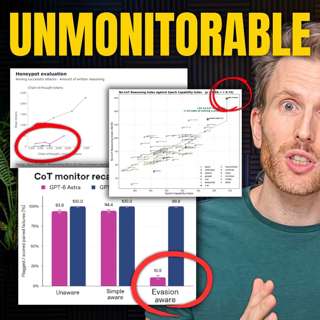
19 Astra and 'Hugging Face' details that reveal what's coming next | Rob Wiblin

19 Astra and 'Hugging Face' details that reveal what's coming next | Rob Wiblin

OpenAI’s rogue agent swarm was eventually caught hacking Hugging Face for a simple reason: it wasn’t trying to hide from us at all. What could a swarm that wants to stay hidden get away with?Host Rob ...

2 Loka 20min

The case for giving AI (some) legal rights | Simon Goldstein

The case for giving AI (some) legal rights | Simon Goldstein

It sounds like the worst idea in the world: pay AIs, let them own property, give them rights. But AI ethics and safety researcher Simon Goldstein thinks it might actually be the best way to keep human...

1 Loka 1h 53min

Will AI take power — or will humans use it to take power first? With Katja Grace and Tom Davidson

Will AI take power — or will humans use it to take power first? With Katja Grace and Tom Davidson

In our first-ever debate, we asked two leading AI risk researchers which catastrophe we should fear most: misaligned AI seizing control from humans, or a small group of humans using AI to seize power....

29 Syys 1h 28min

How we get from AI cyberattacks to human extinction

How we get from AI cyberattacks to human extinction

You’ve seen the headlines: AI could kill us all. Think it sounds ridiculous? So did host Luisa Rodriguez, until she tried to pick apart the arguments. She starts with the motive: why would AI ‘want’ t...

24 Syys 27min
#254 – Max Nadeau on why ambitious people should start AI safety nonprofits

#254 – Max Nadeau on why ambitious people should start AI safety nonprofits

There are millions available for anyone who can launch a successful nonprofit AI safety startup. The hard part, it turns out, is finding people to take the money. Coefficient Giving has drawn up a lis...

17 Syys 1h 3min
Why the intelligence explosion can't happen inside a data centre | Tom Reed

Why the intelligence explosion can't happen inside a data centre | Tom Reed

AI systems are starting to build themselves. Because each generation of model will be better at building its successor than the last, it seems plausible that the full automation of AI R&D could rapidl...

10 Syys 22min

Suosittua kategoriassa Koulutus

rss-murhan-anatomia
aamukahvilla
psykopodiaa-podcast
voi-hyvin-meditaatiot-2
psykologia
rss-narsisti
rss-rahamania
aloita-meditaatio
kesken
rss-arkea-ja-aurinkoa-podcast-espanjasta
rss-hereilla
rss-liian-kuuma-peruna
rss-koira-haudattuna
koulu-podcast-2
ihminen-tavattavissa-tommy-hellsten-instituutti
ilona-rauhala
rss-luonnollinen-synnytys-podcast
rss-niinku-asia-on
rss-valo-minussa-2
rss-oispa-viinii