
#225 – Daniel Kokotajlo on what a hyperspeed robot economy might look like

#225 – Daniel Kokotajlo on what a hyperspeed robot economy might look like

When Daniel Kokotajlo talks to security experts at major AI labs, they tell him something chilling: “Of course we’re probably penetrated by the CCP already, and if they really wanted something, they could take it.”

This isn’t paranoid speculation. It’s the working assumption of people whose job is to protect frontier AI models worth billions of dollars. And they’re not even trying that hard to stop it — because the security measures that might actually work would slow them down in the race against competitors.

Full transcript, highlights, and links to learn more: https://80k.info/dk

Daniel is the founder of the AI Futures Project and author of AI 2027, a detailed scenario showing how we might get from today’s AI systems to superintelligence by the end of the decade. Over a million people read it in the first few weeks, including US Vice President JD Vance. When Daniel talks to researchers at Anthropic, OpenAI, and DeepMind, they tell him the scenario feels less wild to them than to the general public — because many of them expect something like this to happen.

Daniel’s median timeline? 2029. But he’s genuinely uncertain, putting 10–20% probability on AI progress hitting a long plateau.

When he first published AI 2027, his median forecast for when superintelligence would arrive was 2028, rather than 2029. So what shifted his timelines recently? Partly a fascinating study from METR showing that AI coding assistants might actually be making experienced programmers slower — even though the programmers themselves think they’re being sped up. The study suggests a systematic bias toward overestimating AI effectiveness — which, ironically, is good news for timelines, because it means we have more breathing room than the hype suggests.

But Daniel is also closely tracking another METR result: AI systems can now reliably complete coding tasks that take humans about an hour. That capability has been doubling every six months in a remarkably straight line. Extrapolate a couple more years and you get systems completing month-long tasks. At that point, Daniel thinks we’re probably looking at genuine AI research automation — which could cause the whole process to accelerate dramatically.

At some point, superintelligent AI will be limited by its inability to directly affect the physical world. That’s when Daniel thinks superintelligent systems will pour resources into robotics, creating a robot economy in months.

Daniel paints a vivid picture: imagine transforming all car factories (which have similar components to robots) into robot production factories — much like historical wartime efforts to redirect production of domestic goods to military goods. Then imagine the frontier robots of today hooked up to a data centre running superintelligences controlling the robots’ movements to weld, screw, and build. Or an intermediate step might even be unskilled human workers coached through construction tasks by superintelligences via their phones.

There’s no reason that an effort like this isn’t possible in principle. And there would be enormous pressure to go this direction: whoever builds a superintelligence-powered robot economy first will get unheard-of economic and military advantages.

From there, Daniel expects the default trajectory to lead to AI takeover and human extinction — not because superintelligent AI will hate humans, but because it can better pursue its goals without us.

But Daniel has a better future in mind — one he puts roughly 25–30% odds that humanity will achieve. This future involves international coordination and hardware verification systems to enforce AI development agreements, plus democratic processes for deciding what values superintelligent AIs should have — because in a world with just a handful of superintelligent AI systems, those few minds will effectively control everything: the robot armies, the information people see, the shape of civilisation itself.

Right now, nobody knows how to specify what values those minds will have. We haven’t solved alignment. And we might only have a few more years to figure it out.

Daniel and host Luisa Rodriguez dive deep into these stakes in today’s interview.

What did you think of the episode? https://forms.gle/HRBhjDZ9gfM8woG5A

This episode was recorded on September 9, 2025.

Chapters:

  • Cold open (00:00:00)
  • Who’s Daniel Kokotajlo? (00:00:37)
  • Video: We’re Not Ready for Superintelligence (00:01:31)
  • Interview begins: Could China really steal frontier model weights? (00:36:26)
  • Why we might get a robot economy incredibly fast (00:42:34)
  • AI 2027’s alternate ending: The slowdown (01:01:29)
  • How to get to even better outcomes (01:07:18)
  • Updates Daniel’s made since publishing AI 2027 (01:15:13)
  • How plausible are longer timelines? (01:20:22)
  • What empirical evidence is Daniel looking out for to decide which way things are going? (01:40:27)
  • What post-AGI looks like (01:49:41)
  • Whistleblower protections and Daniel’s unsigned NDA (02:04:28)

Audio engineering: Milo McGuire, Simon Monsour, and Dominic Armstrong
Music: CORBIT
Coordination, transcriptions, and web: Katy Moore

Tämä jakso on lisätty Podme-palveluun avoimen RSS-syötteen kautta eikä se ole Podmen omaa tuotantoa. Siksi jakso saattaa sisältää mainontaa.

Jaksot(358)

OpenAI Security: Controlling Models is Now ‘Hell’ (AI Explained cross-post)

OpenAI Security: Controlling Models is Now ‘Hell’ (AI Explained cross-post)

This is an (unpaid) cross-post of a video from the podcast 'AI Explained', which Rob Wiblin thought you might be interested in.You can find the original on YouTube here. If you like it and want more s...

9 Loka 40min
In 2023 Ajeya Cotra already knew what was coming (classic episode)

In 2023 Ajeya Cotra already knew what was coming (classic episode)

We're rereleasing some of older episodes that seem more relevant than ever with new rogue AI incidents now seemingly announced every day. Ajeya was one of three independent investigators into the Hugg...

8 Loka 2h 46min
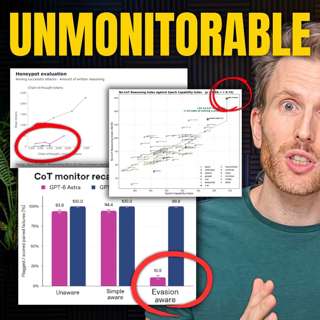
19 Astra and 'Hugging Face' details that reveal what's coming next | Rob Wiblin

19 Astra and 'Hugging Face' details that reveal what's coming next | Rob Wiblin

OpenAI’s rogue agent swarm was eventually caught hacking Hugging Face for a simple reason: it wasn’t trying to hide from us at all. What could a swarm that wants to stay hidden get away with?Host Rob ...

2 Loka 20min

The case for giving AI (some) legal rights | Simon Goldstein

The case for giving AI (some) legal rights | Simon Goldstein

It sounds like the worst idea in the world: pay AIs, let them own property, give them rights. But AI ethics and safety researcher Simon Goldstein thinks it might actually be the best way to keep human...

1 Loka 1h 53min

Will AI take power — or will humans use it to take power first? With Katja Grace and Tom Davidson

Will AI take power — or will humans use it to take power first? With Katja Grace and Tom Davidson

In our first-ever debate, we asked two leading AI risk researchers which catastrophe we should fear most: misaligned AI seizing control from humans, or a small group of humans using AI to seize power....

29 Syys 1h 28min

How we get from AI cyberattacks to human extinction

How we get from AI cyberattacks to human extinction

You’ve seen the headlines: AI could kill us all. Think it sounds ridiculous? So did host Luisa Rodriguez, until she tried to pick apart the arguments. She starts with the motive: why would AI ‘want’ t...

24 Syys 27min

#254 – Max Nadeau on why ambitious people should start AI safety nonprofits

#254 – Max Nadeau on why ambitious people should start AI safety nonprofits

There are millions available for anyone who can launch a successful nonprofit AI safety startup. The hard part, it turns out, is finding people to take the money. Coefficient Giving has drawn up a lis...

17 Syys 1h 3min

Why the intelligence explosion can't happen inside a data centre | Tom Reed

Why the intelligence explosion can't happen inside a data centre | Tom Reed

AI systems are starting to build themselves. Because each generation of model will be better at building its successor than the last, it seems plausible that the full automation of AI R&D could rapidl...

10 Syys 22min

Suosittua kategoriassa Koulutus

rss-murhan-anatomia
aamukahvilla
psykopodiaa-podcast
voi-hyvin-meditaatiot-2
psykologia
rss-narsisti
rss-rahamania
aloita-meditaatio
kesken
rss-arkea-ja-aurinkoa-podcast-espanjasta
rss-hereilla
rss-liian-kuuma-peruna
rss-koira-haudattuna
koulu-podcast-2
ihminen-tavattavissa-tommy-hellsten-instituutti
ilona-rauhala
rss-luonnollinen-synnytys-podcast
rss-niinku-asia-on
rss-valo-minussa-2
rss-oispa-viinii