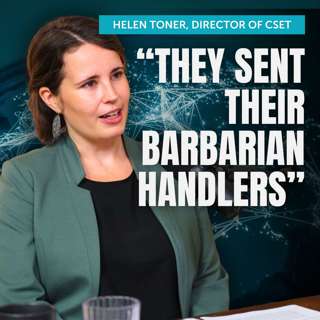

#227 – Helen Toner on the geopolitics of AGI in China and the Middle East

#227 – Helen Toner on the geopolitics of AGI in China and the Middle East

With the US racing to develop AGI and superintelligence ahead of China, you might expect the two countries to be negotiating how they’ll deploy AI, including in the military, without coming to blows. But according to Helen Toner, director of the Center for Security and Emerging Technology in DC, “the US and Chinese governments are barely talking at all.”

In her role as a founder, and now leader, of DC’s top think tank focused on the geopolitical and military implications of AI, Helen has been closely tracking the US’s AI diplomacy since 2019.

“Over the last couple of years there have been some direct [US–China] talks on some small number of issues, but they’ve also often been completely suspended.” China knows the US wants to talk more, so “that becomes a bargaining chip for China to say, ‘We don’t want to talk to you. We’re not going to do these military-to-military talks about extremely sensitive, important issues, because we’re mad.'”

Helen isn’t sure the groundwork exists for productive dialogue in any case. “At the government level, [there’s] very little agreement” on what AGI is, whether it’s possible soon, whether it poses major risks. Without shared understanding of the problem, negotiating solutions is very difficult.

Another issue is that so far the Chinese Communist Party doesn’t seem especially “AGI-pilled.” While a few Chinese companies like DeepSeek are betting on scaling, she sees little evidence Chinese leadership shares Silicon Valley’s conviction that AGI will arrive any minute now, and export controls have made it very difficult for them to access compute to match US competitors.

When DeepSeek released R1 just three months after OpenAI’s o1, observers declared the US–China gap on AI had all but disappeared. But Helen notes OpenAI has since scaled to o3 and o4, with nothing to match on the Chinese side. “We’re now at something like a nine-month gap, and that might be longer.”

To find a properly AGI-pilled autocracy, we might need to look at nominal US allies. The US has approved massive data centres in the UAE and Saudi Arabia with “hundreds of thousands of next-generation Nvidia chips” — delivering colossal levels of computing power.

When OpenAI announced this deal with the UAE, they celebrated that it was “rooted in democratic values,” and would advance “democratic AI rails” and provide “a clear alternative to authoritarian versions of AI.”

But the UAE scores 18 out of 100 on Freedom House’s democracy index. “This is really not a country that respects rule of law,” Helen observes. Political parties are banned, elections are fake, dissidents are persecuted.

If AI access really determines future national power, handing world-class supercomputers to Gulf autocracies seems pretty questionable. The justification is typically that “if we don’t sell it, China will” — a transparently false claim, given severe Chinese production constraints. It also raises eyebrows that Gulf countries conduct joint military exercises with China and their rulers have “very tight personal and commercial relationships with Chinese political leaders and business leaders.”

In today’s episode, host Rob Wiblin and Helen discuss the above, plus:

  • Ways China exaggerates its chip production for strategic gain
  • The confusing and conflicting goals in the US’s AI policy towards China
  • Whether it matters that China could steal frontier AI models trained in the US
  • Whether Congress is starting to take superintelligence seriously this year
  • Why she rejects ‘non-proliferation’ as a model for AI
  • Plenty more.


Learn more and read the full transcript
on the 80,000 Hours website.


This episode was recorded on September 25, 2025.

CSET is hiring a frontier AI research fellow! https://80k.info/cset-role
Check out its careers page for current roles: https://cset.georgetown.edu/careers/

Chapters:

• Cold open (00:00:00)
• Who’s Helen Toner? (00:01:03)
• Helen’s role on the OpenAI board, and what happened with Sam Altman (00:01:32)
• The Center for Security and Emerging Technology (CSET) (00:07:45)
• CSET’s role in export controls against China (00:10:59)
• Does it matter if the world uses US AI models? (00:21:58)
• Is China actually racing to build AGI? (00:27:56)
• Could China easily steal AI model weights from US companies? (00:39:13)
• The next big thing is probably robotics (00:47:45)
• Why is the Trump administration sabotaging the US high-tech sector? (00:49:24)
• Are data centres in the UAE “good for democracy”? (00:52:41)
• Will AI inevitably concentrate power? (01:07:49)
• “Adaptation buffers” vs non-proliferation (01:30:20)
• Will the military use AI for decision-making? (01:38:23)
• “Alignment” is (usually) a terrible term (01:45:11)
• Is Congress starting to take superintelligence seriously? (01:47:42)
• AI progress isn't actually slowing down (01:50:10)
• What's legit vs not about OpenAI’s restructure (01:58:03)
• Is Helen unusually “normal”? (02:01:33)
• How to keep up with rapid changes in AI and geopolitics (02:05:19)
• What CSET can uniquely add to the DC policy world (02:08:29)
• Talent bottlenecks in DC (02:16:03)
• What evidence, if any, could settle how worried we should be about AI risk? (02:19:07)
• Is CSET hiring? (

Tämä jakso on lisätty Podme-palveluun avoimen RSS-syötteen kautta eikä se ole Podmen omaa tuotantoa. Siksi jakso saattaa sisältää mainontaa.

Jaksot(358)

OpenAI Security: Controlling Models is Now ‘Hell’ (AI Explained cross-post)

OpenAI Security: Controlling Models is Now ‘Hell’ (AI Explained cross-post)

This is an (unpaid) cross-post of a video from the podcast 'AI Explained', which Rob Wiblin thought you might be interested in.You can find the original on YouTube here. If you like it and want more s...

9 Loka 40min

In 2023 Ajeya Cotra already knew what was coming (classic episode)

In 2023 Ajeya Cotra already knew what was coming (classic episode)

We're rereleasing some of older episodes that seem more relevant than ever with new rogue AI incidents now seemingly announced every day. Ajeya was one of three independent investigators into the Hugg...

8 Loka 2h 46min

19 Astra and 'Hugging Face' details that reveal what's coming next | Rob Wiblin

19 Astra and 'Hugging Face' details that reveal what's coming next | Rob Wiblin

OpenAI’s rogue agent swarm was eventually caught hacking Hugging Face for a simple reason: it wasn’t trying to hide from us at all. What could a swarm that wants to stay hidden get away with?Host Rob ...

2 Loka 20min

The case for giving AI (some) legal rights | Simon Goldstein

The case for giving AI (some) legal rights | Simon Goldstein

It sounds like the worst idea in the world: pay AIs, let them own property, give them rights. But AI ethics and safety researcher Simon Goldstein thinks it might actually be the best way to keep human...

1 Loka 1h 53min

Will AI take power — or will humans use it to take power first? With Katja Grace and Tom Davidson

Will AI take power — or will humans use it to take power first? With Katja Grace and Tom Davidson

In our first-ever debate, we asked two leading AI risk researchers which catastrophe we should fear most: misaligned AI seizing control from humans, or a small group of humans using AI to seize power....

29 Syys 1h 28min

How we get from AI cyberattacks to human extinction

How we get from AI cyberattacks to human extinction

You’ve seen the headlines: AI could kill us all. Think it sounds ridiculous? So did host Luisa Rodriguez, until she tried to pick apart the arguments. She starts with the motive: why would AI ‘want’ t...

24 Syys 27min

#254 – Max Nadeau on why ambitious people should start AI safety nonprofits

#254 – Max Nadeau on why ambitious people should start AI safety nonprofits

There are millions available for anyone who can launch a successful nonprofit AI safety startup. The hard part, it turns out, is finding people to take the money. Coefficient Giving has drawn up a lis...

17 Syys 1h 3min

Why the intelligence explosion can't happen inside a data centre | Tom Reed

Why the intelligence explosion can't happen inside a data centre | Tom Reed

AI systems are starting to build themselves. Because each generation of model will be better at building its successor than the last, it seems plausible that the full automation of AI R&D could rapidl...

10 Syys 22min

Suosittua kategoriassa Koulutus

rss-murhan-anatomia
aamukahvilla
psykopodiaa-podcast
voi-hyvin-meditaatiot-2
psykologia
rss-liian-kuuma-peruna
rss-rahamania
rss-narsisti
kesken
rss-luonnollinen-synnytys-podcast
aloita-meditaatio
rss-arkea-ja-aurinkoa-podcast-espanjasta
koulu-podcast-2
rss-koira-haudattuna
ihminen-tavattavissa-tommy-hellsten-instituutti
rss-uskonto-on-tylsaa
rss-suomen-aa-podcast
rss-niinku-asia-on
adhd-podi
rss-valo-minussa-2