#106 – Cal Newport on an industrial revolution for office work

#106 – Cal Newport on an industrial revolution for office work

If you wanted to start a university department from scratch, and attract as many superstar researchers as possible, what’s the most attractive perk you could offer?

How about just not needing an email address.

According to today's guest, Cal Newport — computer science professor and best-selling author of A World Without Email — it should seem obscene and absurd for a world-renowned vaccine researcher with decades of experience to spend a third of their time fielding requests from HR, building management, finance, and so on. Yet with offices organised the way they are today, nothing could be more natural.

Links to learn more, summary and full transcript.

But this isn’t just a problem at the elite level — this affects almost all of us. A typical U.S. office worker checks their email 80 times a day, once every six minutes on average. Data analysis by RescueTime found that a third of users checked email or Slack every three minutes or more, averaged over a full work day.

Each time that happens our focus is broken, killing our momentum on the knowledge work we're supposedly paid to do.

When we lament how much email and chat have reduced our focus and filled our days with anxiety and frenetic activity, we most naturally blame 'weakness of will'. If only we had the discipline to check Slack and email once a day, all would be well — or so the story goes.

Cal believes that line of thinking fundamentally misunderstands how we got to a place where knowledge workers can rarely find more than five consecutive minutes to spend doing just one thing.

Since the Industrial Revolution, a combination of technology and better organization have allowed the manufacturing industry to produce a hundred-fold as much with the same number of people.

Cal says that by comparison, it's not clear that specialised knowledge workers like scientists, authors, or senior managers are *any* more productive than they were 50 years ago. If the knowledge sector could achieve even a tiny fraction of what manufacturing has, and find a way to coordinate its work that raised productivity by just 1%, that would generate on the order of $100 billion globally each year.

Since the 1990s, when everyone got an email address and most lost their assistants, that lack of direction has led to what Cal calls the 'hyperactive hive mind': everyone sends emails and chats to everyone else, all through the day, whenever they need something.

Cal points out that this is so normal we don't even think of it as a way of organising work, but it is: it's what happens when management does nothing to enable teams to decide on a better way of organising themselves.

A few industries have made progress taming the 'hyperactive hive mind'. But on Cal's telling, this barely scratches the surface of the improvements that are possible within knowledge work. And reigning in the hyperactive hive mind won't just help people do higher quality work, it will free them from the 24/7 anxiety that there's someone somewhere they haven't gotten back to.

In this interview Cal and Rob also cover:
• Is this really one of the world's most pressing problems?
• The historical origins of the 'hyperactive hive mind'
• The harm caused by attention switching
• Who's working to solve the problem and how
• Cal's top productivity advice for high school students, university students, and early career workers
• And much more

Chapters:

  • Rob’s intro (00:00:00)
  • The interview begins (00:02:02)
  • The hyperactive hivemind (00:04:11)
  • Scale of the harm (00:08:40)
  • Is email making professors stupid? (00:22:09)
  • Why haven't we already made these changes? (00:29:38)
  • Do people actually prefer the hyperactive hivemind? (00:43:31)
  • Solutions (00:55:52)
  • Advocacy (01:10:47)
  • How to Be a High School Superstar (01:23:03)
  • How to Win at College (01:27:46)
  • So Good They Can't Ignore You (01:31:47)
  • Personal barriers (01:42:51)
  • George Marshall (01:47:11)
  • Rob’s outro (01:49:18)

Producer: Keiran Harris
Audio mastering: Ben Cordell
Transcriptions: Sofia Davis-Fogel

Denne episoden er hentet fra en åpen RSS-feed og er ikke publisert av Podme. Den kan derfor inneholde annonser.

Episoder(364)

Luke Muehlhauser on the most important AI safety work nobody is doing

Luke Muehlhauser on the most important AI safety work nobody is doing

The US government spends 25 times more on military marching bands than on its AI safety institute. And that’s just one of the many institutions we’re missing as AI becomes more powerful and dangerous....

29 Okt 2h 36min
Why Silicon Valley can’t slow down AI on its own | Luisa Rodriguez

Why Silicon Valley can’t slow down AI on its own | Luisa Rodriguez

Two-thirds of Americans think AI is moving too fast. So do the people building it. So why the hell isn’t anyone slowing down?We can’t tell when models are too dangerous. We mostly don’t know how they ...

27 Okt 21min

Tom Milton on how we could verify a US–China deal on AI

Tom Milton on how we could verify a US–China deal on AI

If the US and China agreed to pause frontier AI training, how would either side confirm the other was complying? Today, Tom Milton argues, the most likely answer would be to shut down data centres ent...

23 Okt 1h 48min
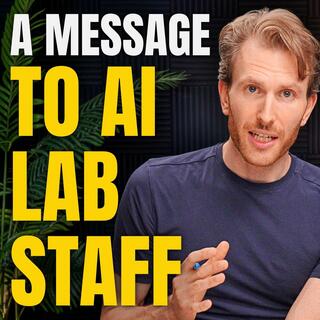
AI lab staff: Has your project been overtaken by events? 8 strategic updates | Rob Wiblin

AI lab staff: Has your project been overtaken by events? 8 strategic updates | Rob Wiblin

I have a plea for all staff at AI companies: reassess if your current role is still your best opportunity for impact. And if it’s not — move.Frontier lab staff listening to this show will mostly alrea...

21 Okt 14min

Introducing our new YouTube channel: Zershaaneh Talks AI

Introducing our new YouTube channel: Zershaaneh Talks AI

Our host Zershaaneh Qureshi has just launched a new YouTube channel: Zershaaneh Talks AI — featuring conversations about who should control AI, how to control AI, and who gets the benefits.The first e...

20 Okt 1min
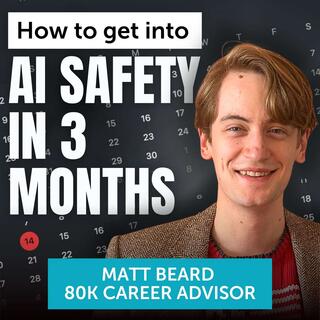
How to get into AI safety in 3 months (article reading by career advisor Matt Beard)

How to get into AI safety in 3 months (article reading by career advisor Matt Beard)

The AI safety field has grown by about 30x in the last eight years. Yet it is still in need of more people. Many want to help, but don’t know where to start. As an advisor at 80,000 Hours, Matt Beard ...

15 Okt 18min
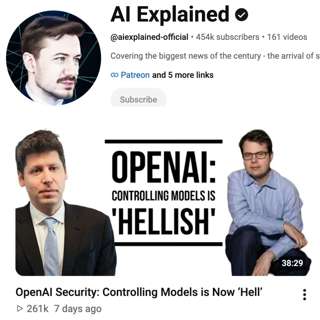
OpenAI Security: Controlling Models is Now ‘Hell’ (AI Explained cross-post)

OpenAI Security: Controlling Models is Now ‘Hell’ (AI Explained cross-post)

This is an (unpaid) cross-post of a video from the podcast 'AI Explained', which Rob Wiblin thought you might be interested in.You can find the original on YouTube here. If you like it and want more s...

9 Okt 40min
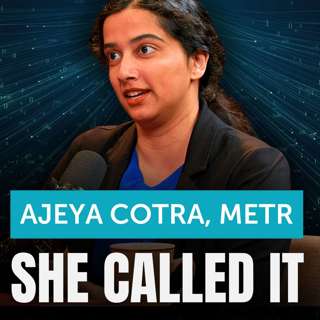
In 2023 Ajeya Cotra already knew what was coming (classic episode)

In 2023 Ajeya Cotra already knew what was coming (classic episode)

We're rereleasing some of older episodes that seem more relevant than ever with new rogue AI incidents now seemingly announced every day. Ajeya was one of three independent investigators into the Hugg...

8 Okt 2h 46min
Populært innen Fakta

fastlegen
dine-penger-pengeradet
fryktlos
relasjonspodden-med-dora-thorhallsdottir-kjersti-idem
rss-strid
foreldreradet
treningspodden
jakt-og-fiskepodden
rss-kunsten-a-leve
rss-bisarr-historie
rss-ekteskapet
sinnsyn
rss-orjasater
hverdagspsyken
gravid-uke-for-uke
rss-sarbar-med-lotte-erik
mikkels-paskenotter
rss-kunstig-intelligens-med-elisabeth-maren-og-morten
rss-kull
branncast