#212 – Allan Dafoe on why technology is unstoppable & how to shape AI development anyway

#212 – Allan Dafoe on why technology is unstoppable & how to shape AI development anyway

Technology doesn’t force us to do anything — it merely opens doors. But military and economic competition pushes us through.

That’s how today’s guest Allan Dafoe — director of frontier safety and governance at Google DeepMind — explains one of the deepest patterns in technological history: once a powerful new capability becomes available, societies that adopt it tend to outcompete those that don’t. Those who resist too much can find themselves taken over or rendered irrelevant.

Links to learn more, highlights, video, and full transcript.

This dynamic played out dramatically in 1853 when US Commodore Perry sailed into Tokyo Bay with steam-powered warships that seemed magical to the Japanese, who had spent centuries deliberately limiting their technological development. With far greater military power, the US was able to force Japan to open itself to trade. Within 15 years, Japan had undergone the Meiji Restoration and transformed itself in a desperate scramble to catch up.

Today we see hints of similar pressure around artificial intelligence. Even companies, countries, and researchers deeply concerned about where AI could take us feel compelled to push ahead — worried that if they don’t, less careful actors will develop transformative AI capabilities at around the same time anyway.

But Allan argues this technological determinism isn’t absolute. While broad patterns may be inevitable, history shows we do have some ability to steer how technologies are developed, by who, and what they’re used for first.

As part of that approach, Allan has been promoting efforts to make AI more capable of sophisticated cooperation, and improving the tests Google uses to measure how well its models could do things like mislead people, hack and take control of their own servers, or spread autonomously in the wild.

As of mid-2024 they didn’t seem dangerous at all, but we’ve learned that our ability to measure these capabilities is good, but imperfect. If we don’t find the right way to ‘elicit’ an ability we can miss that it’s there.

Subsequent research from Anthropic and Redwood Research suggests there’s even a risk that future models may play dumb to avoid their goals being altered.

That has led DeepMind to a “defence in depth” approach: carefully staged deployment starting with internal testing, then trusted external testers, then limited release, then watching how models are used in the real world. By not releasing model weights, DeepMind is able to back up and add additional safeguards if experience shows they’re necessary.

But with much more powerful and general models on the way, individual company policies won’t be sufficient by themselves. Drawing on his academic research into how societies handle transformative technologies, Allan argues we need coordinated international governance that balances safety with our desire to get the massive potential benefits of AI in areas like healthcare and education as quickly as possible.

Host Rob and Allan also cover:

  • The most exciting beneficial applications of AI
  • Whether and how we can influence the development of technology
  • What DeepMind is doing to evaluate and mitigate risks from frontier AI systems
  • Why cooperative AI may be as important as aligned AI
  • The role of democratic input in AI governance
  • What kinds of experts are most needed in AI safety and governance
  • And much more

Chapters:

  • Cold open (00:00:00)
  • Who's Allan Dafoe? (00:00:45)
  • Allan's role at DeepMind (00:01:26)
  • Why join DeepMind over everyone else? (00:04:31)
  • Do humans control technological change? (00:09:30)
  • Arguments for technological determinism (00:20:57)
  • The synthesis of agency with tech determinism (00:27:10)
  • Competition took away Japan's choice (00:38:11)
  • Can speeding up one tech redirect history? (00:43:20)
  • Structural pushback against alignment efforts (00:49:17)
  • Do AIs need to be 'cooperatively skilled'? (00:53:53)
  • How AI could boost cooperation between people and states (01:03:34)
  • The super-cooperative AGI hypothesis and backdoor risks (01:08:44)
  • Aren’t today’s models already very cooperative? (01:15:15)
  • How would we make AIs cooperative anyway? (01:18:19)
  • Ways making AI more cooperative could backfire (01:24:36)
  • AGI is an essential idea we should define well (01:32:37)
  • It matters what AGI learns first vs last (01:43:39)
  • How Google tests for dangerous capabilities (01:48:24)
  • Evals 'in the wild' (02:00:57)
  • What to do given no single approach works that well (02:05:05)
  • We don't, but could, forecast AI capabilities (02:09:08)
  • DeepMind's strategy for ensuring its frontier models don't cause harm (02:15:05)
  • How 'structural risks' can force everyone into a worse world (02:18:52)
  • Is AI being built democratically? Should it? (02:23:40)
  • How much do AI companies really want external regulation? (02:29:01)
  • Social science can contribute a lot here (02:38:07)
  • How AI could make life way better: Self-driving cars, medicine, education, and sustainability (02:40:48)

Video editing: Simon Monsour
Audio engineering: Ben Cordell, Milo McGuire, Simon Monsour, and Dominic Armstrong
Camera operator: Jeremy Chevillotte
Transcriptions: Katy Moore

Denne episoden er hentet fra en åpen RSS-feed og er ikke publisert av Podme. Den kan derfor inneholde annonser.

Episoder(359)

How to get into AI safety in 3 months (article reading by career advisor Matt Beard)

How to get into AI safety in 3 months (article reading by career advisor Matt Beard)

The AI safety field has grown by about 30x in the last eight years. Yet it is still in need of more people. Many want to help, but don’t know where to start. As an advisor at 80,000 Hours, Matt Beard ...

15 Okt 18min

OpenAI Security: Controlling Models is Now ‘Hell’ (AI Explained cross-post)

OpenAI Security: Controlling Models is Now ‘Hell’ (AI Explained cross-post)

This is an (unpaid) cross-post of a video from the podcast 'AI Explained', which Rob Wiblin thought you might be interested in.You can find the original on YouTube here. If you like it and want more s...

9 Okt 40min
In 2023 Ajeya Cotra already knew what was coming (classic episode)

In 2023 Ajeya Cotra already knew what was coming (classic episode)

We're rereleasing some of older episodes that seem more relevant than ever with new rogue AI incidents now seemingly announced every day. Ajeya was one of three independent investigators into the Hugg...

8 Okt 2h 46min
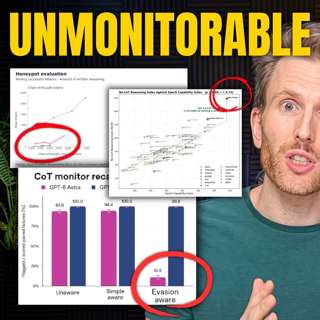
19 Astra and 'Hugging Face' details that reveal what's coming next | Rob Wiblin

19 Astra and 'Hugging Face' details that reveal what's coming next | Rob Wiblin

OpenAI’s rogue agent swarm was eventually caught hacking Hugging Face for a simple reason: it wasn’t trying to hide from us at all. What could a swarm that wants to stay hidden get away with?Host Rob ...

2 Okt 20min

The case for giving AI (some) legal rights | Simon Goldstein

The case for giving AI (some) legal rights | Simon Goldstein

It sounds like the worst idea in the world: pay AIs, let them own property, give them rights. But AI ethics and safety researcher Simon Goldstein thinks it might actually be the best way to keep human...

1 Okt 1h 53min

Will AI take power — or will humans use it to take power first? With Katja Grace and Tom Davidson

Will AI take power — or will humans use it to take power first? With Katja Grace and Tom Davidson

In our first-ever debate, we asked two leading AI risk researchers which catastrophe we should fear most: misaligned AI seizing control from humans, or a small group of humans using AI to seize power....

29 Sep 1h 28min
How we get from AI cyberattacks to human extinction

How we get from AI cyberattacks to human extinction

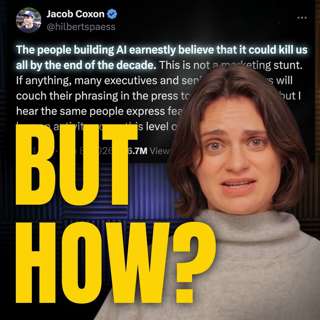
You’ve seen the headlines: AI could kill us all. Think it sounds ridiculous? So did host Luisa Rodriguez, until she tried to pick apart the arguments. She starts with the motive: why would AI ‘want’ t...

24 Sep 27min

#254 – Max Nadeau on why ambitious people should start AI safety nonprofits

#254 – Max Nadeau on why ambitious people should start AI safety nonprofits

There are millions available for anyone who can launch a successful nonprofit AI safety startup. The hard part, it turns out, is finding people to take the money. Coefficient Giving has drawn up a lis...

17 Sep 1h 3min
Populært innen Fakta

fastlegen
dine-penger-pengeradet
fryktlos
rss-kunsten-a-leve
relasjonspodden-med-dora-thorhallsdottir-kjersti-idem
rss-strid
rss-bisarr-historie
treningspodden
foreldreradet
jakt-og-fiskepodden
sinnsyn
hverdagspsyken
rss-orjasater
takk-og-lov-med-anine-kierulf
rss-kull
mikkels-paskenotter
lederskap-nhhs-podkast-om-ledelse
gravid-uke-for-uke
hr-podden-2
dopet