
You May Never Feel Like You Belong. Here's What That Does to the Nervous System.

You May Never Feel Like You Belong. Here's What That Does to the Nervous System.

In this intimate, wide-ranging conversation, Janina Fisher and therapist, educator, and former child refugee Linda Thai explore what it means to live, work, and speak from a body shaped by war, displacement, and structural oppression—while also becoming a “celebrity” in the mental health world. Together they name the “mental health speaker celebrity industrial complex,” the imposter parts that never quite go away, and the quiet cost of being placed on a pedestal while still longing to feel like you truly belong.

Linda shares how her refugee history lives in her nervous system as future-oriented survival strategies—like always carrying her passport or mapping exit plans in response to the current political climate in the U.S.—and how the wilds of Alaska, dogs, and the rhythms of land, seasons, and subsistence living have slowly helped repair her sense of safety and synchrony. Janina reflects on privilege, boundaries, and learning to let in applause and appreciation, while Linda names humiliation as a core, often unnamed wound in the experience of being “othered.”

For clinicians, this conversation offers both personal and clinical wisdom: how we think about refugee and immigrant clients, how we recognize non-human relationships and nature as sources of attachment and regulation, how we soften the “white gaze,” and how we bring more heart, soul, and judicious self-disclosure into our teaching and therapy spaces without losing our professional center.

  • Imposter syndrome doesn’t just “go away.” Janina and Linda normalize imposter feelings as lifelong companions—especially for those who did not grow up with a gut-level sense of belonging—and explore how purpose and mission can coexist with ongoing self-doubt.

  • Humiliation as a core wound of othering. Linda names humiliation as a central, under-discussed wound in collective experiences of racism, xenophobia, and being cast as “unwanted,” beyond the more familiar language of shame, self-loathing, or harsh inner critics.

  • Refugee trauma as future-oriented survival strategy. Linda describes always carrying her passport and planning an exit route as trauma-shaped, future-oriented strategies that live in the present—illustrating how political conditions can re-activate refugee terror and planning.

  • Privilege and the “mental health celebrity industrial complex.” Janina reflects on learning about privilege through collaborations on implicit bias, and both she and Linda unpack what it means to be visible, admired, and sometimes de-personed within a conference culture that elevates “names” while blurring boundaries.

  • Nature, Alaska, and more-than-human attachment. Living in rural Alaska, hunting, fishing, gardening, and tracking the seasons helped Linda reconnect with cyclical rhythms after trauma’s disruption of internal and interpersonal timing. She highlights the clinical importance of including pets, land, and non-human relationships when asking about clients’ support systems.

  • Dogs, nervous systems, and attachment in the therapy room. Both clinicians note how the presence of dogs shifts nervous systems—Janina’s clients become more regulated, and Linda can often read a client’s attachment style more clearly from how they interact with their dog than from formal checklists.

  • From deprivation-based needing to wholehearted wanting. Linda shares how years of “I don’t need anyone” survivalism gradually transformed into an ability to want and need people from a place of joy rather than deprivation—an arc that mirrors many trauma survivors’ journeys.

  • Softening the white gaze and taking in warm, soft eyes. Linda describes how “white gaze” can trigger performance and appeasement parts, while intentionally orienting toward “warm, soft eyes” changed her experience of audiences. Janina, in turn, reflects on consciously softening her own gaze as a white clinician to communicate safety and respect.


Det här avsnittet är hämtat från ett öppet RSS-flöde och publiceras inte av Podme. Det kan innehålla reklam.

Avsnitt(35)

You Want Closeness. So Why Does It Scare You?

You Want Closeness. So Why Does It Scare You?

What happens when the person we most want to feel safe with is also the person who triggers our deepest wounds?In this insightful episode of In Conversation with Janina Fisher, Janina sits down with p...

23 Sep 44min

When Good Therapists Cross Boundaries

When Good Therapists Cross Boundaries

In this reflective episode of In Conversation with Janina Fisher, Janina sits down with pioneering trauma clinician, researcher, and author Dr. Christine Courtois to look back on the evolution of trau...

19 Aug 46min

All Communication is Communication

All Communication is Communication

A thoughtful exploration of neurodivergence, creativity, and the transformative power of seeing clients not as problems to solve, but as people whose worlds are worth entering.In this engaging and dee...

12 Aug 36min

What If the Chemistry of Love Is Also the Chemistry of Trauma?

What If the Chemistry of Love Is Also the Chemistry of Trauma?

In this episode of In Conversation with Janina Fisher, Janina sits down with pioneering neuroscientist Sue Carter, whose groundbreaking work has transformed how we understand attachment, bonding, and ...

5 Aug 47min

What If Your Therapist Doesn’t Know They’re “Unsafe”?

What If Your Therapist Doesn’t Know They’re “Unsafe”?

In this powerful conversation, Janina Fisher is joined by therapists, educators, and longtime collaborators Debra Chatman-Finley and Gliceria Pérez to explore the intersection of trauma, race, identit...

22 Juli 42min
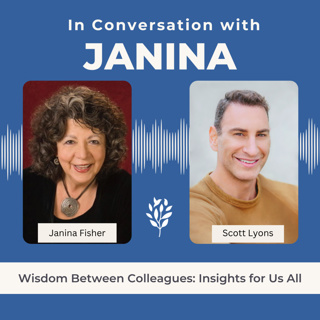
What If Calm Feels Worse Than Crisis?

What If Calm Feels Worse Than Crisis?

In this candid and thought-provoking episode of In Conversation with Janina Fisher, Janina sits down with somatic therapist, educator, and founder of The Embody Lab, Dr. Scott Lyons, for a wide-rangin...

15 Juli 40min

Your Left Brain Says You're Fine. Your Right Brain Knows You're Not.

Your Left Brain Says You're Fine. Your Right Brain Knows You're Not.

In this fascinating episode of In Conversation with Janina Fisher, Janina Fisher sits down with psychiatrist and neuroscientist Fredric Schiffer to explore a provocative question: can trauma be unders...

8 Juli 28min

Healing the World, Healing Ourselves

Healing the World, Healing Ourselves

In this timely and thought-provoking conversation, Janina Fisher sits down with somatic therapist, activist, author, and social change leader Staci Haines to explore the profound relationship between ...

30 Juni 31min

Populärt inom Hälsa

somna-med-henrik
rss-jossan-nina
inga-beiga-morsor
rss-bara-en-till-om-beroende-medberoende
rss-vuxna-pa-latsas
bullfika
not-fanny-anymore
rss-pappahjartat
johannes-hansen-podcast
rss-viktmedicinpodden
angestpodden
sexnoveller-deluxe
rss-i-skallen-pa
sa-in-i-sjalen
sova-med-dan-horning
rss-ronden
rss-traningsklubben
tyngre-traningssnack
rss-hos-psykologen
halsoveckan-by-tyngre