What Can No-Code Really Do With AI?

What Can No-Code Really Do With AI?

In this episode, the team discussed no-code and low-code solutions in AI, exploring their capabilities, limitations, and impact on various industries.

The discussion, including Brian, Jyunmi, Beth, Karl, Andy, and Robert, centered on how these tools democratize AI application development, enabling professionals from diverse backgrounds to create AI-powered solutions without deep coding knowledge.


Key Points Discussed

Defining No-Code and Low-Code: The discussion began with defining no-code and low-code platforms. No-code tools allow users to build applications and workflows without writing any code, while low-code platforms require minimal coding for more complex functionalities.


Impact of Large Language Models (LLMs): The advent of LLMs like GPT has significantly advanced no-code and low-code capabilities, enabling these platforms to understand various coding languages and generate code in response to textual inputs.


Business Applications: The team highlighted how no-code tools are being used in diverse fields such as marketing, to create email funnels and campaigns, showcasing the versatility of these platforms.


Challenges and Limitations: Despite the ease of use, no-code solutions may lack customization options. The team discussed the trade-off between speed, efficiency, and customization, emphasizing the need for a balance based on project requirements.


Future Prospects and Viability: The discussion also touched upon the future of no-code and low-code tools in the face of rapidly advancing AI capabilities. The team pondered whether existing tools should adapt to remain viable amidst AI's evolution.


Practical Advice for Businesses: The consensus was that businesses should start with no-code or low-code solutions for speed and cost-effectiveness but remain open to transitioning to coded solutions for more tailored requirements.


Action Steps for Business Professionals

Explore and Experiment: Business professionals should actively explore various no-code and low-code tools to understand their capabilities and limitations.

Balanced Approach: While embracing these tools for efficiency, remain mindful of the need for customization in certain scenarios.

Continuous Learning: Stay updated on the latest developments in no-code and low-code platforms and AI advancements to leverage them effectively in business strategies.

Problem-Solving Focus: Emphasize problem-solving skills and the ability to adapt solutions to specific business needs, whether through no-code, low-code, or traditional coding methods.


Conclusion

The episode emphasized the transformative potential of no-code and low-code solutions in AI, highlighting their role in making AI more accessible across industries.

While these tools offer significant advantages in terms of speed and ease of use, a balanced approach considering their limitations is crucial for optimal business outcomes.

The future of no-code and low-code in AI looks promising, with continuous advancements expected to further enhance their capabilities and applications.

Det här avsnittet är hämtat från ett öppet RSS-flöde och publiceras inte av Podme. Det kan innehålla reklam.

Avsnitt(875)

Chrome Wants To Be Your Next AI Agent

Chrome Wants To Be Your Next AI Agent

The episode opened with Google’s push to make Chrome an agentic hub. The hosts discussed Jacob Bank returning to Google after building Relay.app and what happens when the browser can work across tabs,...

26 Aug 1h 3min

Who Should You Trust to Teach You AI?

Who Should You Trust to Teach You AI?

The episode opened with Perplexity Deep Research suddenly behaving very differently from the product Brian had used for months. Instead of detailed research, it returned short answers, mixed old conve...

25 Aug 57min

Is the Backlash Against AI Data Centers Justified?

Is the Backlash Against AI Data Centers Justified?

The episode opened with a fact-check of claims defending the current AI data center buildout. Brian compared arguments about electricity prices, taxes and water use against research he had gathered, w...

24 Aug 1h
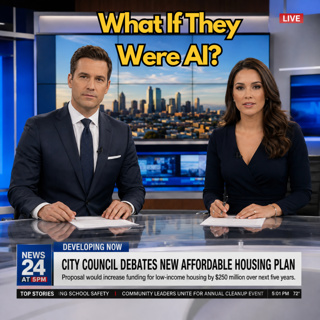
The Synthetic Anchor Conundrum

The Synthetic Anchor Conundrum

Mirage’s AI news experiment points to a version of media that does not need a studio, a broadcast schedule, or a human anchor reading from a desk. A channel can appear in a day. It can label synthetic...

22 Aug 29min

Should We Rebuild Work Around AI?

Should We Rebuild Work Around AI?

The episode opened with a practical warning for people building AI systems: timestamps and time zones can quietly break databases, automations and search tools. That led into Slack Code, a new collabo...

21 Aug 1h 7min

Is Grok Bot the Best AI Work Assistant?

Is Grok Bot the Best AI Work Assistant?

The episode opened with a hands-on comparison of Grokbot, Codex and Claude. Gareth found Grokbot strong for delegation, organization and everyday work, but weaker on difficult problem solving. The dis...

20 Aug 1h 3min

Do We Need to Rethink What Work Is?

Do We Need to Rethink What Work Is?

The episode opened with Apple Vision Pro being used to map a house while running Ethernet cable, letting a worker see marked locations through floors and walls. That led to a wider discussion about di...

19 Aug 1h

Are Custom GPTs Reaching the End?

Are Custom GPTs Reaching the End?

The episode opened with a practical example of how quickly AI coding agents are moving beyond software. Someone used Claude to write a Mac driver for an old Windows-only HP printer, leading to a wider...

18 Aug 50min

Populärt inom Teknik

uppgang-och-fall
market-makers
rss-elektrikerpodden
rss-laddstationen-med-elbilen-i-sverige
 och-bilen-gar-bra
skogsforum-podcast
natets-morka-sida
bli-saker-podden
rss-technokratin
rss-uppgang-och-fall
bilar-med-sladd
rss-veckans-ai
rss-fabriken-2
klocksnack-tillsammans-med-nymans-ur-1851
hej-bruksbil
rss-en-ai-till-kaffet
elbilsveckan
bosse-bildoktorn-och-hasse-p
ai-sweden-podcast
developers-mer-an-bara-kod