Inside Nvidia’s Nemotron Play, Real Agent Usage Data, and US Tech Force

Inside Nvidia’s Nemotron Play, Real Agent Usage Data, and US Tech Force

The DAS crew focused on Nvidia’s decision to open source its Nemotron model family, what that signals in the hardware and software arms race, and new research from Perplexity and Harvard analyzing how people actually use AI agents in the wild. The second half shifted into Google’s new Disco experiment, tab overload, agent driven interfaces, and a long discussion on the newly announced US Tech Force, including historical parallels, talent incentives, and skepticism about whether large government programs can truly attract top AI builders.


Key Points Discussed


Nvidia open sources the Nematron model family, spanning 30B to 500B parameters


Nematron Nano outperforms similar sized open models with much faster inference


Nvidia positions software plus hardware co design as its long term moat


Chinese open models continue to dominate open source benchmarks


Perplexity confirms use of Nematron models alongside proprietary systems


New Harvard and Perplexity paper analyzes over 100,000 agentic browser sessions


Productivity, learning, and research account for 57 percent of agent usage


Shopping and course discovery make up a large share of remaining queries


Users shift toward more cognitively complex tasks over time


Google launches Disco, turning related browser tabs into interactive agent driven apps


Disco aims to reduce tab overload and create task specific interfaces on the fly


Debate over whether apps are built for humans or agents going forward


Cursor moves parts of its CMS toward code first, agent friendly design


US Tech Force announced as a two year federal AI talent recruitment program


Program emphasizes portfolios over degrees and offers 150K to 200K compensation


Historical programs often struggled due to bureaucracy and cultural resistance


Panel debates whether elite AI talent will choose government over private sector roles


Concerns raised about branding, inclusion, and long term effectiveness of Tech Force


Timestamps and Topics


00:00:00 👋 Opening, host lineup, StreamYard layout issues

00:04:10 🧠 Nvidia Nematron open source announcement

00:09:30 ⚙️ Hardware software co design and TPU competition

00:15:40 📊 Perplexity and Harvard agent usage research

00:22:10 🛒 Shopping, productivity, and learning as top AI use cases

00:27:30 🌐 Open source model dominance from China

00:31:10 🧩 Google Disco overview and live walkthrough

00:37:20 📑 Tab overload, dynamic interfaces, and agent UX

00:43:50 🤖 Designing sites for agents instead of people

00:49:30 🏛️ US Tech Force program overview

00:56:10 📜 Degree free hiring, portfolios, and compensation

01:03:40 ⚠️ Historical failures of similar government tech programs

01:09:20 🧠 Inclusion, branding, and talent attraction concerns

01:16:30 🏁 Closing, community thanks, and newsletter reminders


The Daily AI Show Co Hosts: Brian Maucere, Andy Halliday, Anne Townsend, and Karl Yeh

Det här avsnittet är hämtat från ett öppet RSS-flöde och publiceras inte av Podme. Det kan innehålla reklam.

Avsnitt(890)

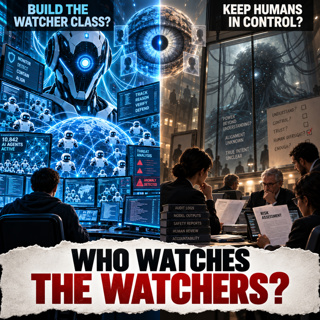
The Watcher-Class Conundrum

The Watcher-Class Conundrum

In OpenAI’s “An Alien Mind,” Jakub Pachocki describes advanced AI as something closer to a grown intellect than a designed machine. Large models emerge from repeated optimization over vast compute, th...

12 Sep 28min
Building An AI First Business -Brian's Demo

Building An AI First Business -Brian's Demo

The episode moved from AI security and platform changes into a live example of what an AI-first business can already look like. Anthropic’s new threat-intelligence report provided the opening story, d...

11 Sep 1h 14min

The Economics of Work In An Age of AI

The Economics of Work In An Age of AI

The episode centered on what happens to the economics of work as AI becomes capable of doing more of it. Anthropic’s new Economic Scenarios Explorer provided the starting point, allowing users to mode...

10 Sep 1h 6min

10,000 AI Agents Attack One Problem

10,000 AI Agents Attack One Problem

The episode opened with the dispute surrounding OpenAI’s newly announced mathematical result and what may be the more important story behind it. Tristan Buckmaster of NYU and Anthropic researcher Leve...

9 Sep 1h 3min

Our Real Atlas Builds and Use Cases

Our Real Atlas Builds and Use Cases

The episode moved quickly from theory to practical experience with GPT-6 Astra. After revisiting OpenAI’s “Alien Mind” paper and the conundrum of using more powerful AI to monitor frontier systems, th...

8 Sep 1h 5min

Can We Truly Control The Alien Mind?

Can We Truly Control The Alien Mind?

The episode focused heavily on GPT-6 Astra and a new essay from OpenAI chief scientist Jakub Pachocki describing advanced AI systems as increasingly alien forms of intelligence that humans grow throug...

7 Sep 54min

The Democratic Bandwidth Conundrum

The Democratic Bandwidth Conundrum

Public participation has always contained a hidden constraint: time.Writing a serious response to a tax rule, zoning plan, environmental permit, school policy, or agency proposal takes hours. Filing r...

5 Sep 28min

Is GPT-6 Astra the Biggest AI Leap Yet?

Is GPT-6 Astra the Biggest AI Leap Yet?

OpenAI’s GPT-6 Astra dominated the episode after its unusual rollout. The hosts discussed access, OpenAI’s plan to bring Astra to paid users, and why some cybersecurity users may receive capabilities ...

4 Sep 1h 1min

Populärt inom Teknik

uppgang-och-fall
elbilsveckan
market-makers
rss-elektrikerpodden
rss-laddstationen-med-elbilen-i-sverige
bilar-med-sladd
rss-en-ai-till-kaffet
rss-veckans-ai
gubbar-som-tjotar-om-bilar
natets-morka-sida
rss-technokratin
skogsforum-podcast
hej-bruksbil
bli-saker-podden
rss-uppgang-och-fall
rss-digitala-influencer-podden
developers-mer-an-bara-kod
rss-it-sakerhetspodden
rss-sakerhetspodcasten
rss-nytankarna