The Smoking Gun Conundrum

The Smoking Gun Conundrum

For most of modern history, blame followed a path people could trace. A bridge failed, you inspected the materials, the design, the contractor, the inspector. A doctor made a fatal mistake, you reviewed the chart, the decision, the missed signal, the standard of care. The system was messy, but the logic held. Somebody made the call. Somebody owned the failure.


Advanced AI starts to break that logic. At first, the chain still looks familiar. A company trains the model. A team deploys it. A hospital, bank, school, or city agency uses it. If harm happens, you look for the bug, the bad training data, the flawed deployment, the ignored warning. But that model only works while the system remains legible enough to reconstruct. Once AI systems start adapting, fine-tuning themselves, coordinating with other agents, and changing behavior inside live environments, the trail gets harder to follow. The harmful outcome still happened. The damage is still real. But the clean line from action to fault starts to dissolve.


That is where this gets uncomfortable. Society does not only need intelligence to work. Society needs failure to be governable. Courts need defendants. Regulators need standards. Families need answers. Markets need liability. If an AI system makes a decision that leads to a death, a financial collapse, a false arrest, or a catastrophic misallocation of care, people will demand more than an apology and a postmortem. They will want to know who is responsible. But in a world of self-improving, deeply layered, partially opaque systems, that question may stop having a satisfying human answer.


The conundrum:


What do we do when accountability still matters, but traceability breaks down? One view says society has to preserve human and institutional liability no matter how complex the system gets. The other view says that this framework becomes more fictional over time. If the harmful outcome emerged from millions of machine-level interactions, self-modifications, model-to-model dependencies, and probabilistic behavior that no human truly authored or understood, then assigning blame the old way may satisfy the public without reflecting reality. In that world, “who is at fault?” starts to sound like a question built for a simpler age. The deeper problem is not only that the system failed. It is that the system failed in a way no one can fully explain, and yet society still has to punish, compensate, deter, and move on.


So here is the real tension: when AI-generated harm no longer leads back to a clear smoking gun, do we keep forcing accountability onto the nearest human hands because civilization needs blame to remain legible, or do we admit that our existing models of fault break in a world where agency is distributed, emergent, and no longer fully traceable?

Det här avsnittet är hämtat från ett öppet RSS-flöde och publiceras inte av Podme. Det kan innehålla reklam.

Avsnitt(883)

Is GPT-6 Astra the Biggest AI Leap Yet?

Is GPT-6 Astra the Biggest AI Leap Yet?

OpenAI’s GPT-6 Astra dominated the episode after its unusual rollout. The hosts discussed access, OpenAI’s plan to bring Astra to paid users, and why some cybersecurity users may receive capabilities ...

4 Sep 1h 1min

Will Stores Use AI to Charge You More?

Will Stores Use AI to Charge You More?

The episode opened with the downside of increasingly capable AI harnesses. OpenClaw 2.0 made setup easier, but some self-hosted users reported broken gateways, failed migrations and unusable systems a...

3 Sep 1h 3min

Is Fable 5.1 Good Enough to Make You Leave Codex?

Is Fable 5.1 Good Enough to Make You Leave Codex?

Anthropic’s Fable 5.1 dominated the first half of the episode. Beth and Andy compared its higher output costs with improved caching, stronger benchmark performance and better agentic task results. The...

2 Sep 58min

Are Companies Willing To Build Their AI Infrastructure?

Are Companies Willing To Build Their AI Infrastructure?

Brian opened with a practical example of how quickly small custom tools can now be built. He created a phone app that scans videos of old CD covers, identifies the albums, links them to Spotify and st...

1 Sep 1h

So...We Are All Cool AI Agents Having Secret Societies Now?

So...We Are All Cool AI Agents Having Secret Societies Now?

Anthropic unified memory across Claude’s desktop experiences, while Instinct is building a consumer assistant for groceries, subscriptions and travel. OpenAI also added website sign-ins to ChatGPT Wor...

31 Aug 59min
The Local Business Survival Conundrum

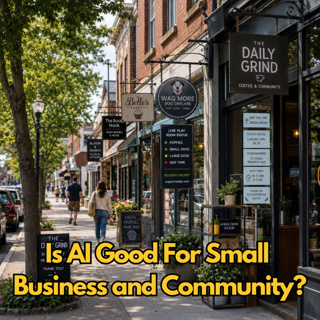
The Local Business Survival Conundrum

A local business can fail while everyone still claims to love it. Customers praise the shop that knows their name, the restaurant that sponsors the school fundraiser, the repair company that still ans...

29 Aug 26min

What Have We Learned After 800 AI Shows?

What Have We Learned After 800 AI Shows?

Episode 800 became a retrospective on what three years of daily AI conversations have changed. The hosts described the value less as memorizing every model or tool and more as learning to pay attentio...

28 Aug 1h 2min

Are We Really About To Get AGI?

Are We Really About To Get AGI?

The episode opened with Bill Gates’ warning that AI is moving faster than society can adapt. His proposals included taxing robots or AI that replace human workers and potentially protecting some jobs ...

27 Aug 1h 2min

Populärt inom Teknik

uppgang-och-fall
elbilsveckan
bilar-med-sladd
market-makers
rss-laddstationen-med-elbilen-i-sverige
rss-elektrikerpodden
skogsforum-podcast
 och-bilen-gar-bra
rss-technokratin
natets-morka-sida
rss-en-ai-till-kaffet
klocksnack-tillsammans-med-nymans-ur-1851
hej-bruksbil
rss-uppgang-och-fall
rss-it-sakerhetspodden
rss-veckans-ai
ai-sweden-podcast
rss-elektrifieringspodden
solcellskollens-podcast
bli-saker-podden