The Public Wealth Fund Conundrum

The Public Wealth Fund Conundrum

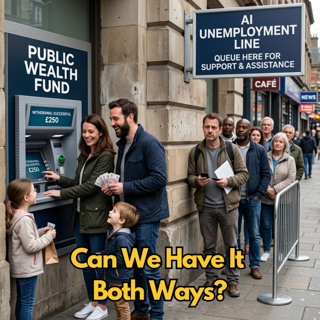
In its new paper, OpenAI floats a striking idea for the intelligence age: a Public Wealth Fund. The premise is simple. If advanced AI creates enormous economic gains, those gains should not flow only to founders, major firms, and investors. A public fund could give every citizen a direct stake in AI-driven growth, with returns distributed broadly rather than captured narrowly. Paper: At first glance, the idea feels like a serious answer to one of AI’s biggest political problems. If AI makes the economy more productive while also disrupting jobs, reshaping industries, and concentrating power, then a shared fund offers a new kind of social contract. If the country gets richer from AI, ordinary people should feel that wealth too. But the idea does more than spread money around. It changes the emotional and political relationship between the public and the system causing the disruption. Once your household, your retirement, or your community starts benefiting from AI-driven returns, automation no longer feels like something happening over there. It starts to feel like a system you are partly invested in.

That is where the deeper tension begins. A public dividend could make AI growth more legitimate and more broadly shared. But it could also make it harder to resist the damage AI causes, because the same system hollowing out a profession, reducing bargaining power, or thinning out a community is also sending value back to the public.


The Conundrum:

If AI wealth is widely shared through a public fund, society may finally solve one of the ugliest parts of technological change: a small group gets rich while everyone else is told to be patient. A shared dividend could make growth feel legitimate, reduce backlash, and give ordinary people a real stake in national prosperity.

But it could also weaken one of the few forces that still slows bad transitions down. If the public is paid from the upside of automation, then layoffs, institutional thinning, and regional decline become harder to oppose cleanly. The question is no longer just whether change is fair. It is whether people can still judge that change clearly once they are being compensated by it. If AI can make every citizen a shareholder in disruption, should we see that as long-overdue shared prosperity, or as a system that quietly buys away the pressure to challenge what automation is doing to public life?

Det här avsnittet är hämtat från ett öppet RSS-flöde och publiceras inte av Podme. Det kan innehålla reklam.

Avsnitt(879)

So...We Are All Cool AI Agents Having Secret Societies Now?

So...We Are All Cool AI Agents Having Secret Societies Now?

Anthropic unified memory across Claude’s desktop experiences, while Instinct is building a consumer assistant for groceries, subscriptions and travel. OpenAI also added website sign-ins to ChatGPT Wor...

31 Aug 59min
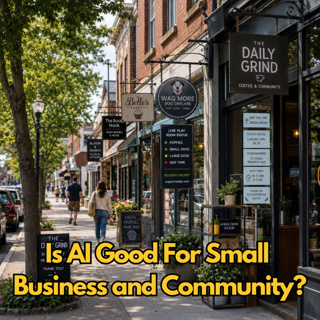
The Local Business Survival Conundrum

The Local Business Survival Conundrum

A local business can fail while everyone still claims to love it. Customers praise the shop that knows their name, the restaurant that sponsors the school fundraiser, the repair company that still ans...

29 Aug 26min

What Have We Learned After 800 AI Shows?

What Have We Learned After 800 AI Shows?

Episode 800 became a retrospective on what three years of daily AI conversations have changed. The hosts described the value less as memorizing every model or tool and more as learning to pay attentio...

28 Aug 1h 2min

Are We Really About To Get AGI?

Are We Really About To Get AGI?

The episode opened with Bill Gates’ warning that AI is moving faster than society can adapt. His proposals included taxing robots or AI that replace human workers and potentially protecting some jobs ...

27 Aug 1h 2min

Chrome Wants To Be Your Next AI Agent

Chrome Wants To Be Your Next AI Agent

The episode opened with Google’s push to make Chrome an agentic hub. The hosts discussed Jacob Bank returning to Google after building Relay.app and what happens when the browser can work across tabs,...

26 Aug 1h 3min

Who Should You Trust to Teach You AI?

Who Should You Trust to Teach You AI?

The episode opened with Perplexity Deep Research suddenly behaving very differently from the product Brian had used for months. Instead of detailed research, it returned short answers, mixed old conve...

25 Aug 57min

Is the Backlash Against AI Data Centers Justified?

Is the Backlash Against AI Data Centers Justified?

The episode opened with a fact-check of claims defending the current AI data center buildout. Brian compared arguments about electricity prices, taxes and water use against research he had gathered, w...

24 Aug 1h

The Synthetic Anchor Conundrum

The Synthetic Anchor Conundrum

Mirage’s AI news experiment points to a version of media that does not need a studio, a broadcast schedule, or a human anchor reading from a desk. A channel can appear in a day. It can label synthetic...

22 Aug 29min

Populärt inom Teknik

uppgang-och-fall
market-makers
rss-elektrikerpodden
skogsforum-podcast
rss-laddstationen-med-elbilen-i-sverige
natets-morka-sida
rss-technokratin
elbilsveckan
rss-en-ai-till-kaffet
 och-bilen-gar-bra
rss-veckans-ai
klocksnack-tillsammans-med-nymans-ur-1851
bilar-med-sladd
hej-bruksbil
bli-saker-podden
prova-programmering-av-distansakademin
rss-fabriken-2
rss-uppgang-och-fall
kodsnack
gubbar-som-tjotar-om-bilar