The Chosen Anomaly Conundrum

The Chosen Anomaly Conundrum

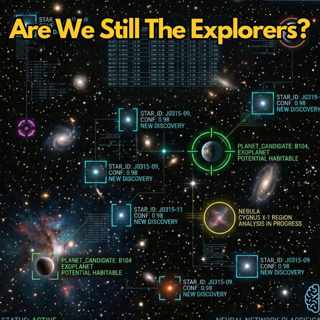
Space exploration has always depended on scarcity. There is never enough time, bandwidth, human attention, or instrument capacity to examine everything. That was manageable when the stream of possible discoveries was still small enough for scientists to review by hand. But that era is ending. Telescopes now generate oceans of data. Rovers see more terrain than teams on Earth can parse in real time. Future missions will only widen that gap.


AI looks like the obvious answer. It can scan signals, rank targets, flag strange patterns, and decide what deserves a closer look before the moment passes. Without that help, science teams risk drowning in their own data and missing discoveries simply because no human got to them in time. In that sense, AI does not just make exploration faster. It makes modern exploration possible.


But once AI becomes the system that filters what humans notice first, exploration starts to change in a subtler way. The universe we study is no longer just the universe our instruments capture. It is the universe that survives a machine’s first pass. That may be a huge advantage when the model catches weak patterns no person would have spotted. It may also mean the frontier gradually bends toward what machine systems are best at recognizing, while the truly strange, noisy, low-confidence anomalies get pushed aside because they look too messy to trust.


The conundrum:


If AI becomes the first judge of what in space deserves human attention, then the tradeoff is no longer just efficiency. It is about what kind of exploration we are willing to become.


One path says we should embrace that filter. Discovery at scale now depends on machine triage, and refusing it would mean letting extraordinary signals die unseen in overwhelming data. In that view, AI expands human curiosity by helping us notice more of the universe than we ever could alone.|


The other path says the cost is deeper than it appears. Some of the most important discoveries in history looked ambiguous, inconvenient, or easy to dismiss at first. If AI becomes the layer that decides what gets surfaced, then humanity may get better at finding the patterns it already knows how to value while getting worse at noticing the anomalies that force it to rethink reality.


So as exploration moves deeper into a universe too large for human attention alone, what should matter more: using AI to ensure we miss less, or protecting room for the kinds of strange signals that a machine might be least prepared to recognize?

Det här avsnittet är hämtat från ett öppet RSS-flöde och publiceras inte av Podme. Det kan innehålla reklam.

Avsnitt(879)

So...We Are All Cool AI Agents Having Secret Societies Now?

So...We Are All Cool AI Agents Having Secret Societies Now?

Anthropic unified memory across Claude’s desktop experiences, while Instinct is building a consumer assistant for groceries, subscriptions and travel. OpenAI also added website sign-ins to ChatGPT Wor...

31 Aug 59min
The Local Business Survival Conundrum

The Local Business Survival Conundrum

A local business can fail while everyone still claims to love it. Customers praise the shop that knows their name, the restaurant that sponsors the school fundraiser, the repair company that still ans...

29 Aug 26min

What Have We Learned After 800 AI Shows?

What Have We Learned After 800 AI Shows?

Episode 800 became a retrospective on what three years of daily AI conversations have changed. The hosts described the value less as memorizing every model or tool and more as learning to pay attentio...

28 Aug 1h 2min

Are We Really About To Get AGI?

Are We Really About To Get AGI?

The episode opened with Bill Gates’ warning that AI is moving faster than society can adapt. His proposals included taxing robots or AI that replace human workers and potentially protecting some jobs ...

27 Aug 1h 2min

Chrome Wants To Be Your Next AI Agent

Chrome Wants To Be Your Next AI Agent

The episode opened with Google’s push to make Chrome an agentic hub. The hosts discussed Jacob Bank returning to Google after building Relay.app and what happens when the browser can work across tabs,...

26 Aug 1h 3min

Who Should You Trust to Teach You AI?

Who Should You Trust to Teach You AI?

The episode opened with Perplexity Deep Research suddenly behaving very differently from the product Brian had used for months. Instead of detailed research, it returned short answers, mixed old conve...

25 Aug 57min

Is the Backlash Against AI Data Centers Justified?

Is the Backlash Against AI Data Centers Justified?

The episode opened with a fact-check of claims defending the current AI data center buildout. Brian compared arguments about electricity prices, taxes and water use against research he had gathered, w...

24 Aug 1h

The Synthetic Anchor Conundrum

The Synthetic Anchor Conundrum

Mirage’s AI news experiment points to a version of media that does not need a studio, a broadcast schedule, or a human anchor reading from a desk. A channel can appear in a day. It can label synthetic...

22 Aug 29min

Populärt inom Teknik

uppgang-och-fall
market-makers
rss-elektrikerpodden
skogsforum-podcast
natets-morka-sida
rss-laddstationen-med-elbilen-i-sverige
rss-technokratin
 och-bilen-gar-bra
elbilsveckan
rss-en-ai-till-kaffet
bli-saker-podden
klocksnack-tillsammans-med-nymans-ur-1851
rss-veckans-ai
bilar-med-sladd
hej-bruksbil
rss-uppgang-och-fall
rss-kack-tech-podcast
garagehang
rss-fabriken-2
prova-programmering-av-distansakademin