The Ambient Witness Conundrum

The Ambient Witness Conundrum

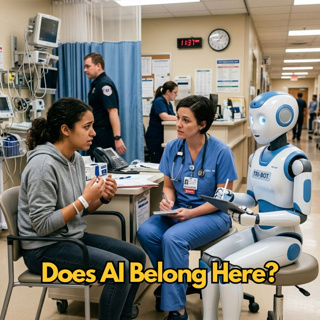
Medicine has always depended on observation. In an emergency department, being watched is part of being cared for. A nurse notices breathing, skin color, confusion, pain, panic, silence, or a family member saying something the patient forgot to mention. In that setting, attention is not intrusion by default. It is often the thing that keeps someone alive.

AI changes what observation becomes. A sentence that once disappeared after a nurse heard it can now be captured, processed, summarized, and placed into the medical record. A conversation that once helped one clinician understand one patient can become part of a larger operational system. That may help nurses spend less time typing and more time looking at patients. It may also make care more continuous, especially when shifts change and details get lost.

The old consent logic starts to break in the ER. A sign on the wall or an opt-out notice assumes people are calm enough to understand the tradeoff. Many are not. They are scared, sick, medicated, embarrassed, translating for a parent, trying to remember symptoms, or deciding what to say in front of a child. At the same time, stopping every clinical interaction to negotiate recording may slow down the very care people came to receive.

The Conundrum:

One side says hospitals should be allowed to make ambient AI listening a normal part of care, as long as the system is disclosed, secured, reviewed by clinicians, and limited to documentation or clinical use. The patient came to be observed. If a passing comment, a change in tone, or a repeated complaint helps staff understand what is happening, ignoring that signal can become its own kind of failure. In a crowded ER, privacy is not the only value at stake. Missed information has a cost too.

The other side says a hospital visit should still leave room for unrecorded speech. Patients and families say things in medical spaces that are raw, confused, legally sensitive, emotionally private, or simply human. If every word might become data, people may start managing themselves instead of speaking freely. Opting out also puts the burden on the person with the least power in the room, at the moment when they most need help.

Once AI turns bedside conversation into clinical infrastructure, what should carry more weight: the hospital’s duty to observe what might improve care, or the patient’s right to have some words disappear after they are spoken?

Det här avsnittet är hämtat från ett öppet RSS-flöde och publiceras inte av Podme. Det kan innehålla reklam.

Avsnitt(875)

Chrome Wants To Be Your Next AI Agent

Chrome Wants To Be Your Next AI Agent

The episode opened with Google’s push to make Chrome an agentic hub. The hosts discussed Jacob Bank returning to Google after building Relay.app and what happens when the browser can work across tabs,...

26 Aug 1h 3min

Who Should You Trust to Teach You AI?

Who Should You Trust to Teach You AI?

The episode opened with Perplexity Deep Research suddenly behaving very differently from the product Brian had used for months. Instead of detailed research, it returned short answers, mixed old conve...

25 Aug 57min

Is the Backlash Against AI Data Centers Justified?

Is the Backlash Against AI Data Centers Justified?

The episode opened with a fact-check of claims defending the current AI data center buildout. Brian compared arguments about electricity prices, taxes and water use against research he had gathered, w...

24 Aug 1h

The Synthetic Anchor Conundrum

The Synthetic Anchor Conundrum

Mirage’s AI news experiment points to a version of media that does not need a studio, a broadcast schedule, or a human anchor reading from a desk. A channel can appear in a day. It can label synthetic...

22 Aug 29min

Should We Rebuild Work Around AI?

Should We Rebuild Work Around AI?

The episode opened with a practical warning for people building AI systems: timestamps and time zones can quietly break databases, automations and search tools. That led into Slack Code, a new collabo...

21 Aug 1h 7min

Is Grok Bot the Best AI Work Assistant?

Is Grok Bot the Best AI Work Assistant?

The episode opened with a hands-on comparison of Grokbot, Codex and Claude. Gareth found Grokbot strong for delegation, organization and everyday work, but weaker on difficult problem solving. The dis...

20 Aug 1h 3min

Do We Need to Rethink What Work Is?

Do We Need to Rethink What Work Is?

The episode opened with Apple Vision Pro being used to map a house while running Ethernet cable, letting a worker see marked locations through floors and walls. That led to a wider discussion about di...

19 Aug 1h

Are Custom GPTs Reaching the End?

Are Custom GPTs Reaching the End?

The episode opened with a practical example of how quickly AI coding agents are moving beyond software. Someone used Claude to write a Mac driver for an old Windows-only HP printer, leading to a wider...

18 Aug 50min

Populärt inom Teknik

uppgang-och-fall
market-makers
rss-elektrikerpodden
rss-laddstationen-med-elbilen-i-sverige
 och-bilen-gar-bra
skogsforum-podcast
natets-morka-sida
bli-saker-podden
rss-technokratin
rss-uppgang-och-fall
bilar-med-sladd
rss-veckans-ai
rss-fabriken-2
klocksnack-tillsammans-med-nymans-ur-1851
hej-bruksbil
rss-en-ai-till-kaffet
elbilsveckan
bosse-bildoktorn-och-hasse-p
ai-sweden-podcast
developers-mer-an-bara-kod