
The AI Grid Conundrum

The AI Grid Conundrum

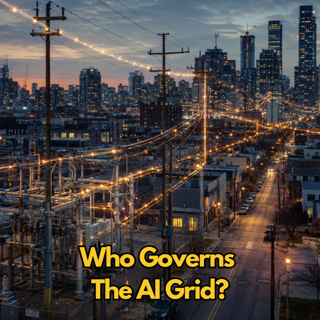
Electricity gives us a useful way to think about AI governance. Power is experienced locally. People care where the plant is built, how much the bill costs, who gets service restored first, and what risks their community absorbs. But electricity also depends on a grid that stretches beyond any one town or state. Local choices matter, yet no community can pretend the system ends at its border.


AI is beginning to take on that same shape. A school board may want one set of rules for student chatbots. A hospital network may need another for diagnostic tools. A state may want strict limits on automated hiring or child-facing AI companions. Those decisions are local in the sense that the harms are felt locally. But the systems underneath are rarely local. The same foundation models, cloud providers, data brokers, software vendors, and security standards may sit behind thousands of separate uses.


That creates a governance problem that neither side can solve cleanly. If every state or city writes its own AI rules, communities keep the power to respond to what they actually fear. They are not forced to accept a distant standard written for someone else’s politics, industries, or risk tolerance. But a patchwork can also make the system harder to inspect, harder to secure, and harder to trust. An AI tool used across hospitals, schools, banks, and employers may end up governed by dozens of overlapping rulebooks while the technical system underneath remains the same.


A single national framework has the opposite appeal. It could make audits clearer, liability easier, security stronger, and compliance less chaotic. But it could also erase the places where disagreement matters. Communities do not all face the same risks from AI, and they do not all define harm the same way. A clean grid can become a quiet transfer of power away from the people who live with the consequences.


The Conundrum:


As AI becomes more like infrastructure, should governance stay close to the communities that experience its harms, allowing different places to write different rules around schools, hospitals, policing, hiring, energy use, and children?


Or should AI be governed more like a national grid, with shared standards strong enough to keep a deeply connected system reliable, auditable, and secure, even when that means local communities lose some control over the systems shaping their lives?


When AI is experienced locally but built and operated through shared infrastructure, what deserves more weight: the legitimacy of local rulemaking, or the reliability of one common system?

Det här avsnittet är hämtat från ett öppet RSS-flöde och publiceras inte av Podme. Det kan innehålla reklam.

Avsnitt(872)

The Synthetic Anchor Conundrum

The Synthetic Anchor Conundrum

Mirage’s AI news experiment points to a version of media that does not need a studio, a broadcast schedule, or a human anchor reading from a desk. A channel can appear in a day. It can label synthetic...

22 Aug 29min

Should We Rebuild Work Around AI?

Should We Rebuild Work Around AI?

The episode opened with a practical warning for people building AI systems: timestamps and time zones can quietly break databases, automations and search tools. That led into Slack Code, a new collabo...

21 Aug 1h 7min

Is Grok Bot the Best AI Work Assistant?

Is Grok Bot the Best AI Work Assistant?

The episode opened with a hands-on comparison of Grokbot, Codex and Claude. Gareth found Grokbot strong for delegation, organization and everyday work, but weaker on difficult problem solving. The dis...

20 Aug 1h 3min

Do We Need to Rethink What Work Is?

Do We Need to Rethink What Work Is?

The episode opened with Apple Vision Pro being used to map a house while running Ethernet cable, letting a worker see marked locations through floors and walls. That led to a wider discussion about di...

19 Aug 1h

Are Custom GPTs Reaching the End?

Are Custom GPTs Reaching the End?

The episode opened with a practical example of how quickly AI coding agents are moving beyond software. Someone used Claude to write a Mac driver for an old Windows-only HP printer, leading to a wider...

18 Aug 50min

Are AI Harnesses the New AI Wrappers?

Are AI Harnesses the New AI Wrappers?

The episode opened with the reported Stripe acquisition of OpenRouter at a $7 billion valuation and questions about how OpenRouter’s business model supports that price. The conversation expanded into ...

17 Aug 58min

The Pool of One Conundrum

The Pool of One Conundrum

Insurance has always worked by not knowing. You paid into a pool with people you would never meet, and nobody could say which of you would be the one who burned, crashed, or got sick. Everyone paid fo...

15 Aug 23min

Can AI Solve the Energy Problem It Is Creating?

Can AI Solve the Energy Problem It Is Creating?

The episode opened with the growing power demands behind AI. The hosts discussed Nvidia, Google and Microsoft’s work on 800-volt DC power for data centers, which could reduce energy lost converting el...

14 Aug 58min

Populärt inom Teknik

uppgang-och-fall
market-makers
rss-elektrikerpodden
 och-bilen-gar-bra
rss-laddstationen-med-elbilen-i-sverige
bli-saker-podden
rss-technokratin
rss-en-ai-till-kaffet
rss-uppgang-och-fall
skogsforum-podcast
hej-bruksbil
gubbar-som-tjotar-om-bilar
bilar-med-sladd
rss-milpodden
natets-morka-sida
klocksnack-tillsammans-med-nymans-ur-1851
rss-fabriken-2
rss-veckans-ai
elbilsveckan
developers-mer-an-bara-kod