The Relief Trap Conundrum

The Relief Trap Conundrum

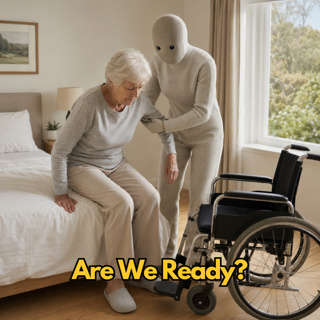
The first useful elder-care robots will probably look like a helper.


They will lift a parent from bed at 2:13 in the morning. They will steady a walker, fetch a dropped phone, sort pills, warm soup, change sheets, wipe a counter, open a jar, and notice that a gait has changed. Recent robotics demos already point in that direction: more humanlike hands, better grip, safer motion, and general-purpose machines beginning to handle physical tasks that used to require trained human bodies.


When these competent AI robots reach mainstream, they have the ability to directly impact the family care dynamic. A daughter with a job and children of her own may love her father and still dread the next fall. A spouse may want to keep a wife at home and still be destroyed by years of broken sleep. Adult siblings may argue less about love than about logistics: who drives, who pays, who calls the doctor, who takes the overnight shift, who gets to keep their own life.


A capable care robot changes that burden. It can make home care safer, less humiliating, and less physically punishing. It can let family members arrive less exhausted and more emotionally available. But it can also make absence feel responsible. The app says medication was taken. The robot says lunch was eaten. The fall alert never came. The family can tell itself the person is cared for, while slowly visiting less, calling less, and seeing less.


The Conundrum:


The real question is not whether families should use humanoid robots in elder care. Most will, once the machines are useful enough and affordable enough. Refusing help will look noble in theory and unbearable in practice.


The harder question is whether robot-assisted relief should change what families still owe.


One side says yes. If a robot can handle the draining work, families should be allowed to step back without shame. Love should not require physical collapse. No one should have to prove devotion by losing sleep, risking injury, or turning every visit into a shift. A robot that handles the hard routine may preserve relationships that caregiving would otherwise poison. It may let a son be a son again instead of a resentful night nurse.


The other side says relief can become a quiet moral anesthetic. Once the robot handles the visible tasks, family members may stop confronting decline directly. They may miss the fear in a parent’s face, the confusion that does not trigger an alert, the loneliness hidden under clean clothes and completed meals. The robot does not need denial, but families do. A dashboard can become the story people tell themselves so they do not have to look too closely.


So when humanoid robots make elder care safer, easier, and less humiliating, should families accept that relief as a legitimate release from daily obligation? Or does responsibility require some form of continued presence precisely because the machine makes it easier to disappear?


At what point does help stop protecting the caregiver and start protecting the family from the emotional weight of being there?

Det här avsnittet är hämtat från ett öppet RSS-flöde och publiceras inte av Podme. Det kan innehålla reklam.

Avsnitt(871)

Should We Rebuild Work Around AI?

Should We Rebuild Work Around AI?

The episode opened with a practical warning for people building AI systems: timestamps and time zones can quietly break databases, automations and search tools. That led into Slack Code, a new collabo...

21 Aug 1h 7min

Is Grok Bot the Best AI Work Assistant?

Is Grok Bot the Best AI Work Assistant?

The episode opened with a hands-on comparison of Grokbot, Codex and Claude. Gareth found Grokbot strong for delegation, organization and everyday work, but weaker on difficult problem solving. The dis...

20 Aug 1h 3min

Do We Need to Rethink What Work Is?

Do We Need to Rethink What Work Is?

The episode opened with Apple Vision Pro being used to map a house while running Ethernet cable, letting a worker see marked locations through floors and walls. That led to a wider discussion about di...

19 Aug 1h

Are Custom GPTs Reaching the End?

Are Custom GPTs Reaching the End?

The episode opened with a practical example of how quickly AI coding agents are moving beyond software. Someone used Claude to write a Mac driver for an old Windows-only HP printer, leading to a wider...

18 Aug 50min

Are AI Harnesses the New AI Wrappers?

Are AI Harnesses the New AI Wrappers?

The episode opened with the reported Stripe acquisition of OpenRouter at a $7 billion valuation and questions about how OpenRouter’s business model supports that price. The conversation expanded into ...

17 Aug 58min

The Pool of One Conundrum

The Pool of One Conundrum

Insurance has always worked by not knowing. You paid into a pool with people you would never meet, and nobody could say which of you would be the one who burned, crashed, or got sick. Everyone paid fo...

15 Aug 23min

Can AI Solve the Energy Problem It Is Creating?

Can AI Solve the Energy Problem It Is Creating?

The episode opened with the growing power demands behind AI. The hosts discussed Nvidia, Google and Microsoft’s work on 800-volt DC power for data centers, which could reduce energy lost converting el...

14 Aug 58min

Is Grok 4.6 Changing the Economics of AI Agents?

Is Grok 4.6 Changing the Economics of AI Agents?

The episode opened with Grok 4.6, which reportedly moved close to Claude Opus 5 and GPT-5.6 Sol on Artificial Analysis benchmarks while offering lower costs and stronger efficiency on long-running age...

14 Aug 1h 5min

Populärt inom Teknik

uppgang-och-fall
market-makers
rss-elektrikerpodden
rss-laddstationen-med-elbilen-i-sverige
skogsforum-podcast
rss-en-ai-till-kaffet
 och-bilen-gar-bra
rss-uppgang-och-fall
hej-bruksbil
gubbar-som-tjotar-om-bilar
bosse-bildoktorn-och-hasse-p
under-femton
bilar-med-sladd
klocksnack-tillsammans-med-nymans-ur-1851
garagehang
bli-saker-podden
rss-veckans-ai
elbilsveckan
rss-milpodden
natets-morka-sida