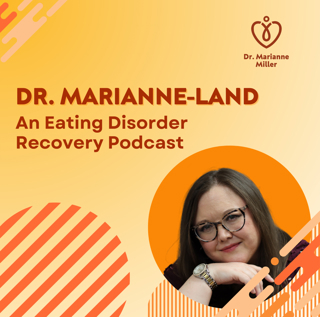
Why Lived Experience Matters in Anorexia & Bulimia Recovery for Neurodivergent People: 5 Things I've Learned as Both a Therapist & Someone in Recovery

Why Lived Experience Matters in Anorexia & Bulimia Recovery for Neurodivergent People: 5 Things I've Learned as Both a Therapist & Someone in Recovery

Does it matter whether your eating disorder therapist has personally recovered from anorexia or bulimia?

In this solo episode of Dr. Marianne-Land, I explore that question from two perspectives: as an eating disorder therapist and as someone who spent about 25 years navigating anorexia, binge eating, orthorexia, bulimia, compulsive exercise, and the long road to recovery.

Lived experience does not replace professional training, and professional training does not require lived experience. Both forms of knowledge have value. In this episode, I share how my personal recovery has shaped my clinical work and why that perspective can be especially meaningful for autistic people, ADHDers, AuDHDers, and other neurodivergent adults recovering from anorexia and bulimia.

What You'll Learn

You'll hear five lessons that have transformed the way I understand eating disorder recovery. We discuss why what appears to be resistance is often nervous system overwhelm, how to tell the difference between neurodivergent traits and eating disorder symptoms, why shame rarely creates lasting recovery, how safety supports sustainable healing, and why recovery ultimately becomes about building a meaningful life instead of simply eliminating symptoms.

Why Neurodivergent People Often Need a Different Recovery Conversation

Traditional eating disorder treatment does not always account for sensory processing differences, executive functioning challenges, autistic burnout, ADHD, interoceptive differences, or the ways trauma and neurodivergence can intersect with anorexia and bulimia.

In this episode, I explain why understanding your nervous system can make recovery feel more compassionate, more realistic, and more sustainable. Rather than forcing yourself to fit a rigid recovery model, you can begin building an approach that respects both your neurodivergence and your recovery goals.

Who This Episode Is For

This episode is for adults recovering from anorexia nervosa, atypical anorexia, bulimia nervosa, chronic eating disorders, or long-term restrictive eating. It's also for autistic adults, ADHDers, AuDHD adults, highly sensitive people, therapists, dietitians, parents, caregivers, and anyone who wants a deeper understanding of neurodivergent-affirming eating disorder treatment.

Mentioned in This Episode

If you want to learn more about sensory processing, autonomy, nervous system regulation, and neurodivergent-affirming approaches to eating, check out my ARFID and Selective Eating Course. Although the course focuses on ARFID, many of the concepts also apply to neurodivergent people recovering from anorexia, bulimia, and other eating disorders.

Related Episodes

Harm Reduction for Eating Disorders: How Lived Experience Shapes Recovery, Support, & Long-Term Healing on Apple & Spotify.

Lived Experience of ARFID in Autistics & ADHDers: Sensory Survival & Misunderstandings With Dr. Panicha McGuire, LMFT, RPT on Apple & Spotify.

Unmasking in Eating Disorder Recovery: What Neurodivergent People Need to Know About Safety & Healing via Apple & Spotify.

Connect With Dr. Marianne Miller

If you're looking for eating disorder therapy in California or Washington, D.C., or eating disorder coaching from anywhere in the world, I'd love to help. I specialize in anorexia, bulimia, ARFID, binge eating disorder, autism, ADHD, AuDHD, and neurodivergent-affirming eating disorder treatment.

Visit www.drmariannemiller.com to learn more about working with me, explore my ARFID course, and listen to more episodes of Dr. Marianne-Land.

If you found this episode helpful, please follow the podcast, leave a rating or review on Apple Podcasts or on Spotify, and share it with someone who could benefit from hearing that recovery does not have to look the same for everyone.

Det här avsnittet är hämtat från ett öppet RSS-flöde och publiceras inte av Podme. Det kan innehålla reklam.

Avsnitt(350)

Eating Disorders in Midlife: Rebuilding Trust With Food & Your Body With Amber Caudle

Eating Disorders in Midlife: Rebuilding Trust With Food & Your Body With Amber Caudle

Binge eating recovery requires more than changing what or how you eat. Chef, eating psychology coach, and author Amber Caudle joins Dr. Marianne to discuss her 30-year struggle with binge eating, rest...

21 Sep 33min

ARFID & PDA: Why Eating Can Feel Like a Demand Even When No One Is Pressuring You

ARFID & PDA: Why Eating Can Feel Like a Demand Even When No One Is Pressuring You

ARFID and PDA can make eating feel difficult even when no one is telling you what, when, or how much to eat. For autistic and neurodivergent people with Avoidant/Restrictive Food Intake Disorder (ARFI...

18 Sep 15min

Tradwives, Disordered Eating, & the Thin Ideal: Why Young Women Are Being Told to Shrink Again

Tradwives, Disordered Eating, & the Thin Ideal: Why Young Women Are Being Told to Shrink Again

Tradwife culture is having a moment, but what happens when traditional femininity, purity culture, the thin ideal, and disordered eating begin to overlap? In this SOLO episode, Dr. Marianne Miller exa...

16 Sep 20min

Is Eating Disorder Recovery a Form of Neurodivergence? Diet Culture, Hunger, & Body Trust With Shira Collings, LPC

Is Eating Disorder Recovery a Form of Neurodivergence? Diet Culture, Hunger, & Body Trust With Shira Collings, LPC

Eating disorder recovery often requires developing a relationship with food, hunger, movement, and body size that differs sharply from what society considers “normal.” In this conversation, Dr. Marian...

14 Sep 27min

Autism, Food Rigidity, & Eating Disorders: How Autistic Traits Can Help & Hinder Recovery

Autism, Food Rigidity, & Eating Disorders: How Autistic Traits Can Help & Hinder Recovery

Autism and eating disorders can create a complicated relationship with food rigidity, routines, sensory needs, and predictability. For autistic people recovering from anorexia, ARFID, bulimia, or othe...

11 Sep 19min

Why Is Eating Disorder Recovery So Scary? Understanding Fear, Safety, & Letting Go

Why Is Eating Disorder Recovery So Scary? Understanding Fear, Safety, & Letting Go

Eating disorder recovery can feel surprisingly scary, even when you genuinely want to get better. Letting go of restriction, binge eating, purging, compulsive exercise, food rules, or body checking ca...

9 Sep 15min

How to Help Your Child With an Eating Disorder: Replacing Control With Connection With Dr. Tom Wooldridge

How to Help Your Child With an Eating Disorder: Replacing Control With Connection With Dr. Tom Wooldridge

Supporting a child or teen with an eating disorder can leave parents caught between the urgency to help them eat and the fear that increasing control will create more conflict around food. In this epi...

7 Sep 32min

Anorexia & Binge Eating: The Binge-Restrict Cycle in Long-Term Eating Disorder Recovery

Anorexia & Binge Eating: The Binge-Restrict Cycle in Long-Term Eating Disorder Recovery

Can you have anorexia and struggle with binge eating, too? If you find yourself moving between food restriction and binge eating, you may wonder whether your eating disorder has changed or whether you...

4 Sep 10min
Populärt inom Hälsa

somna-med-henrik
rss-jossan-nina
inga-beiga-morsor
rss-vuxna-pa-latsas
rss-bara-en-till-om-beroende-medberoende
johannes-hansen-podcast
rss-viktmedicinpodden
not-fanny-anymore
angestpodden
sexnoveller-deluxe
sa-in-i-sjalen
bullfika
rss-ronden
sova-med-dan-horning
rss-pappahjartat
rss-traningsklubben
tyngre-traningssnack
rss-basta-livet
halsoveckan-by-tyngre
rss-hos-psykologen