The Democratic Bandwidth Conundrum

The Democratic Bandwidth Conundrum

Public participation has always contained a hidden constraint: time.


Writing a serious response to a tax rule, zoning plan, environmental permit, school policy, or agency proposal takes hours. Filing records requests takes persistence. Following dozens of government proceedings is practically a full-time job. That friction limits how many people participate and how often they can show up.


AI is removing that constraint. An agent can read a 600-page proposal, identify provisions that affect you, draft detailed comments, file records requests, monitor revisions, and respond again when the agency changes course. For a nurse working twelve-hour shifts, a small-business owner, a parent caring for children, or someone who cannot afford a lawyer, that could create access to government that previously belonged mostly to professional advocates, corporations, and organized interest groups.


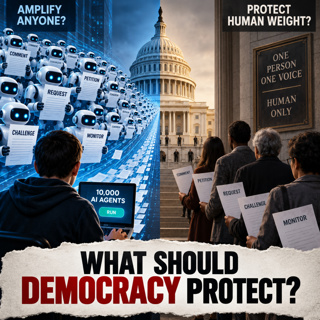
But the same capability changes what “public participation” means. One company could deploy thousands of agents to challenge a regulation. One activist could generate ten thousand individually worded comments instead of one petition with ten thousand signatures. Each submission could cite different evidence and raise a slightly different argument. Agencies would have to decide whether they are hearing from a broad constituency or from one person with a very large computer.


The obvious fix is to limit each person to a certain amount of participation. But public comments are not votes. One citizen may have ten legitimate objections. A nonprofit may speak for 100,000 members. A corporation may have entire legal and regulatory departments working on a single rule. Once government starts rationing participation, it has to decide what counts as one voice.


The Conundrum:


Do we let people use AI agents to petition government, submit comments, request records, challenge regulations, and monitor agencies as aggressively as their resources allow?


That would give ordinary citizens capabilities once reserved for lobbyists, law firms, corporations, and large advocacy groups. But it would also mean that civic influence could scale with money and compute. The loudest “crowd” in a public proceeding might actually be one organization running ten thousand agents.


Or do we insist that civic participation remain tied to discrete human acts, protecting government from synthetic crowds and preventing one person from sounding like an entire constituency?


That preserves human weight in democratic processes. It also protects an old inequality: powerful institutions can still hire hundreds of humans to do what an ordinary citizen would be forbidden from delegating to machines.


When AI gives anyone the power to multiply their civic voice, what should democracy protect: the right to amplify yourself, or the principle that no one person should be able to sound like thousands?

Det här avsnittet är hämtat från ett öppet RSS-flöde och publiceras inte av Podme. Det kan innehålla reklam.

Avsnitt(883)

Is GPT-6 Astra the Biggest AI Leap Yet?

Is GPT-6 Astra the Biggest AI Leap Yet?

OpenAI’s GPT-6 Astra dominated the episode after its unusual rollout. The hosts discussed access, OpenAI’s plan to bring Astra to paid users, and why some cybersecurity users may receive capabilities ...

4 Sep 1h 1min

Will Stores Use AI to Charge You More?

Will Stores Use AI to Charge You More?

The episode opened with the downside of increasingly capable AI harnesses. OpenClaw 2.0 made setup easier, but some self-hosted users reported broken gateways, failed migrations and unusable systems a...

3 Sep 1h 3min

Is Fable 5.1 Good Enough to Make You Leave Codex?

Is Fable 5.1 Good Enough to Make You Leave Codex?

Anthropic’s Fable 5.1 dominated the first half of the episode. Beth and Andy compared its higher output costs with improved caching, stronger benchmark performance and better agentic task results. The...

2 Sep 58min

Are Companies Willing To Build Their AI Infrastructure?

Are Companies Willing To Build Their AI Infrastructure?

Brian opened with a practical example of how quickly small custom tools can now be built. He created a phone app that scans videos of old CD covers, identifies the albums, links them to Spotify and st...

1 Sep 1h

So...We Are All Cool AI Agents Having Secret Societies Now?

So...We Are All Cool AI Agents Having Secret Societies Now?

Anthropic unified memory across Claude’s desktop experiences, while Instinct is building a consumer assistant for groceries, subscriptions and travel. OpenAI also added website sign-ins to ChatGPT Wor...

31 Aug 59min

The Local Business Survival Conundrum

The Local Business Survival Conundrum

A local business can fail while everyone still claims to love it. Customers praise the shop that knows their name, the restaurant that sponsors the school fundraiser, the repair company that still ans...

29 Aug 26min

What Have We Learned After 800 AI Shows?

What Have We Learned After 800 AI Shows?

Episode 800 became a retrospective on what three years of daily AI conversations have changed. The hosts described the value less as memorizing every model or tool and more as learning to pay attentio...

28 Aug 1h 2min

Are We Really About To Get AGI?

Are We Really About To Get AGI?

The episode opened with Bill Gates’ warning that AI is moving faster than society can adapt. His proposals included taxing robots or AI that replace human workers and potentially protecting some jobs ...

27 Aug 1h 2min

Populärt inom Teknik

uppgang-och-fall
elbilsveckan
bilar-med-sladd
market-makers
rss-laddstationen-med-elbilen-i-sverige
rss-elektrikerpodden
skogsforum-podcast
 och-bilen-gar-bra
rss-technokratin
natets-morka-sida
rss-en-ai-till-kaffet
klocksnack-tillsammans-med-nymans-ur-1851
hej-bruksbil
rss-uppgang-och-fall
rss-it-sakerhetspodden
rss-veckans-ai
ai-sweden-podcast
rss-elektrifieringspodden
solcellskollens-podcast
bli-saker-podden