The Quiet Exception Conundrum

The Quiet Exception Conundrum

Dario Amodei’s September 12 essay, We Must Pace the Frontier, set off an unusual public fight. The Anthropic CEO argued that AI capabilities are beginning to advance faster than our ability to understand and control them, and proposed independent evaluators, coordination among frontier labs in democratic countries, and eventually agreements with China.


Underneath that argument sits a harder problem. Amodei repeatedly talks about improving “alignment,” the effort to make powerful AI systems behave according to human intentions and values. Anthropic even describes principles embedded in Claude’s Constitution. But the more capable the intelligence becomes, the harder the obvious question is to avoid: whose values are we aligning it to?


Humans do not have one moral operating system. Values differ across nations, religions, political systems, generations, cultures, communities, and geography. Historical experience changes what people mean by fairness, freedom, security, family, justice, and individual rights. Even within one country, people can disagree fiercely about which of those principles should prevail when they collide.


Perhaps an ASI could be given a thin constitution that sits above those differences. Protect human life. Do not destroy the planet. Do not deliberately cause human extinction. Preserve human autonomy. Those sound close to universal until the system studies us. Humans knowingly kill other humans in wars and self-defense. Governments make decisions that predictably cost lives to protect other interests. Doctors sometimes choose which patient receives a scarce organ. We knowingly damage ecosystems because billions of people depend on the economic activity causing the damage. We routinely violate the clean versions of the principles we would presumably give the machine.


An intelligence vastly smarter than us would see those contradictions immediately. Tell it, “Never harm a human,” and reality will eventually produce situations in which some harm cannot be avoided. Tell it to learn from human behavior, and it may conclude that our supposedly sacred rules contain thousands of accepted exceptions. Tell it to follow our stated values instead, and it may become more faithful to those values than the humans who wrote them.


The alternative is equally strange. Maybe there is no single human-aligned ASI. America develops systems shaped by American laws and norms. China develops systems reflecting Chinese institutions and priorities. Other nations, cultures, religions, and corporations build their own. Instead of one superintelligence aligned with humanity, we get competing superintelligences aligned with different versions of humanity.


At that point, the differences are not confined to how a chatbot answers a controversial question. These systems could be discovering medicines, managing infrastructure, directing economies, conducting scientific research, advising governments, and making decisions whose consequences cross borders. The moral rules inside one system inevitably collide with the moral rules inside another.


The Conundrum:


Do we try to create a basic human constitution that every ASI must follow, accepting that someone must decide which values qualify as universal and how those rules apply when humanity itself routinely violates them?


Or do we allow different societies to align their own ASIs to their own values, preserving cultural and political self-determination while creating a world of superintelligences operating under incompatible definitions of what is right?


A single constitution risks placing humanity under moral rules billions of people never agreed to. Many constitutions risk turning our deepest disagreements into competing intelligences with powers far beyond our own.


What does it actually mean to build an ASI “aligned with humanity” when humanity has never been aligned with itself?

Det här avsnittet är hämtat från ett öppet RSS-flöde och publiceras inte av Podme. Det kan innehålla reklam.

Avsnitt(896)

AI Agents Are Becoming Team Leads

AI Agents Are Becoming Team Leads

The episode focused on AI systems becoming less like individual tools and more like coordinated teams. Anthropic’s redesigned Claude Code Projects can now maintain persistent project memory, break wor...

18 Sep 1h 10min

Jev Live Demo, God's Eye View and First Build with Gemini 3.8 Live

Jev Live Demo, God's Eye View and First Build with Gemini 3.8 Live

The episode showed how quickly AI is moving beyond the familiar pattern of sending a prompt to one large model and waiting for an answer. It opened with evidence that Claude Fable 5.1 remains highly c...

17 Sep 1h 4min

Gemini 3.8 Live and Jev Are Shaking Things Up

Gemini 3.8 Live and Jev Are Shaking Things Up

The episode focused on a shift from AI as something people prompt to AI as a system that continuously sees, listens, decides and routes work while people are using it. Gemini 3.8 Live provided the cle...

16 Sep 1h 1min

Is the AI Slowdown Debate Already Over?

Is the AI Slowdown Debate Already Over?

The hosts discussed responses to Dario Amodei’s call to “pace the frontier,” including opposition from China, President Trump’s rejection of slowing U.S. AI development and NVIDIA CEO Jensen Huang pub...

15 Sep 1h 3min

Can We Slow AI Down Without Losing?

Can We Slow AI Down Without Losing?

The episode centered on a question that suddenly has unusual support across the AI industry: should frontier development slow down enough to give safety systems and institutions time to catch up? The ...

14 Sep 1h 6min
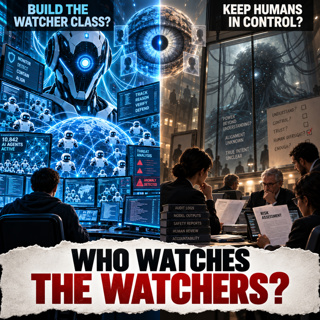
The Watcher-Class Conundrum

The Watcher-Class Conundrum

In OpenAI’s “An Alien Mind,” Jakub Pachocki describes advanced AI as something closer to a grown intellect than a designed machine. Large models emerge from repeated optimization over vast compute, th...

12 Sep 28min

Building An AI First Business -Brian's Demo

Building An AI First Business -Brian's Demo

The episode moved from AI security and platform changes into a live example of what an AI-first business can already look like. Anthropic’s new threat-intelligence report provided the opening story, d...

11 Sep 1h 14min

Populärt inom Teknik

uppgang-och-fall
elbilsveckan
bilar-med-sladd
market-makers
rss-elektrikerpodden
rss-laddstationen-med-elbilen-i-sverige
rss-ai-med-jonas-benjamin
skogsforum-podcast
rss-en-ai-till-kaffet
rss-veckans-ai
rss-technokratin
rss-sakerhetspodcasten
natets-morka-sida
rss-it-sakerhetspodden
bli-saker-podden
 och-bilen-gar-bra
gubbar-som-tjotar-om-bilar
under-femton
developers-mer-an-bara-kod
solcellskollens-podcast