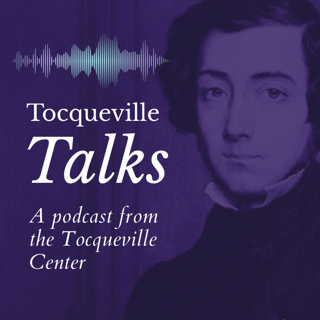
31. Finland's President Alexander Stubb on Political Philosophy, Power & a World in Transition

31. Finland's President Alexander Stubb on Political Philosophy, Power & a World in Transition

What can political philosophy teach a president about leadership, power, and a changing international order?

In this episode of Tocqueville Talks, Alexander Stubb, President of the Republic of Finland, joins Tocqueville Center Director Brent Nelsen and Beth L'Arrivée for a conversation about political philosophy, European and international affairs, liberal education, technology, and the ideas that have shaped his approach to political leadership.

Stubb's intellectual path began in an important way at Furman University. Long before becoming Finland's president—and after a career that has included academia and senior positions in Finnish and European politics—he was a Furman political science student encountering international relations and the great texts of political thought.

Stubb reflects on how that education helped shape his commitment to open societies, democracy, constitutional government, the rule of law, and international cooperation. He discusses thinkers including Plato, Aristotle, Hobbes, Machiavelli, and especially John Locke, whose Second Treatise of Government helped reinforce his understanding of liberal democracy and constitutional government.

But what happens when political philosophy encounters political reality?

Stubb emphasizes the limits as well as the importance of theory. Politics ultimately involves human beings: personality, relationships, emotion, judgment, and circumstances that cannot be captured fully by theoretical models.

That tension leads to one of the central ideas of his approach to international affairs: values-based realism.

Stubb describes the challenge of holding together two demands. Democratic countries should remain committed to values such as freedom, equality, justice, human rights, democracy, and the rule of law. At the same time, international politics requires dealing with states that may not share those principles. Foreign policy therefore requires both a commitment to values and a realistic understanding of interests, power, and political circumstances.

The conversation also turns toward education and human flourishing. Stubb reflects on Finland's relationship with nature, the connection between physical and intellectual life, and the importance of sustained reading. Drawing on Neil Postman's Amusing Ourselves to Death, he considers whether social media, smartphones, and artificial intelligence are weakening our capacity for sustained attention—or whether technology can instead be used as an instrument for deeper thought.

Finally, Stubb reflects on the changing international system. The period that followed the end of the Cold War, he argues, is coming to an end. But rather than claiming that a clearly defined new order has already arrived, he emphasizes that we are living through a period of transition whose outcome remains unsettled.

For Stubb, that uncertainty also creates a responsibility for the next generation. Today's students will not merely inherit the world that follows the post-Cold War era; they will help shape it.

At its heart, the conversation asks:

How can political leaders remain committed to democratic principles while confronting the realities of power in a changing world?

Det här avsnittet är hämtat från ett öppet RSS-flöde och publiceras inte av Podme. Det kan innehålla reklam.

Avsnitt(31)

30. Why College Should Challenge What You Believe | Tocqueville Fellows on Learning to Disagree

30. Why College Should Challenge What You Believe | Tocqueville Fellows on Learning to Disagree

What if the purpose of college isn't to confirm what you believe—but to teach you how to question it?In this episode of Tocqueville Talks, Furman University students Laura Grace McSwain and Liza Sherb...

21 Sep 22min

29. The Big Questions Facing American Democracy | Tocqueville Talks 2026–27 Preview

29. The Big Questions Facing American Democracy | Tocqueville Talks 2026–27 Preview

What are the biggest questions facing American democracy—and how can universities create spaces where they are seriously debated?In this season-opening episode of Tocqueville Talks, Tocqueville Center...

10 Sep 30min

28. Why Americans Are So Patriotic | Tocqueville's Surprising Answer

28. Why Americans Are So Patriotic | Tocqueville's Surprising Answer

Why does patriotism seem so powerful in America—and what happens when it begins to disappear?As Americans celebrate the nation's 250th anniversary, Alexis de Tocqueville's reflections on patriotism ma...

10 Juli 23min

27. Why the Old Political Order Is Cracking | Populism, MAGA, and the Future of Democracy

27. Why the Old Political Order Is Cracking | Populism, MAGA, and the Future of Democracy

For generations, politics in Europe and America was dominated by large, stable political parties. Today, those old political alignments are breaking down.Why are voters abandoning established parties?...

3 Juli 35min

26. What Swimming Can Teach Us About Democracy | Tocqueville's Forgotten Insight

26. What Swimming Can Teach Us About Democracy | Tocqueville's Forgotten Insight

What can a neighborhood swim league teach us about democracy?More than you might think.When Alexis de Tocqueville visited America in 1831, he was astonished by what he called associations—ordinary cit...

25 Juni 41min

25. Is the Postwar Order Ending? Europe, Trump, Ukraine, and the Future of the West — Eleanor Beardsley

25. Is the Postwar Order Ending? Europe, Trump, Ukraine, and the Future of the West — Eleanor Beardsley

For eighty years, Europe and the United States built a common political, economic, and military order.Today, many Europeans wonder whether that world is ending.In this episode of Tocqueville Talks, Br...

18 Juni 27min

24. Why Everything Feels Increasingly Unreal — Beth and Rob L'Arrivée

24. Why Everything Feels Increasingly Unreal — Beth and Rob L'Arrivée

Why does everything feel increasingly unreal?The people most trapped in abstraction are often the people consuming the most information.Tocqueville saw this danger almost 200 years ago.In this episode...

11 Juni 22min
Populärt inom Politik & nyheter

svenska-fall
aftonbladet-krim
fordomspodden
p3-krim
rss-krimstad
flashback-forever
rss-expressen-dok
spar
aftonbladet-daily
rss-vad-fan-hande
rss-sanning-konsekvens
svd-ledarredaktionen
rss-krimreportrarna
politiken
omni-podd
rss-flodet
rss-utopia-2
en-runda-till
rss-frandfors-horna
motiv