

#54 – OpenAI on publication norms, malicious uses of AI, and general-purpose learning algorithms

#54 – OpenAI on publication norms, malicious uses of AI, and general-purpose learning algorithms

OpenAI’s Dactyl is an AI system that can manipulate objects with a human-like robot hand. OpenAI Five is an AI system that can defeat humans at the video game Dota 2. The strange thing is they were both developed using the same general-purpose reinforcement learning algorithm.

How is this possible and what does it show?

In today's interview Jack Clark, Policy Director at OpenAI, explains that from a computational perspective using a hand and playing Dota 2 are remarkably similar problems.

A robot hand needs to hold an object, move its fingers, and rotate it to the desired position. In Dota 2 you control a team of several different people, moving them around a map to attack an enemy.

Your hand has 20 or 30 different joints to move. The number of main actions in Dota 2 is 10 to 20, as you move your characters around a map.

When you’re rotating an objecting in your hand, you sense its friction, but you don’t directly perceive the entire shape of the object. In Dota 2, you're unable to see the entire map and perceive what's there by moving around – metaphorically 'touching' the space.

Read our new in-depth article on becoming an AI policy specialist: The case for building expertise to work on US AI policy, and how to do it

Links to learn more, summary and full transcript

This is true of many apparently distinct problems in life. Compressing different sensory inputs down to a fundamental computational problem which we know how to solve only requires the right general-purpose software.

The creation of such increasingly 'broad-spectrum' learning algorithms like has been a key story of the last few years, and this development like have unpredictable consequences, heightening the huge challenges that already exist in AI policy.

Today’s interview is a mega-AI-policy-quad episode; Jack is joined by his colleagues Amanda Askell and Miles Brundage, on the day they released their fascinating and controversial large general language model GPT-2.

We discuss:

• What are the most significant changes in the AI policy world over the last year or two?
• What capabilities are likely to develop over the next five, 10, 15, 20 years?
• How much should we focus on the next couple of years, versus the next couple of decades?
• How should we approach possible malicious uses of AI?
• What are some of the potential ways OpenAI could make things worse, and how can they be avoided?
• Publication norms for AI research
• Where do we stand in terms of arms races between countries or different AI labs?
• The case for creating newsletters
• Should the AI community have a closer relationship to the military?
• Working at OpenAI vs. working in the US government
• How valuable is Twitter in the AI policy world?

Rob is then joined by two of his colleagues – Niel Bowerman & Michelle Hutchinson – to quickly discuss:

• The reaction to OpenAI's release of GPT-2
• Jack’s critique of our US AI policy article
• How valuable are roles in government?
• Where do you start if you want to write content for a specific audience?

Get this episode by subscribing to our podcast on the world’s most pressing problems and how to solve them: type 80,000 Hours into your podcasting app. Or read the transcript below.

The 80,000 Hours Podcast is produced by Keiran Harris.

Det här avsnittet är hämtat från ett öppet RSS-flöde och publiceras inte av Podme. Det kan innehålla reklam.

Avsnitt(344)

Spencer Greenberg on staying sane while trying to save the world

Spencer Greenberg on staying sane while trying to save the world

If you genuinely believe that humanity could be wiped out by AI or a pandemic, what is the appropriate amount of fear to feel?“As much as possible” can seem like the only reasonable answer. If the wor...

28 Juli 2h 9min

Jasmine Sun on what the people building AI really believe

Jasmine Sun on what the people building AI really believe

Many AI researchers believe mass job displacement is coming — and some even think there’s a chance their technology will kill everyone. But they’re building it anyway. Writer and journalist Jasmine Su...

21 Juli 1h 6min

#247 – Anton Leicht on how middle powers avoid losing everything in a post-AI world

#247 – Anton Leicht on how middle powers avoid losing everything in a post-AI world

In a post-AGI world, can a country without access to frontier AI even be considered sovereign anymore?Anton Leicht says once frontier AI becomes a core economic input, the countries that own it will p...

14 Juli 1h 33min

#246 – Sneha Revanur on how a small team of activists helped pass America's landmark AI safety laws

#246 – Sneha Revanur on how a small team of activists helped pass America's landmark AI safety laws

Six years ago, aged just 15, Sneha Revanur founded the AI advocacy nonprofit Encode AI — back when AI felt like a niche issue. Now the world’s caught up with her, and she’s ready to share everything s...

8 Juli 52min

We can guess what intergalactic war would look like. And strangely, it matters.

We can guess what intergalactic war would look like. And strangely, it matters.

Intergalactic war is probably billions of years away — yet physics can already tell us how it ends. And strangely that conclusion is relevant to decisions people have to make today.In this video, Rob ...

18 Juni 15min

How AI could create the world’s biggest problems (article by Zershaaneh Qureshi)

How AI could create the world’s biggest problems (article by Zershaaneh Qureshi)

Imagine you’re living 15,000 years ago. Your people are hunter-gatherers and you sleep under the stars. If someone told you humans would one day build cities with millions of people, fly through the a...

11 Juni 1h 29min
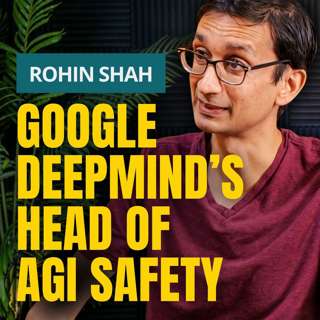
#245 – Rohin Shah on what it's really like to run AGI safety at Google DeepMind (and where I disagree with 'doomers')

#245 – Rohin Shah on what it's really like to run AGI safety at Google DeepMind (and where I disagree with 'doomers')

Most people working on AI safety think without a massive effort AI systems will probably end up with goals catastrophically different from humanity’s. Today’s guest, Rohin Shah — head of AGI Safety an...

2 Juni 2h 48min

What makes for a dream job? | Benjamin Todd

What makes for a dream job? | Benjamin Todd

What actually makes a job fulfilling? It's not what most career advice tells you. "Follow your passion" sounds inspiring, but it's misleading — and the research backs that up.Drawing on hundreds of st...

28 Maj 28min

Populärt inom Utbildning

historiepodden-se
det-skaver
rss-bara-en-till-om-missbruk-medberoende-2
nu-blir-det-historia
harrisons-dramatiska-historia
not-fanny-anymore
rss-viktmedicinpodden
johannes-hansen-podcast
allt-du-velat-veta
rss-traningsklubben
sektledare
i-vantan-pa-katastrofen
sa-in-i-sjalen
rss-basta-livet
rikatillsammans-om-privatekonomi-rikedom-i-livet
rss-max-tant-med-max-villman
vi-gar-till-historien
rss-sjalsligt-avkladd
sex-pa-riktigt-med-marika-smith
rss-okrystat