

#63 – Vitalik Buterin on better ways to fund public goods, blockchain's failures, & effective giving

#63 – Vitalik Buterin on better ways to fund public goods, blockchain's failures, & effective giving

Historically, progress in the field of cryptography has had major consequences. It has changed the course of major wars, made it possible to do business on the internet, and enabled private communication between both law-abiding citizens and dangerous criminals. Could it have similarly significant consequences in future?

Today's guest — Vitalik Buterin — is world-famous as the lead developer of Ethereum, a successor to the cryptographic-currency Bitcoin, which added the capacity for smart contracts and decentralised organisations. Buterin first proposed Ethereum at the age of 20, and by the age of 23 its success had likely made him a billionaire.

At the same time, far from indulging hype about these so-called 'blockchain' technologies, he has been candid about the limited good accomplished by Bitcoin and other currencies developed using cryptographic tools — and the breakthroughs that will be needed before they can have a meaningful social impact. In his own words, *"blockchains as they currently exist are in many ways a joke, right?"*

But Buterin is not just a realist. He's also an idealist, who has been helping to advance big ideas for new social institutions that might help people better coordinate to pursue their shared goals.

Links to learn more, summary and full transcript.

By combining theories in economics and mechanism design with advances in cryptography, he has been pioneering the new interdiscriplinary field of 'cryptoeconomics'. Economist Tyler Cowen hasobserved that, "at 25, Vitalik appears to repeatedly rediscover important economics results from famous papers, without knowing about the papers at all."

Along with previous guest Glen Weyl, Buterin has helped develop a model for so-called 'quadratic funding', which in principle could transform the provision of 'public goods'. That is, goods that people benefit from whether they help pay for them or not.

Examples of goods that are fully or partially 'public goods' include sound decision-making in government, international peace, scientific advances, disease control, the existence of smart journalism, preventing climate change, deflecting asteroids headed to Earth, and the elimination of suffering. Their underprovision in part reflects the difficulty of getting people to pay for anything when they can instead free-ride on the efforts of others. Anything that could reduce this failure of coordination might transform the world.

But these and other related proposals face major hurdles. They're vulnerable to collusion, might be used to fund scams, and remain untested at a small scale — not to mention that anything with a square root sign in it is going to struggle to achieve societal legitimacy. Is the prize large enough to justify efforts to overcome these challenges?

In today's extensive three-hour interview, Buterin and I cover:

• What the blockchain has accomplished so far, and what it might achieve in the next decade;
• Why many social problems can be viewed as a coordination failure to provide a public good;
• Whether any of the ideas for decentralised social systems emerging from the blockchain community could really work;
• His view of 'effective altruism' and 'long-termism';
• Why he is optimistic about 'quadratic funding', but pessimistic about replacing existing voting with 'quadratic voting';
• Why humanity might have to abandon living in cities;
• And much more.

Get this episode by subscribing to our podcast on the world’s most pressing problems and how to solve them: type 80,000 Hours into your podcasting app.

The 80,000 Hours Podcast is produced by Keiran Harris.

Det här avsnittet är hämtat från ett öppet RSS-flöde och publiceras inte av Podme. Det kan innehålla reklam.

Avsnitt(344)

Spencer Greenberg on staying sane while trying to save the world

Spencer Greenberg on staying sane while trying to save the world

If you genuinely believe that humanity could be wiped out by AI or a pandemic, what is the appropriate amount of fear to feel?“As much as possible” can seem like the only reasonable answer. If the wor...

28 Juli 2h 9min

Jasmine Sun on what the people building AI really believe

Jasmine Sun on what the people building AI really believe

Many AI researchers believe mass job displacement is coming — and some even think there’s a chance their technology will kill everyone. But they’re building it anyway. Writer and journalist Jasmine Su...

21 Juli 1h 6min

#247 – Anton Leicht on how middle powers avoid losing everything in a post-AI world

#247 – Anton Leicht on how middle powers avoid losing everything in a post-AI world

In a post-AGI world, can a country without access to frontier AI even be considered sovereign anymore?Anton Leicht says once frontier AI becomes a core economic input, the countries that own it will p...

14 Juli 1h 33min

#246 – Sneha Revanur on how a small team of activists helped pass America's landmark AI safety laws

#246 – Sneha Revanur on how a small team of activists helped pass America's landmark AI safety laws

Six years ago, aged just 15, Sneha Revanur founded the AI advocacy nonprofit Encode AI — back when AI felt like a niche issue. Now the world’s caught up with her, and she’s ready to share everything s...

8 Juli 52min

We can guess what intergalactic war would look like. And strangely, it matters.

We can guess what intergalactic war would look like. And strangely, it matters.

Intergalactic war is probably billions of years away — yet physics can already tell us how it ends. And strangely that conclusion is relevant to decisions people have to make today.In this video, Rob ...

18 Juni 15min

How AI could create the world’s biggest problems (article by Zershaaneh Qureshi)

How AI could create the world’s biggest problems (article by Zershaaneh Qureshi)

Imagine you’re living 15,000 years ago. Your people are hunter-gatherers and you sleep under the stars. If someone told you humans would one day build cities with millions of people, fly through the a...

11 Juni 1h 29min
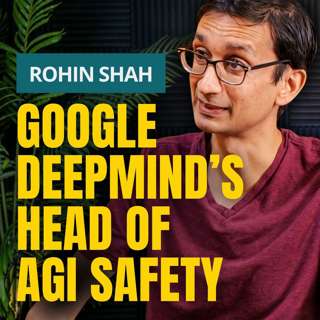
#245 – Rohin Shah on what it's really like to run AGI safety at Google DeepMind (and where I disagree with 'doomers')

#245 – Rohin Shah on what it's really like to run AGI safety at Google DeepMind (and where I disagree with 'doomers')

Most people working on AI safety think without a massive effort AI systems will probably end up with goals catastrophically different from humanity’s. Today’s guest, Rohin Shah — head of AGI Safety an...

2 Juni 2h 48min

What makes for a dream job? | Benjamin Todd

What makes for a dream job? | Benjamin Todd

What actually makes a job fulfilling? It's not what most career advice tells you. "Follow your passion" sounds inspiring, but it's misleading — and the research backs that up.Drawing on hundreds of st...

28 Maj 28min

Populärt inom Utbildning

historiepodden-se
det-skaver
rss-bara-en-till-om-missbruk-medberoende-2
nu-blir-det-historia
harrisons-dramatiska-historia
not-fanny-anymore
rss-viktmedicinpodden
johannes-hansen-podcast
allt-du-velat-veta
rss-traningsklubben
sektledare
i-vantan-pa-katastrofen
sa-in-i-sjalen
rss-basta-livet
rikatillsammans-om-privatekonomi-rikedom-i-livet
rss-max-tant-med-max-villman
vi-gar-till-historien
rss-sjalsligt-avkladd
sex-pa-riktigt-med-marika-smith
rss-okrystat