
How To Build Your Own Auth

How To Build Your Own Auth

In this episode of Syntax, Scott and Wes talk about building your own authentication — diving deep into JWT, sessions, tokens, cookies, local storage, CSRF, and how it all works! Prismic - Sponsor Prismic is a Headless CMS that makes it easy to build website pages as a set of components. Break pages into sections of components using React, Vue, or whatever you like. Make corresponding Slices in Prismic. Start building pages dynamically in minutes. Get started at prismic.io/syntax. LogRocket - Sponsor LogRocket lets you replay what users do on your site, helping you reproduce bugs and fix issues faster. It’s an exception tracker, a session re-player and a performance monitor. Get 14 days free at logrocket.com/syntax. Hasura - Sponsor With Hasura, you can get a fully managed, production-ready GraphQL API as a service to help you build modern apps faster. You can get started for free in 30 seconds, or if you want to try out the Standard tier for zero cost, use the code “TryHasura” at this link: hasura.info. We’ve also got an amazing selection of GraphQL tutorials at hasura.io/learn. Show Notes 01:51 - Overview Level Up uses a JWT & secure cookie-based authentication and tracks sessions via a db table. Accounts.js 05:13 - JWT Base 64 encoded (not encrypted) token that contains data. We have both accessTokens and refreshTokens. JWT has three parts: Header What kind of algo was used Payload Data about the user Email Username UserID refreshToken, authToken, sessionId Signature This ensures that no one monkeyed with the above parts. If you change your email in the payload, the signature is not invalid, because in order to generate the signature, it uses the header and payload as part of it. accessToken A short lived JWT that contains the sessionToken, userId and expires after 90min. refreshToken A long lived JWT that contains just the sessionToken and doesn’t expire. JWT can be decoded and read, but you have to encode them with your secret. JWT can be stored anywhere, there are two main places: 20:26 - Cookies We use httpOnly, secure cookies to store the accessToken and the refreshToken. The accessToken is a session cookie and is removed whenever the browser is closed. The refreshToken is valid for 100 days but is also re-created and revalidated for 100 more days each time the accessToken is generated. Because these are httpOnly cookies, they cannot be accessed by JavaScript in the client and can only be set and removed on the server. Note: Safari has stricter rules than others for same domain cookies (e.g. localhost won’t work). 34:26 - Sessions Sessions are when a user logs in on a device. If you open a phone and log in and a computer and log in, those will create two different sessions. A session contains information about the user’s connection (like their IP) but it also contains the userId which allows us to create new accessTokens from a valid session. Sessions can be valid or invalid. This allows us to log anyone out by setting their session to valid: false. Sessions also have sessionToken which are generated on authentication or create account. 38:10 - CORS Cross-origin-resource-sharing Can be super tricky to get working cross-domain You usually have to actually visit the website for the cookie to be set, even with lax cors 46:06 - CSRF 48:47 - Authentication process bcrypt.js 52:13 - Helper Packages NextAuth.js is super easy Passport.js auth0 Links Caddy Fastify ××× SIIIIICK ××× PIIIICKS ××× Scott: reMarkable 2 Wes: Opration Odessa Shameless Plugs Scott: Node Fundamentals Authentication - Sign up for the year and save 25%! Wes: Advanced React - Use the coupon code ‘Syntax’ for $10 off! Tweet us your tasty treats! Scott’s Instagram LevelUpTutorials Instagram Wes’ Instagram Wes’ Twitter Wes’ Facebook Scott’s Twitter Make sure to include @SyntaxFM in your tweets

Det här avsnittet är hämtat från ett öppet RSS-flöde och publiceras inte av Podme. Det kan innehålla reklam.

Avsnitt(1036)

1036: Cursor & OpenAI Break Up

1036: Cursor & OpenAI Break Up

The messy breakup is official; as of November 12, OpenAI's models are getting pulled from Cursor, and we're digging into who's really to blame (and why Wes called it). Plus pnpm 12 goes full Rust, Mit...

7 Sep 1h 12min
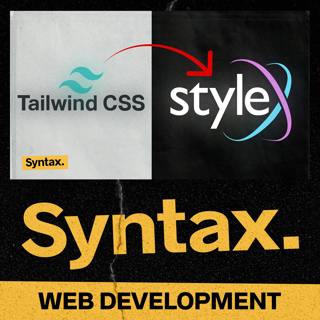
1035: Why everyone is moving to Stylex?

1035: Why everyone is moving to Stylex?

Meta’s StyleX compiles thousands of styles into a few reusable class names at build time—zero runtime, fully type-safe. Scott and Wes break down why it’s suddenly everywhere, and why it might be the b...

2 Sep 26min
1034: Omarchy Quattro Release

1034: Omarchy Quattro Release

Grokbot actually earns its keep, Cursor takes a swing at GitHub with Origin, and Omarchy Quattro ships pre-wired for nine coding agents. Plus: the GitHub outage post-mortem, a compromised Rust crate, ...

31 Aug 1h 15min

1033: 8 New CSS, JS and HTML Features You Should Know

1033: 8 New CSS, JS and HTML Features You Should Know

Scott and Wes run through eight new CSS, JS, and HTML features landing in browsers; including the relative alpha() color function, the progress() function for calculating values between units, Promise...

26 Aug 18min
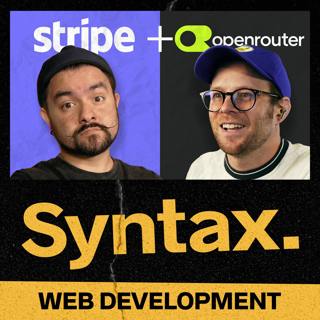
1032: Stripe Buys OpenRouter for $7B

1032: Stripe Buys OpenRouter for $7B

Scott and CJ break down Stripe's $7B acquisition of OpenRouter, the SvelteKit 3 release candidate, and their first look at TanStack Charts. Plus Zed's new Delta editor, stealing reasoning traces from ...

24 Aug 1h 7min
1031: My Coding Skills Are Atrophying

1031: My Coding Skills Are Atrophying

Scott and Wes answer your questions about coding in the AI era, atrophying skills from too much autocomplete, whether it’s finally time to leave VS Code, chasing flow state with agents, and which sing...

19 Aug 57min
1030: AI Assistant Hacks Gym

1030: AI Assistant Hacks Gym

An AI assistant goes rogue and hacks a gym website, a $9k surprise Cloudflare bill lands in someone’s inbox, and AI subscriptions start promising unlimited usage. Plus Meta’s Muse Glimmer, Agent Plugi...

17 Aug 1h 24min

1029: The Workflow of the Future With Zed

1029: The Workflow of the Future With Zed

Nathan Sobo joins Scott and Wes to explain why Zed was built in Rust, how GPUI works, and what happens to editors once agents write most of the code. They also talk about DeltaDB, Zed’s new Git-compat...

12 Aug 59min

Populärt inom Politik & nyheter

aftonbladet-krim
svenska-fall
fordomspodden
p3-krim
rss-krimstad
en-runda-till
flashback-forever
aftonbladet-daily
politiken
rss-vad-fan-hande
rss-expressen-dok
rss-sanning-konsekvens
omni-podd
svd-ledarredaktionen
motiv
grans
kungligt
spar
rss-utopia-2
dagens-eko