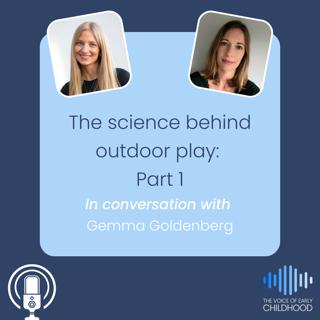
The science behind outdoor play: Part 1

The science behind outdoor play: Part 1

In this series on the science behind outdoor play Angelica talks to Gemma Goldenberg who is researching how indoor and outdoor environments affect children's stress, attention and self-regulated behaviour.

In this episode, part 1 of the series, Gemma gives us an introduction to her research, including a look at the methods she decided to use and unpicking some of the decisions and complexities around this.

The discussion focuses on making research accessible to a wider audience, specifically to those outside of academia, namely families and educators. As well as ensuring that research findings reach policy makers and have an impact on practice sooner rather than later, as is often the case.

Gemma and Angelica discuss:

00:56 - Making research more accessible for educators and parents
03:30 - The problem with research being shared on social media
05:58 - Why is research not influencing policy and practice quicker?
10:00 - Researcher bias and choosing methods carefully
14:30 - Controlling variables for accurate findings
19:00 - Measuring self-regulation
24:33 - Mixed methods research
26:19 - Educators shaping research: A two-way dialogue
27:50 - Ethics: Parental and informed consent
29:45 - Researching in areas of disadvantage


In part 2 Gemma will share with us how children and educators reacted to her research process and some of the challenges the project faced.

Read Gemma's articles and find out more on The Voice of Early Childhood website: www.thevoiceofearlychildhood.com

Det här avsnittet är hämtat från ett öppet RSS-flöde och publiceras inte av Podme. Det kan innehålla reklam.

Avsnitt(173)

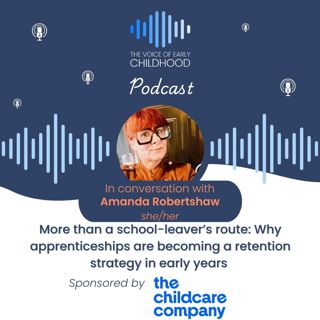
More than a school-leaver's route: Why apprenticeships are becoming a retention strategy in early years

More than a school-leaver's route: Why apprenticeships are becoming a retention strategy in early years

Apprenticeships are often viewed as an entry route for young people, but they can also provide a valuable pathway for developing and retaining existing early years staff. This article and podcast epis...

28 Sep 37min
Are our expectations of children in early childhood evidence informed?

Are our expectations of children in early childhood evidence informed?

What does it really mean for a child to be 'school ready', and are the expectations we place on children actually informed by evidence? Adam Marycz explores how policy, accountability and long-held as...

22 Sep 46min
Reimagining outdoor learning: Understanding agency from risk to resilience

Reimagining outdoor learning: Understanding agency from risk to resilience

This podcast episode and article are a research-informed exploration of how outdoor environments, adult language and risk narratives shape children's agency. Drawing on the Reimagining Outdoor Learni...

14 Sep 42min

Marketing your early childhood setting is an investment, not a cost

Marketing your early childhood setting is an investment, not a cost

This article and podcast episode explore why marketing should be viewed as an investment rather than a cost, why profitability matters for sustainability, the role a setting's website plays in both oc...

7 Sep 39min
Beyond the diagnosis: Navigating the SEND journey with families

Beyond the diagnosis: Navigating the SEND journey with families

Receiving a SEND diagnosis is a transformative moment for families. This podcast episode and article explore how practitioners bridge the gap between statutory requirements and empathetic support, emp...

31 Aug 24min
Early childhood safeguarding changes 2026: Moving beyond compliance to a culture of safety

Early childhood safeguarding changes 2026: Moving beyond compliance to a culture of safety

Maggie Bolger and Ann Marie Christian explore the changing safeguarding landscape in early childhood, including KCSIE, the EYFS, safer recruitment, reporting concerns and the September changes. They a...

24 Aug 1h 2min
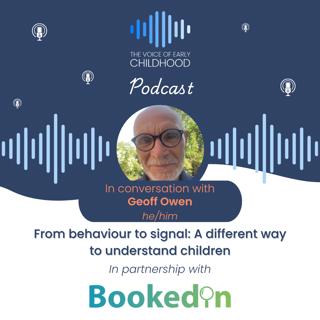
From Behaviour to signal: A different way to understand children

From Behaviour to signal: A different way to understand children

Many childhood behaviours labelled as difficult, oppositional or defiant may make far more sense than we realise. This article and podcast episode explore a biological perspective on defiance, screens...

18 Aug 56min

The brain that loves to laugh

The brain that loves to laugh

Laughter is often treated as a pleasant extra, or even a distraction from learning. Drawing on their work across psychology, education, health and community contexts, Dr Jacqueline Harding and Dr Jawa...

17 Aug 46min

Populärt inom Utbildning

historiepodden-se
det-skaver
nu-blir-det-historia
rss-bara-en-till-om-beroende-medberoende
rss-dr-bjorklund
not-fanny-anymore
roda-vita-rosen
harrisons-dramatiska-historia
rss-viktmedicinpodden
johannes-hansen-podcast
allt-du-velat-veta
rss-foraldramotet-bring-lagercrantz
rikatillsammans-om-privatekonomi-rikedom-i-livet
i-vantan-pa-katastrofen
sa-in-i-sjalen
rss-basta-livet
rss-ai-med-jonas-benjamin
rss-traningsklubben
rss-max-tant-med-max-villman
rss-beratta-alltid-det-har