Applying the lessons from Docker with Solomon Hykes

Applying the lessons from Docker with Solomon Hykes

This week on The Business of Open Source, I have the first episode I recorded on-site at KubeCon Salt Lake City (and the only full-length episode), with Solomon Hykes, CEO and co-founder of Dagger, and co-founder of Docker.


One thing Solomon mentions briefly but that is very important is that there are limits to what can be learned from Docker’s story, simply because the situation was so unique. Docker experienced explosive growth, at least some of which was due to having the right technology at the right time. This kind of explosive growth is very rare, though, and it brought it’s own set of challenges. The point being that while most companies will struggle to get enough adoption, Docker struggled to monetize effectively but got so many chances to try again just because it had a massive community.


  • The hypothesis — or actually, lack thereof — behind creating the original Docker open source project.
  • How having a massive community does help — but also doesn’t guarantee you’ll be able to build a financially sustainable company
  • When you build a massively successful technology or standard, you’ll attract competition — and in the case of Docker, the competitors were savvy companies who’d won the previous cloud wars and ultimately were quicker to figure out how to monetize Docker containers than Docker itself
  • What Solomon is doing differently at Dagger compared to Docker, one of which is thinking about monetization much sooner
  • The open source movement was founded on such explicitly anti-commercial principles that companies building in the space would often not be intellectually honest about the fact that they were building both a software to give away for free as well as a business that needed revenue. Docker tried too hard to please everyone, including those who felt that open source should be pure and non-commercial — at Dagger, they’re much more transparent and upfront about the fact that it’s a company with commercial ambitions.
  • Solomon also talked about the difference between components and product, and how designing products requires control, including the ability to just say no without explaining yourself.


###

It was fascinating to hear Solomon talk about the lack of intellectual honesty around who pays for the development and maintenance of a lot of open source projects, because that precise topic was the focus of two panels I moderated at KubeCon, one during the main conference and one during CloudNative StartupFest.


If you’re struggling to articulate how your product and project are different from each other (and others in the ecosystem) and why someone should pay you, you might want to work with me. Reach out!

Det här avsnittet är hämtat från ett öppet RSS-flöde och publiceras inte av Podme. Det kan innehålla reklam.

Avsnitt(279)

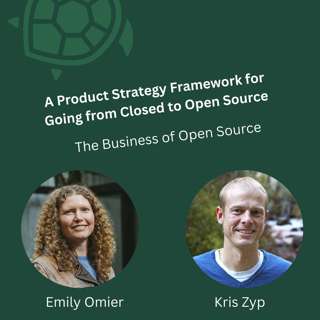
A Product Strategy Framework for Going from Closed to Open Source

A Product Strategy Framework for Going from Closed to Open Source

In this episode of The Business of Open Source, I spoke with Kris Zyp, SVP of engineering at HarperDB, in the third and final episode in the series about how Harper went from a closed-source company t...

18 Aug 31min
Giving your Users a Well-Lit Path with Matt Watson

Giving your Users a Well-Lit Path with Matt Watson

In today’s episode of The Business of Open Source, I spoke with Matt Watson, CEO of Fullscale, about a number of topics related to product development and how AI is changing that. Let’s start with a q...

10 Aug 34min
Interviewing your Target Customers to Accelerate Product-Market Fit

Interviewing your Target Customers to Accelerate Product-Market Fit

This week on The Business of Open Source, I talk with Julien Verlaguet, the CEO of Skiplabs. Julien is a programming language guy, and we talked about what it means to maintain an open source programm...

3 Aug 37min
Making AI an Opportunity with Joshua Drake

Making AI an Opportunity with Joshua Drake

In this episode of The Business of Open Source, I talked with Joshua Drake, president and CTO of Command Prompt, about business management, bootstrapping versus taking investment, and AI, open source ...

30 Juli 40min
From Closed to Open: Shortening Sales Cycles with Stephen Goldberg

From Closed to Open: Shortening Sales Cycles with Stephen Goldberg

This week on The Business of Open Source, I chatted with Stephen Goldberg, co-founder of Harper, about the process of taking Harper from a closed-source software company to a open source company. I al...

6 Juli 33min
Does AI Make Open Core Models More Difficult? with Sam Alba

Does AI Make Open Core Models More Difficult? with Sam Alba

Today on The Business of Open Source I spoke with Sam Alba, co-founder of Mendral, formerly of Dagger, and the first hire at Docker. We talked a lot about about how AI is changing the developer tools ...

2 Juli 39min
Closed to Open Source Series: Doing Open Source "Right" with Ethan Arrowood

Closed to Open Source Series: Doing Open Source "Right" with Ethan Arrowood

One of the myths that swirl around the open source company ecosystem is that all open source companies started as an open source project that then suddenly got traction, and followed by the founders f...

22 Juni 40min
The Value of Code is Dropping to Zero with Yann Lechelle

The Value of Code is Dropping to Zero with Yann Lechelle

In this episode of The Business of Open Source, I talked with Yann Lechelle, Executive President of :Probabl.Perhaps the most interesting part of the conversation was about whether or not there is a r...

15 Juni 42min

Populärt inom Business & ekonomi

framgangspodden
badfluence
rss-jossan-nina
varvet
dynastin
rss-borsens-finest
avanzapodden
uppgang-och-fall
svd-tech-brief
rss-inga-dumma-fragor-om-pengar
borsmorgon
rss-dagen-med-di
fill-or-kill
bathina-en-podcast
rss-hos-psykologen
rss-kort-lang-analyspodden-fran-di
lastbilspodden
tabberaset
rikatillsammans-om-privatekonomi-rikedom-i-livet
market-makers