

#134 Classic episode – Ian Morris on what big-picture history teaches us

#134 Classic episode – Ian Morris on what big-picture history teaches us

Wind back 1,000 years and the moral landscape looks very different to today. Most farming societies thought slavery was natural and unobjectionable, premarital sex was an abomination, women should obey their husbands, and commoners should obey their monarchs.

Wind back 10,000 years and things look very different again. Most hunter-gatherer groups thought men who got too big for their britches needed to be put in their place rather than obeyed, and lifelong monogamy could hardly be expected of men or women.

Why such big systematic changes — and why these changes specifically?

That's the question bestselling historian Ian Morris takes up in his book, Foragers, Farmers, and Fossil Fuels: How Human Values Evolve. Ian has spent his academic life studying long-term history, trying to explain the big-picture changes that play out over hundreds or thousands of years.

Rebroadcast: this episode was originally released in July 2022.

Links to learn more, highlights, and full transcript.

There are a number of possible explanations one could offer for the wide-ranging shifts in opinion on the 'right' way to live. Maybe the natural sciences progressed and people realised their previous ideas were mistaken? Perhaps a few persuasive advocates turned the course of history with their revolutionary arguments? Maybe everyone just got nicer?

In Foragers, Farmers and Fossil Fuels Ian presents a provocative alternative: human culture gradually evolves towards whatever system of organisation allows a society to harvest the most energy, and we then conclude that system is the most virtuous one. Egalitarian values helped hunter-gatherers hunt and gather effectively. Once farming was developed, hierarchy proved to be the social structure that produced the most grain (and best repelled nomadic raiders). And in the modern era, democracy and individuality have proven to be more productive ways to collect and exploit fossil fuels.

On this theory, it's technology that drives moral values much more than moral philosophy. Individuals can try to persist with deeply held values that limit economic growth, but they risk being rendered irrelevant as more productive peers in their own society accrue wealth and power. And societies that fail to move with the times risk being conquered by more pragmatic neighbours that adapt to new technologies and grow in population and military strength.

There are many objections one could raise to this theory, many of which we put to Ian in this interview. But the question is a highly consequential one: if we want to guess what goals our descendants will pursue hundreds of years from now, it would be helpful to have a theory for why our ancestors mostly thought one thing, while we mostly think another.

Big though it is, the driver of human values is only one of several major questions Ian has tackled through his career.

In this classic episode, we discuss all of Ian's major books.

Chapters:

  • Rob's intro (00:00:53)
  • The interview begins (00:02:30)
  • Geography is Destiny (00:03:38)
  • Why the West Rules—For Now (00:12:04)
  • War! What is it Good For? (00:28:19)
  • Expectations for the future (00:40:22)
  • Foragers, Farmers, and Fossil Fuels (00:53:53)
  • Historical methodology (01:03:14)
  • Falsifiable alternative theories (01:15:59)
  • Archaeology (01:22:56)
  • Energy extraction technology as a key driver of human values (01:37:43)
  • Allowing people to debate about values (02:00:16)
  • Can productive wars still occur? (02:13:28)
  • Where is history contingent and where isn’t it? (02:30:23)
  • How Ian thinks about the future (03:13:33)
  • Macrohistory myths (03:29:51)
  • Ian’s favourite archaeology memory (03:33:19)
  • The most unfair criticism Ian’s ever received (03:35:17)
  • Rob's outro (03:39:55)

Producer: Keiran Harris
Audio mastering: Ben Cordell
Transcriptions: Katy Moore

Det här avsnittet är hämtat från ett öppet RSS-flöde och publiceras inte av Podme. Det kan innehålla reklam.

Avsnitt(344)

Spencer Greenberg on staying sane while trying to save the world

Spencer Greenberg on staying sane while trying to save the world

If you genuinely believe that humanity could be wiped out by AI or a pandemic, what is the appropriate amount of fear to feel?“As much as possible” can seem like the only reasonable answer. If the wor...

28 Juli 2h 9min

Jasmine Sun on what the people building AI really believe

Jasmine Sun on what the people building AI really believe

Many AI researchers believe mass job displacement is coming — and some even think there’s a chance their technology will kill everyone. But they’re building it anyway. Writer and journalist Jasmine Su...

21 Juli 1h 6min

#247 – Anton Leicht on how middle powers avoid losing everything in a post-AI world

#247 – Anton Leicht on how middle powers avoid losing everything in a post-AI world

In a post-AGI world, can a country without access to frontier AI even be considered sovereign anymore?Anton Leicht says once frontier AI becomes a core economic input, the countries that own it will p...

14 Juli 1h 33min

#246 – Sneha Revanur on how a small team of activists helped pass America's landmark AI safety laws

#246 – Sneha Revanur on how a small team of activists helped pass America's landmark AI safety laws

Six years ago, aged just 15, Sneha Revanur founded the AI advocacy nonprofit Encode AI — back when AI felt like a niche issue. Now the world’s caught up with her, and she’s ready to share everything s...

8 Juli 52min

We can guess what intergalactic war would look like. And strangely, it matters.

We can guess what intergalactic war would look like. And strangely, it matters.

Intergalactic war is probably billions of years away — yet physics can already tell us how it ends. And strangely that conclusion is relevant to decisions people have to make today.In this video, Rob ...

18 Juni 15min

How AI could create the world’s biggest problems (article by Zershaaneh Qureshi)

How AI could create the world’s biggest problems (article by Zershaaneh Qureshi)

Imagine you’re living 15,000 years ago. Your people are hunter-gatherers and you sleep under the stars. If someone told you humans would one day build cities with millions of people, fly through the a...

11 Juni 1h 29min
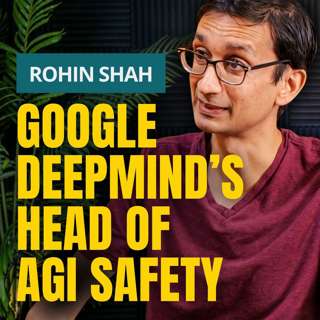
#245 – Rohin Shah on what it's really like to run AGI safety at Google DeepMind (and where I disagree with 'doomers')

#245 – Rohin Shah on what it's really like to run AGI safety at Google DeepMind (and where I disagree with 'doomers')

Most people working on AI safety think without a massive effort AI systems will probably end up with goals catastrophically different from humanity’s. Today’s guest, Rohin Shah — head of AGI Safety an...

2 Juni 2h 48min

What makes for a dream job? | Benjamin Todd

What makes for a dream job? | Benjamin Todd

What actually makes a job fulfilling? It's not what most career advice tells you. "Follow your passion" sounds inspiring, but it's misleading — and the research backs that up.Drawing on hundreds of st...

28 Maj 28min

Populärt inom Utbildning

historiepodden-se
det-skaver
rss-bara-en-till-om-missbruk-medberoende-2
nu-blir-det-historia
harrisons-dramatiska-historia
not-fanny-anymore
rss-viktmedicinpodden
johannes-hansen-podcast
allt-du-velat-veta
rss-traningsklubben
sektledare
i-vantan-pa-katastrofen
sa-in-i-sjalen
rss-basta-livet
rikatillsammans-om-privatekonomi-rikedom-i-livet
rss-max-tant-med-max-villman
vi-gar-till-historien
rss-sjalsligt-avkladd
sex-pa-riktigt-med-marika-smith
rss-okrystat