

#138 Classic episode – Sharon Hewitt Rawlette on why pleasure and pain are the only things that intrinsically matter

#138 Classic episode – Sharon Hewitt Rawlette on why pleasure and pain are the only things that intrinsically matter

What in the world is intrinsically good — good in itself even if it has no other effects? Over the millennia, people have offered many answers: joy, justice, equality, accomplishment, loving god, wisdom, and plenty more.

The question is a classic that makes for great dorm-room philosophy discussion. But it’s hardly just of academic interest. The issue of what (if anything) is intrinsically valuable bears on every action we take, whether we’re looking to improve our own lives, or to help others. The wrong answer might lead us to the wrong project and render our efforts to improve the world entirely ineffective.

Today’s guest, Sharon Hewitt Rawlette — philosopher and author of The Feeling of Value: Moral Realism Grounded in Phenomenal Consciousness — wants to resuscitate an answer to this question that is as old as philosophy itself.

Rebroadcast: this episode was originally released in September 2022.

Links to learn more, highlights, and full transcript.

That idea, in a nutshell, is that there is only one thing of true intrinsic value: positive feelings and sensations. And similarly, there is only one thing that is intrinsically of negative value: suffering, pain, and other unpleasant sensations.

Lots of other things are valuable too: friendship, fairness, loyalty, integrity, wealth, patience, houses, and so on. But they are only instrumentally valuable — that is to say, they’re valuable as means to the end of ensuring that all conscious beings experience more pleasure and other positive sensations, and less suffering.

As Sharon notes, from Athens in 400 BC to Britain in 1850, the idea that only subjective experiences can be good or bad in themselves — a position known as ‘philosophical hedonism’ — has been one of the most enduringly popular ideas in ethics.

And few will be taken aback by the notion that, all else equal, more pleasure is good and less suffering is bad. But can they really be the only intrinsically valuable things?

Over the 20th century, philosophical hedonism became increasingly controversial in the face of some seemingly very counterintuitive implications. For this reason the famous philosopher of mind Thomas Nagel called The Feeling of Value “a radical and important philosophical contribution.”

So what convinces Sharon that philosophical hedonism deserves another go? In today’s interview with host Rob Wiblin, Sharon explains the case for a theory of value grounded in subjective experiences, and why she believes these counterarguments are misguided. A philosophical hedonist shouldn’t get in an experience machine, nor override an individual’s autonomy, except in situations so different from the classic thought experiments that it no longer seems strange they would do so.

Chapters:

  • Cold open (00:00:00)
  • Rob’s intro (00:00:41)
  • The interview begins (00:04:27)
  • Metaethics (00:05:58)
  • Anti-realism (00:12:21)
  • Sharon's theory of moral realism (00:17:59)
  • The history of hedonism (00:24:53)
  • Intrinsic value vs instrumental value (00:30:31)
  • Egoistic hedonism (00:38:12)
  • Single axis of value (00:44:01)
  • Key objections to Sharon’s brand of hedonism (00:58:00)
  • The experience machine (01:07:50)
  • Robot spouses (01:24:11)
  • Most common misunderstanding of Sharon’s view (01:28:52)
  • How might a hedonist actually live (01:39:28)
  • The organ transplant case (01:55:16)
  • Counterintuitive implications of hedonistic utilitarianism (02:05:22)
  • How could we discover moral facts? (02:19:47)
  • Rob’s outro (02:24:44)

Producer: Keiran Harris
Audio mastering: Ryan Kessler
Transcriptions: Katy Moore

Det här avsnittet är hämtat från ett öppet RSS-flöde och publiceras inte av Podme. Det kan innehålla reklam.

Avsnitt(344)

Spencer Greenberg on staying sane while trying to save the world

Spencer Greenberg on staying sane while trying to save the world

If you genuinely believe that humanity could be wiped out by AI or a pandemic, what is the appropriate amount of fear to feel?“As much as possible” can seem like the only reasonable answer. If the wor...

28 Juli 2h 9min

Jasmine Sun on what the people building AI really believe

Jasmine Sun on what the people building AI really believe

Many AI researchers believe mass job displacement is coming — and some even think there’s a chance their technology will kill everyone. But they’re building it anyway. Writer and journalist Jasmine Su...

21 Juli 1h 6min

#247 – Anton Leicht on how middle powers avoid losing everything in a post-AI world

#247 – Anton Leicht on how middle powers avoid losing everything in a post-AI world

In a post-AGI world, can a country without access to frontier AI even be considered sovereign anymore?Anton Leicht says once frontier AI becomes a core economic input, the countries that own it will p...

14 Juli 1h 33min

#246 – Sneha Revanur on how a small team of activists helped pass America's landmark AI safety laws

#246 – Sneha Revanur on how a small team of activists helped pass America's landmark AI safety laws

Six years ago, aged just 15, Sneha Revanur founded the AI advocacy nonprofit Encode AI — back when AI felt like a niche issue. Now the world’s caught up with her, and she’s ready to share everything s...

8 Juli 52min

We can guess what intergalactic war would look like. And strangely, it matters.

We can guess what intergalactic war would look like. And strangely, it matters.

Intergalactic war is probably billions of years away — yet physics can already tell us how it ends. And strangely that conclusion is relevant to decisions people have to make today.In this video, Rob ...

18 Juni 15min

How AI could create the world’s biggest problems (article by Zershaaneh Qureshi)

How AI could create the world’s biggest problems (article by Zershaaneh Qureshi)

Imagine you’re living 15,000 years ago. Your people are hunter-gatherers and you sleep under the stars. If someone told you humans would one day build cities with millions of people, fly through the a...

11 Juni 1h 29min
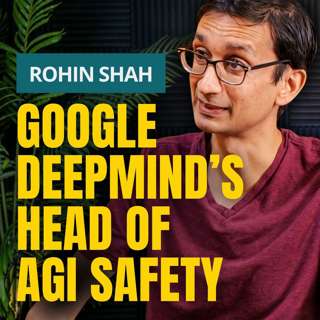
#245 – Rohin Shah on what it's really like to run AGI safety at Google DeepMind (and where I disagree with 'doomers')

#245 – Rohin Shah on what it's really like to run AGI safety at Google DeepMind (and where I disagree with 'doomers')

Most people working on AI safety think without a massive effort AI systems will probably end up with goals catastrophically different from humanity’s. Today’s guest, Rohin Shah — head of AGI Safety an...

2 Juni 2h 48min

What makes for a dream job? | Benjamin Todd

What makes for a dream job? | Benjamin Todd

What actually makes a job fulfilling? It's not what most career advice tells you. "Follow your passion" sounds inspiring, but it's misleading — and the research backs that up.Drawing on hundreds of st...

28 Maj 28min

Populärt inom Utbildning

historiepodden-se
det-skaver
rss-bara-en-till-om-missbruk-medberoende-2
nu-blir-det-historia
harrisons-dramatiska-historia
not-fanny-anymore
rss-viktmedicinpodden
johannes-hansen-podcast
allt-du-velat-veta
rss-traningsklubben
sektledare
i-vantan-pa-katastrofen
sa-in-i-sjalen
rss-basta-livet
rikatillsammans-om-privatekonomi-rikedom-i-livet
rss-max-tant-med-max-villman
vi-gar-till-historien
rss-sjalsligt-avkladd
sex-pa-riktigt-med-marika-smith
rss-okrystat