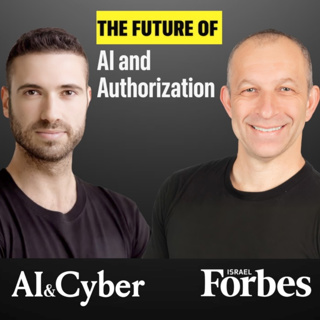

Passwordless Security in the Age of AI: A Conversation with Slavik Markovich, CEO of Descope

Passwordless Security in the Age of AI: A Conversation with Slavik Markovich, CEO of Descope

Cybersecurity is once again at a critical crossroads—this time, driven by the explosive growth of AI technologies. During a recent visit to Descope’s Palo Alto office, I sat down with CEO Slavik Markovich, a veteran in the cybersecurity space whose past ventures, Demisto (acquired by Palo Alto Networks) and Sentrigo (acquired by McAfee), shaped much of the modern security landscape. Our conversation centered around how AI is radically reshaping digital identity.


Slavik and his team—collaborators for nearly three decades—launched Descope with a bold mission: eliminate passwords altogether. “Passwords are the worst of both worlds,” he noted, “hard for humans to remember and easy for computers to crack.” As AI supercharges phishing and other attack vectors, traditional passwords only grow more inadequate.


Instead, Slavik advocates for passkeys—phishing-resistant, cryptographic keys stored locally and authenticated via biometrics, without ever exposing the biometric data. It's a fundamentally more secure and seamless approach to authentication.


Descope’s innovation doesn’t stop there. As AI evolves into “agentic” form—digital agents acting on behalf of users—the company is tackling a new security frontier. These agents don’t fit neatly into existing models of user authentication or machine-to-machine trust. “The industry is shifting toward agentic AI,” Slavik explained, “and that’s expanding the scale and complexity of identity management.”


One surprisingly common challenge they’re solving is the "confused agent problem," where digital agents unintentionally act with higher privileges than intended. Descope positions itself as the intermediary—managing progressive authorization, mediating between users, agents, and applications, and ensuring secure, compliant interactions.


For CISOs and enterprise leaders, this shift presents both urgency and opportunity. AI is no longer an emerging edge case—it’s embedded in tools and workflows across organizations. Security teams must act swiftly to secure agent-driven interactions and identity touchpoints or risk falling behind.


At Clarity, where I focus on AI-powered threats like deepfakes and next-gen phishing, I see firsthand how vital identity management has become. It’s no longer just a login issue—it’s the first and most critical line of defense. Security solutions must be both robust and frictionless, balancing user experience with airtight protection.


Slavik also shared a personal insight that stood out to me: “We prioritize having fun. We’ve built multiple companies together because we genuinely enjoy the journey.” That mindset resonates. The best cybersecurity innovations come from passionate teams that love solving hard problems, not just building defenses.


The identity revolution is already underway. Organizations that embrace passwordless, agent-aware authentication now will dramatically improve both their security and user experience. Those that delay will face rising vulnerabilities and growing user frustration.


Our industry isn’t just evolving—it’s undergoing a full-scale transformation. Proactively embracing agentic AI, passkeys, and adaptive identity strategies is not just smart—it’s essential. Those who lead will define the future of digital trust. Those who don’t may find themselves struggling to catch up in a threat landscape redefined by AI.

Avsnitt(1170)

Ep100: Laura Lauder | Lauder Family Venture Philanthropy Fund

Ep100: Laura Lauder | Lauder Family Venture Philanthropy Fund

Laura is a social entrepreneur and venture philanthropist in Silicon Valley, focusing on Signature Initiatives that she has designed and launched with experts and other philanthropists. Her initiatives include the Center for Media and Democracy in Israel: (A ProPublica model in Israel), DeLeT: A Jewish Teach-for-America and a Jewish Teen Philanthropy program worldwide.. She serves on 11 nonprofit and foundation boards, is an avid cyclist and, in 2009, won a bronze medal in the Maccabi Games in Israel!

2 Sep 202023min

Ep99: Shmuel Shottan | SVP Storage Engineering at Hitachi Vantara

Ep99: Shmuel Shottan | SVP Storage Engineering at Hitachi Vantara

Shmuel is the SVP, Storage Engineering at Hitachi Vantara and was previously CTO and SVP Engineering of BlueArc, the leading provider of the most scalable and the highest performing network storage solutions (acquired by Hitachi). He previously led technology and strategy and 3 other startups that were acquired, and joined Quantum Technology Ventures as a general partner. Shmuel is passionate about mentoring, coaching, and advising young entrepreneurs.

2 Sep 202022min

Ep97: Lisandro Brill | Latin America Venture Capitalist

Ep97: Lisandro Brill | Latin America Venture Capitalist

Lisandro is one of the pioneers of the venture capital industry in Latin America (J-Ventures LP for Latin American Community, AxiaVentures, AltaVentures – México & USA -, OIKOS AgriFoodTech. He is focused on creating and investing in companies that improve the lives of people around the world, especially in developing areas, and his investments have amounted to multiple exits and IPOs. He holds a BA in Economics (Cum Laude) from University of Buenos Aires, and a MPA from Harvard Kennedy School of Government.

2 Sep 202021min

Ep96: Gil Frostig | Prev a VP (Intel and Qualcomm), and Strategic Investor

Ep96: Gil Frostig | Prev a VP (Intel and Qualcomm), and Strategic Investor

Gil is a veteran high-tech executive with 35 years of management and leadership experience. During his career at Intel (VP), he led several mergers and acquisitions, and managed organizations of up to 2,000 engineers around the world (including developing the solution that kicked off the global WiFi revolution). As VP R&D of Qualcomm, he led the development of Wi-Fi, Bluetooth, and NFC technologies and products. Currently Gil 's focus is on startups and J-Ventures roles.

2 Sep 202023min

Ep98: Miri Polachek | CEO of Joy Ventures

Ep98: Miri Polachek | CEO of Joy Ventures

Miri is the CEO of Joy Ventures, and previously co-founded Israel Brain Technologies (IBT), a non-profit envisioned by late Israeli President Shimon Peres that accelerated brain-related innovation and established Israel as a global brain technology hub. She began her business career as a corporate economist at Teva Pharmaceuticals and later held financial management positions at Pfizer in New York, later VP Finance at IntegraMed. Miri holds a Master of Arts in Health Economics from Boston University and an MBA from NYU.

2 Sep 202031min

Ep94: Cindy Padnos | Founder & Managing Partner at Illuminate Ventures

Ep94: Cindy Padnos | Founder & Managing Partner at Illuminate Ventures

Cindy is the founder and Managing Partner of Illuminate Ventures, a seed stage firm investing exclusively in Enterprise/B2B software startups. Previously, she was founder/CEO of SaaS startup Vivant (now part of Oracle), CEO of Acumen and VP marketing at Scopus (IPO then acquired by Siebel). Cindy has been recognized as one of the Most Influential Women in Tech (Fast Company), Most Influential Women in Silicon Valley (New York Times) and dubbed ”Queen B2B” (VentureBeat).

1 Sep 202025min

Ep93: David Demarest | Stanford GSB Professor, Prev. White House senior staff

Ep93: David Demarest | Stanford GSB Professor, Prev. White House senior staff

David is a Stanford Business School Professor and has held numerous executive positions in communications and strategy. He was an assistant to President George H. W. Bush and member of the White House senior staff, was head of communications at Bank of America, head of brand management at Visa and most recently Stanford’s senior public affairs official.

1 Sep 202025min

Ep91: Julie Zelenski | Computer Science Lecturer at Stanford University

Ep91: Julie Zelenski | Computer Science Lecturer at Stanford University

Julie gew up in a town with a population of 262, and came to Stanford for her undergraduate degree. Upon graduating she joined Steve Jobs at NeXT in 1989 and continued with Apple on the MacOS X team. She later fell in love with teaching and became a full-time Stanford lecturer, providing inspiration to thousands of students. Julie also served on the Computer Science Advancement Placement development committee, writing and grading an exam for 20,000 students (AP Computer Science).

1 Sep 202025min

Populärt inom Business & ekonomi

badfluence
framgangspodden
varvet
rss-jossan-nina
uppgang-och-fall
rss-svart-marknad
bathina-en-podcast
rss-borsens-finest
24fragor
lastbilspodden
avanzapodden
affarsvarlden
rss-kort-lang-analyspodden-fran-di
dynastin
fill-or-kill
kapitalet-en-podd-om-ekonomi
svd-tech-brief
borsmorgon
rss-dagen-med-di
rss-inga-dumma-fragor-om-pengar



















