255. Maggie: lioness or poodle?

255. Maggie: lioness or poodle?

Maggie Thatcher in 1987 pulled off a trick that had eluded all other British Prime Ministers of the twentieth century: she won three general elections in a row. Even more, she won a second Commons landslide down from the 144 seats in 1983, but still massive at 102 seats. It was a remarkable feat, to set alongside her being the first woman Prime Minister of Britain, though she always preferred to present herself as the first scientist.

With that huge majority, she seemed well placed to pursue her policy agenda to make Britain great again. But that’s where she ran into problems. This week, we’re going to talk about what the obstacles to her were in foreign affairs, before turning to the domestic ones next week.

She had three main paths to choose between: she could go all in on the Atlantic Alliance with the US, banking on the special relationship; she could go with the Commonwealth, using that association of former imperial possessions to rebuild British global power; or she could throw the country’s lot in with Europe, sacrificing some British sovereignty to the EEC, in return, as Harold Macmillan had written quarter of a century earlier, for sharing in the sovereignty the other nations had given up.

The problem was, as experience would show, that the special relationship with the US had become deeply one-sided, with the US treating Britan as very much a junior partner (which, to be fair, it was). While her backers praised her for standing up against those in parliament who resented granting the US permission to fly bombing raids against Libya from British bases, calling her a lioness in a den of Daniels, those opponents regarded her as a poodle doing the bidding of the American president. As for the Commonwealth, this loose association of nations with no real structure for taking or acting on decisions, was never going to get Britain anywhere. And when it came to Europe, Thatcher grew increasingly sceptical about the EEC as time went on, resenting any granting of authority to it outside the purely economic area.

That, sadly, left Thatcher with no real option for taking things forward. Majority or not, she was increasingly boxed in. Lioness or poodle, she found her way blocked in every direction.


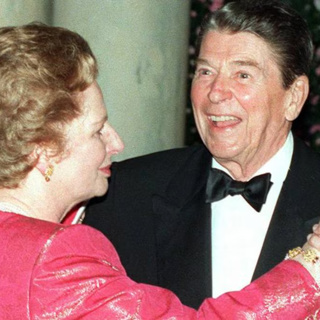
Illustration: 'You lead and I'll follow': Thatcher dancing with Reagan, a special relationship in which the US calls all the shots. Photo by Charles Tasnadi from the Globe and Mail.

Music: Bach Partita #2c by J Bu licensed under an Attribution-NonCommercial-No Derivatives (aka Music Sharing) 3.0 International License


Avsnitt(275)

234. Fall of an iron curtain and of a jewel from the crown

234. Fall of an iron curtain and of a jewel from the crown

It was a strange world that emerged from the Second World War.Both genocide and the mass killing of civilians, above all through bombing, culminating with the A-bombs dropped on Japan, had become some...

9 Mars 202514min

233. Shocks and surprises at the war’s end

233. Shocks and surprises at the war’s end

Following the German surrender in May 1945, the ‘Big Three’ – the United States, the Soviet Union and Britain – met for the third and last time in conference. And this time, appropriately, they met on...

2 Mars 202514min
232. Bickering allies win in Europe

232. Bickering allies win in Europe

At the Yalta conference, between the US, the Soviet Union and Britain, the tensions between the Allies became increasingly obvious. Representing Britain, Churchill wanted the Allies’ war effort to be ...

23 Feb 202514min
231. Nazis facing defeat

231. Nazis facing defeat

By the time of the Yalta conference in February 1945, between the USA, Soviet Union and Britain, the latter still being treated as a great power though its decline was already clear, there could be li...

16 Feb 202514min
230. From Husky to Overlord, Sicily to the D-Day beaches

230. From Husky to Overlord, Sicily to the D-Day beaches

In 1943, Britain didn’t feel the Western Allies were ready yet for an invasion of France, and with its influence at the highest point it ever reached, it was able to persuade the Americans reluctantly...

9 Feb 202514min
229. The tide turns

229. The tide turns

The tide turned against the Axis and in favour of the Allies in the course of 1943. Victories at Stalingrad in Russia, in the Battle of the Atlantic, and in North Africa, came on top of American advan...

2 Feb 202514min
228. Turning points: 1943

228. Turning points: 1943

This is an episode for turning points. The year’s 1943. The Battle of Stalingrad, where the unstoppable German offensive into Russia was finally stopped and turned around, with Soviet forces essentia...

26 Jan 202514min
227. Tough times: 1941 and 1942

227. Tough times: 1941 and 1942

The years 1941 and 1942 were tough ones… Things were going badly in the Battle of the Atlantic, with Germany threatening to strangle Britain by sinking more merchant ships than the British could bear ...

19 Jan 202514min

Populärt inom Historia

massmordarpodden
historiska-brott
p3-historia
kod-katastrof
olosta-mord
historiepodden-se
motiv
rss-historiska-brottslingar
historianu-med-urban-lindstedt
rss-massmordarpodden
rss-seriemordarpodden
rss-historien-om-2
krigshistoriepodden
rss-brottsligt
harrisons-dramatiska-historia
militarhistoriepodden
nu-blir-det-historia
bedragare
palmemordet
rss-folkets-historia