257. Iron Lady out, Grey Man in

257. Iron Lady out, Grey Man in

With the poll tax, Thatcher took one bad decision to many.

From the point of view of orthodox Thatcherite thought, it sounded like a good idea. She’d been working for years to shrink the state but, while she could herself cut public spending at national level, local government could keep racking it up if it so chose. She’d introduced rate capping to limit how far local councils could raise local taxes.

The poll tax – officially the Community Charge – was the next step. In the old system, with local taxation based on house values, it was the rich that paid the most even though it was the poor that mainly benefited from local services. A flat rate tax per head – which the Community Charge was, hence the derogatory name Poll Tax – would, the theory suggested, give poor voters a direct relationship with local taxation and expenditure, making them less likely to vote for council candidates who would push for increased local spending.

In fact, the tax was seen as unfair and its introduction led angry protests that on occasion led to rioting.

It wasn’t, though, the poll tax that directly ended Thatcher’s time at the top. Instead, it was another row with one of her closest colleagues. Already Michael Heseltine, in 1986, and Nigel Lawson, in 1989, had been significant figures – so-called ‘big beasts’ – leaving her government. Now, in the autumn of 1990, she fell out with Geoffrey Howe. He too resigned and in his resignation speech talked about how his loyalty was divided between Thatcher herself and the country or party.

The day after his resignation, Heseltine announced he would challenge Thatcher for the Tory leadership. In the resulting election, like Heath against her, she won the first round but by too narrow a margin to prevent a second round. Like Health against her, she resigned.

It wasn’t Heseltine, however, who replaced her. On the contrary, much to many people’s surprise, it was John Major, who’d only been elected to parliament in 1979 and only served in cabinet since 1986, who came through as the compromise candidate Tory MPs could rally behind. He became party leader and Prime Minister.

And then, much to everyone’s surprise again, he went on, partly helped by campaigning errors by Neil Kinnock’s Labour Party, to win the election in 1992. The Tories had won four general elections in a row. But now that would return the grey man to Downing Street rather than the Iron Lady.

A very different proposition…


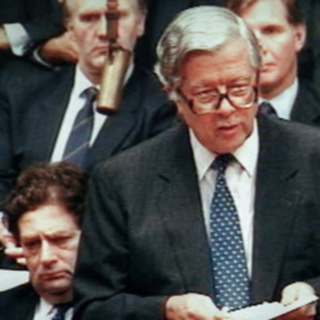
Illustration: Geoffrey Howe delivering his resignation speech to the Commons, 13 November 1990, with Nigel Lawson sitting next to him. Photo PA from the Guardian.

Music: Bach Partita #2c by J Bu licensed under an Attribution-NonCommercial-No Derivatives (aka Music Sharing) 3.0 International License


Avsnitt(275)

242. A wind of change driving the retreat from empire

242. A wind of change driving the retreat from empire

‘The wind of change’ was the other famous phrase of Harold Macmillan’s, along with ‘You’ve never had it so good’. It came in a speech in which he talked about how a movement had grown up in many count...

4 Maj 202514min
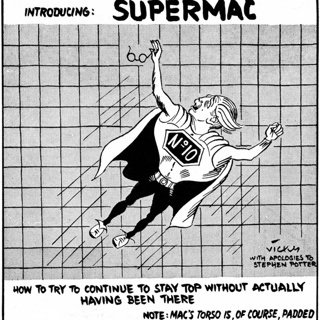
241. Supermac: you've never had it so good

241. Supermac: you've never had it so good

Macmillan overcame the terrible legacy of the Suez catastrophe and, running an economy focused on growth to fund increasing living standards, giving him the opportunity to annouce that people had neve...

27 Apr 202514min
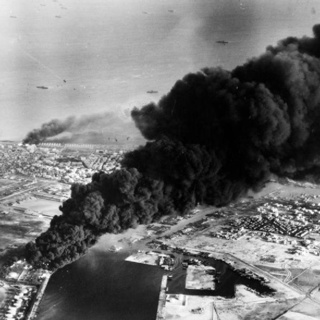
240. Suez: nail in the imperial coffin

240. Suez: nail in the imperial coffin

Anthony Eden started his premiership well, chalking up a general election win and the lowest level of unemployment Britain has seen at any time since the Second World War. Little else went well, howev...

20 Apr 202514min
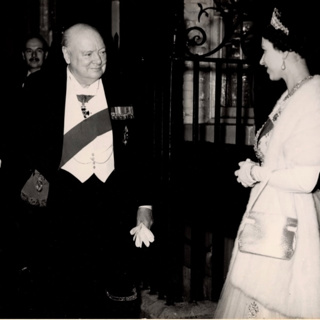
239. Winston back, Winston out

239. Winston back, Winston out

The old man was back. The Conservatives won the 1951 election and Winston Churchill returned to Downing Street. And he really was an old man – nearly 77 when he took office. To many, he it seemed incr...

13 Apr 202514min
238. Decline to defeat

238. Decline to defeat

Circumstances seemed unfavourable for a Labour victory in a 1950 election but, when it was held, Attlee managed to lead his party to the second win in its history. It took a majority of the popular vo...

6 Apr 202514min
237. Citizen socialism at home, resisting the Soviets abroad

237. Citizen socialism at home, resisting the Soviets abroad

What Attlee’s government had shown was that, though it regarded itself as Socialist, it was a very distinctive kind of Socialism and heavily influenced by Liberal thinking. Where a more Marxist Social...

30 Mars 202514min
236. Greyness at home, decline abroad

236. Greyness at home, decline abroad

Of the five ‘giant evils’ William Beveridge identified, the Attlee government set out to deal with want through social security, squalor through better housing, ignorance through more schooling and di...

23 Mars 202514min
235. Clem against the Evil Giants

235. Clem against the Evil Giants

In the July 1945 general election, the British public offered Winston Churchill, as he put it himself, the ‘order of the boot’. A victorious war Prime Minister was kicked out. In his place, his deputy...

16 Mars 202514min

Populärt inom Historia

massmordarpodden
historiska-brott
p3-historia
kod-katastrof
olosta-mord
historiepodden-se
motiv
rss-historiska-brottslingar
historianu-med-urban-lindstedt
rss-massmordarpodden
rss-seriemordarpodden
rss-historien-om-2
krigshistoriepodden
rss-brottsligt
harrisons-dramatiska-historia
militarhistoriepodden
nu-blir-det-historia
bedragare
palmemordet
rss-folkets-historia