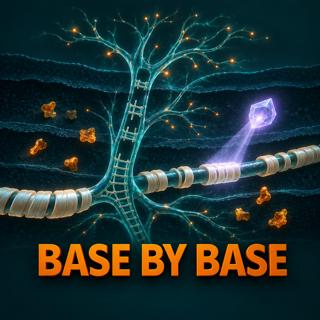
354: How Cohesin Acetylation and ATPase Shape Chromatin Loops and Cohesion
Base by Base30 Huhti

354: How Cohesin Acetylation and ATPase Shape Chromatin Loops and Cohesion

Costantino L et al., PNAS - Costantino et al. dissect how Eco1-mediated acetylation of Smc3 (K112, K113) and cohesin ATPase activity separately regulate chromatin loop size, loop positioning, and sister chromatid tethering in budding yeast using Micro-C XL, ChIP, and biochemical ATPase assays. Key terms: cohesin, acetylation, ATPase, chromatin loops, sister chromatid cohesion.

Study Highlights:
Using a panel of budding yeast mutants, the authors show that acetylation of either Smc3 K112 or K113 is sufficient to produce positioned chromatin loops, while loss of both (Eco1 depletion) leads to expanded, unpositioned loops despite normal cohesin binding. K113 acetylation is required for sister chromatid cohesion (tethering), but cohesion-defective K113R mutants still form positioned loops, indicating looping can occur without tethering. K112 acetyl-mimic reduces loader-stimulated ATPase yet retains wild-type loop architecture, whereas hyper-ATPase mutants convert random loops into more positioned loops. The DE (low-ATPase) mutant produces long, unpositioned loops despite normal cohesin binding and Pds5 recruitment, indicating separable mechanisms downstream of acetylation and Pds5.

Conclusion:
Acetylation and ATPase activity separately tune cohesin's functions: acetylation at Smc3 K112/K113 helps position loops and control ATPase responsiveness, K113 acetylation is essential for tethering, and ATPase level biases cohesin toward random versus positioned loops, supporting active loop extrusion as the primary loop-forming mechanism.

Music:
Enjoy the music based on this article at the end of the episode.

Article title:
Cohesin acetylation and ATPase activity control cohesion and loop architecture through distinct mechanisms

First author:
Costantino L

Journal:
PNAS

DOI:
10.1073/pnas.2531218123

Reference:
Costantino L, Ye T, Boardman K, Xiang S, Luo J, Mu Y, Ma W, Koshland D. Cohesin acetylation and ATPase activity control cohesion and loop architecture through distinct mechanisms. PNAS. 2026;123(17):e2531218123. doi:10.1073/pnas.2531218123.

License:
This episode is based on an open-access article published under the Creative Commons Attribution 4.0 International License (CC BY 4.0) – https://creativecommons.org/licenses/by/4.0/

Support:
Base by Base – Stripe donations: https://donate.stripe.com/7sY4gz71B2sN3RWac5gEg00

Official website https://basebybase.com

On PaperCast Base by Base you'll discover the latest in genomics, functional genomics, structural genomics, and proteomics.

Episode link: https://basebybase.com/episodes/cohesin-acetylation-atpase-loop-architecture

QC:
This episode was checked against the original article PDF and publication metadata for the episode release published on 2026-04-30.

QC Scope:
- article metadata and core scientific claims from the narration
- excludes analogies, intro/outro, and music
- transcript coverage: Audited the transcript sections describing cohesin functions (loop extrusion and tethering), Eco1-mediated Smc3 acetylation at K112/K113, ATPase regulation by Scc2/Scc4, mutations (K112R, K113R, K112Q, K113Q, DE, TI), Micro-C XL method and CARs, Pds5 involvement, and the active loop extrusion model versus loop capture.
- transcript topics: Cohesin functions: loop extrusion and sister chromatid tethering; Smc3 K112/K113 acetylation and Eco1; ATPase regulation by loader Scc2/Scc4 and acetylation; Mutant analyses: K112R, K113R, K112Q, K113Q, ECO1-AID, TI, DE; Micro-C XL methodology and CARs/positioned loops; Pds5 binding and loop regulation

QC Summary:
- factual score: 10/10
- metadata score: 10/10
- supported core claims: 6
- claims flagged for review: 0
- metadata checks passed: 4
- metadata issues found: 0

Metadata Audited:
- article_doi
- article_titl...

Chapters
  • (00:00:20) - Base by Base: The motor of cell division
  • (00:05:37) - The chemical engine of cell cohesion
  • (00:06:57) - Cohesin's passive loop capture model
  • (00:10:22) - How does DNA cohesion work?
  • (00:11:30) - Two Marked Tracks

Tämä jakso on lisätty Podme-palveluun avoimen RSS-syötteen kautta eikä se ole Podmen omaa tuotantoa. Siksi jakso saattaa sisältää mainontaa.

Jaksot(462)

461: Adult Ank3 loss quiets neurons and lowers a myelin protein

461: Adult Ank3 loss quiets neurons and lowers a myelin protein

Yoon et al., Proceedings of the National Academy of Sciences - ANK3, which encodes the scaffolding protein ankyrin-G, is a major risk gene for bipolar disorder and schizophrenia, yet what it does in a...

24 Syys 24min

460: The lupus variant that also sharpens antiviral defense

460: The lupus variant that also sharpens antiviral defense

Virolainen et al., The American Journal of Human Genetics - A lupus signal on chromosome 11p15 narrows to a coding haplotype in IRF7 that most people in the world carry. This study shows the risk form...

21 Syys 24min

459: Cerebral palsy genetics: 515 candidate genes, evidence for 89

459: Cerebral palsy genetics: 515 candidate genes, evidence for 89

Arterbery et al., The American Journal of Human Genetics - Hundreds of genes have been reported as causes of cerebral palsy, yet there is no agreed model of what a pathogenic variant in a child with C...

13 Syys 24min
458: Somatic or inherited? Reading TP53 risk from shared DNA

458: Somatic or inherited? Reading TP53 risk from shared DNA

MacGregor et al., The American Journal of Human Genetics - Pathogenic TP53 variants found in blood have long been read as inherited Li-Fraumeni alleles, but many turn out to be somatic clones that gre...

10 Syys 25min

457: A deletion that raises Alzheimer risk, a duplication that lowers it

457: A deletion that raises Alzheimer risk, a duplication that lowers it

Quenez O et al., The American Journal of Human Genetics - Rare copy-number variants were called from 22,319 exomes covering early-onset Alzheimer disease, late-onset disease and unaffected controls, t...

9 Syys 24min

456: Beyond exons: where heritability hides as traits get more polygenic

456: Beyond exons: where heritability hides as traits get more polygenic

Fuhrer J et al., The American Journal of Human Genetics - Across 34 complex traits and disorders, a MiXeR-based framework partitions SNP heritability over 74 functional annotations and finds that exon...

8 Syys 45min

455: Agentic genomics: the bottleneck moves from code to judgment

455: Agentic genomics: the bottleneck moves from code to judgment

Corpas M et al., Cell Genomics - A Perspective arguing that autonomous AI agents which discover, configure and chain bioinformatics operations from natural-language instructions have shifted the bottl...

7 Syys 13min

454: Efavirenz retarda a doença priônica mexendo no colesterol do cérebro [PT]

454: Efavirenz retarda a doença priônica mexendo no colesterol do cérebro [PT]

Ali T et al., JCI Insight - Um antirretroviral aprovado para HIV, dado por via oral em microdose, prolongou a sobrevida de camundongos que carregam a proteína priônica humana e foram infectados com pr...

2 Syys 17min

Suosittua kategoriassa Tiede

rss-mita-tulisi-tietaa
rss-poliisin-mieli
utelias-mieli
rss-hereilla
tiedekulma-podcast
rss-duodecim-lehti
rss-luontopodi-samuel-glassar-tutkii-luonnon-ihmeita
hippokrateen-vastaanotolla
rss-bios-podcast
docemilia
rss-politiikasta-podcast
rss-tiedetta-vai-tarinaa
rss-ranskaa-raakana
rss-lihavuudesta-podcast
radio-antro
rss-radplus