445: Why Thymine Survived the UV: Photodamage Pathways Explained

445: Why Thymine Survived the UV: Photodamage Pathways Explained

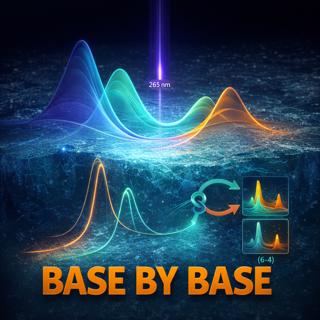
Khosh Abady K et al., PNAS - Spectroscopic comparison of thymine and uracil under 265 nm UVC shows thymine is more photoreactive and absorbs more primordial UVC, yet channels damage into reversible CPDs rather than irreversible (6-4) lesions, supporting an evolutionary 'molecular sunscreen' role. Key terms: UV photodamage, thymine, uracil, cyclobutane pyrimidine dimer, origin of life.

Study Highlights:
The authors used absorption, fluorescence, and Raman spectroscopy with 265 nm UVC irradiation to compare thymine and uracil photochemistry under controlled conditions. Thymine shows a faster overall absorbance decay (k = 0.174 min−1) than uracil (k = 0.064 min−1) and ~9% broader, redshifted absorption that increases overlap with primordial UVC. Thymine exhibits ~4.5× stronger intrinsic fluorescence and produces higher-amplitude photoproduct fluorescence while accumulating irreversible (6-4) photoproducts more slowly (k = 1.56 min−1) than uracil (k = 2.04 min−1). Raman markers distinguish CPD and (6-4) pathways and indicate thymine preferentially funnels damage into reversible CPD formation amenable to nonenzymatic self-repair.

Conclusion:
Thymine, though more photoreactive and exposed to higher primordial UVC flux, appears evolutionarily selected to localize UV damage into reversible lesions (CPDs) and provide molecular 'sunscreen' protection while enabling nonenzymatic self-repair, complementing later biochemical fidelity mechanisms.

Music:
Enjoy the music based on this article at the end of the episode.

Article title:
UV photodamage pathways and the evolutionary selection of thymine over uracil in early genetic systems

First author:
Khosh Abady K

Journal:
PNAS

DOI:
10.1073/pnas.2615278123

Reference:
Khosh Abady K, Karpourazar N, Rentzepis PM. UV photodamage pathways and the evolutionary selection of thymine over uracil in early genetic systems. PNAS. 2026. doi:10.1073/pnas.2615278123

License:
This episode is based on an open-access article published under the Creative Commons Attribution 4.0 International License (CC BY 4.0) – https://creativecommons.org/licenses/by/4.0/

Support:
Base by Base is independent and ad-free — no sponsors, no paywall. If an episode was worth your time, chip in and keep the papers audited and the original songs coming:
❤️ Support monthly: https://buy.stripe.com/cNifZhclVebvagk2JDgEg01
☕ One-time donation: https://donate.stripe.com/7sY4gz71B2sN3RWac5gEg00
More at basebybase.com

On PaperCast Base by Base you'll discover the latest in genomics, functional genomics, structural genomics, and proteomics.

Episode link: https://basebybase.com/episodes/uv-photodamage-thymine-vs-uracil

QC:
This episode was checked against the original article PDF and publication metadata for the episode release published on 2026-08-22.

QC Scope:
- article metadata and core scientific claims from the narration
- excludes analogies, intro/outro, and music
- transcript coverage: Audited transcript sections: background on RNA world and thymine vs uracil, experimental design with frozen-state bases, absorption/fluorescence/Raman results, and interpretation including CPD vs (6-4) pathways, molecular sunscreen hypothesis, evolutionary implications, and applications to pathogen detection/UV disinfe
- transcript topics: RNA world background and thymine vs uracil photochemistry; Experimental design: frozen-ice state, 130 µM concentration, 265.3 nm narrowband UVC LED, -15 °C; Absorption spectra and photodegradation kinetics (k values for thymine and uracil); Fluorescence kinetics and photoproduct formation; Raman signatures for CPD and (6-4) photoproducts; Methyl group effects on base stacking and CPD bias

QC Summary:
- factual score: 10/10
- metadata score: 10/10
- supported core claims: 5
- claims flagged f...

Chapters
  • (00:00:00) - Base by Base
  • (00:00:29) - Why DNA vs RNA was the ultimate solar hard drive
  • (00:06:02) - The UV glow of early life
  • (00:10:51) - Thiine protects the DNA from UV damage
  • (00:16:00) - Molecular sunscreen: The UV protection
  • (00:21:19) - How DNA protected its ancestors from the sun
  • (00:24:26) - Make It Bend, Don't Let It Break

Tämä jakso on lisätty Podme-palveluun avoimen RSS-syötteen kautta eikä se ole Podmen omaa tuotantoa. Siksi jakso saattaa sisältää mainontaa.

Jaksot(462)

461: Adult Ank3 loss quiets neurons and lowers a myelin protein

461: Adult Ank3 loss quiets neurons and lowers a myelin protein

Yoon et al., Proceedings of the National Academy of Sciences - ANK3, which encodes the scaffolding protein ankyrin-G, is a major risk gene for bipolar disorder and schizophrenia, yet what it does in a...

24 Syys 24min
460: The lupus variant that also sharpens antiviral defense

460: The lupus variant that also sharpens antiviral defense

Virolainen et al., The American Journal of Human Genetics - A lupus signal on chromosome 11p15 narrows to a coding haplotype in IRF7 that most people in the world carry. This study shows the risk form...

21 Syys 24min
459: Cerebral palsy genetics: 515 candidate genes, evidence for 89

459: Cerebral palsy genetics: 515 candidate genes, evidence for 89

Arterbery et al., The American Journal of Human Genetics - Hundreds of genes have been reported as causes of cerebral palsy, yet there is no agreed model of what a pathogenic variant in a child with C...

13 Syys 24min
458: Somatic or inherited? Reading TP53 risk from shared DNA

458: Somatic or inherited? Reading TP53 risk from shared DNA

MacGregor et al., The American Journal of Human Genetics - Pathogenic TP53 variants found in blood have long been read as inherited Li-Fraumeni alleles, but many turn out to be somatic clones that gre...

10 Syys 25min
457: A deletion that raises Alzheimer risk, a duplication that lowers it

457: A deletion that raises Alzheimer risk, a duplication that lowers it

Quenez O et al., The American Journal of Human Genetics - Rare copy-number variants were called from 22,319 exomes covering early-onset Alzheimer disease, late-onset disease and unaffected controls, t...

9 Syys 24min
456: Beyond exons: where heritability hides as traits get more polygenic

456: Beyond exons: where heritability hides as traits get more polygenic

Fuhrer J et al., The American Journal of Human Genetics - Across 34 complex traits and disorders, a MiXeR-based framework partitions SNP heritability over 74 functional annotations and finds that exon...

8 Syys 45min
455: Agentic genomics: the bottleneck moves from code to judgment

455: Agentic genomics: the bottleneck moves from code to judgment

Corpas M et al., Cell Genomics - A Perspective arguing that autonomous AI agents which discover, configure and chain bioinformatics operations from natural-language instructions have shifted the bottl...

7 Syys 13min

454: Efavirenz retarda a doença priônica mexendo no colesterol do cérebro [PT]

454: Efavirenz retarda a doença priônica mexendo no colesterol do cérebro [PT]

Ali T et al., JCI Insight - Um antirretroviral aprovado para HIV, dado por via oral em microdose, prolongou a sobrevida de camundongos que carregam a proteína priônica humana e foram infectados com pr...

2 Syys 17min

Suosittua kategoriassa Tiede

rss-mita-tulisi-tietaa
utelias-mieli
rss-poliisin-mieli
tiedekulma-podcast
rss-hereilla
rss-duodecim-lehti
rss-luontopodi-samuel-glassar-tutkii-luonnon-ihmeita
rss-bios-podcast
docemilia
mielipaivakirja
rss-ranskaa-raakana
rss-lihavuudesta-podcast
hippokrateen-vastaanotolla
rss-radplus
radio-antro
rss-politiikasta-podcast