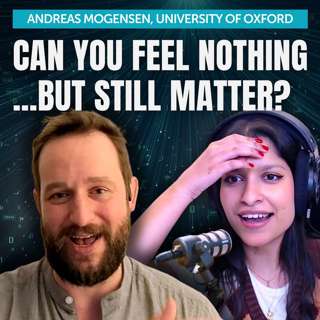

#232 – Andreas Mogensen on what we owe 'philosophical Vulcans' and unconscious beings

#232 – Andreas Mogensen on what we owe 'philosophical Vulcans' and unconscious beings

Most debates about the moral status of AI systems circle the same question: is there something that it feels like to be them? But what if that’s the wrong question to ask? Andreas Mogensen — a senior researcher in moral philosophy at the University of Oxford — argues that so-called 'phenomenal consciousness' might be neither necessary nor sufficient for a being to deserve moral consideration.

Links to learn more and full transcript: https://80k.info/am25

For instance, a creature on the sea floor that experiences nothing but faint brightness from the sun might have no moral claim on us, despite being conscious.

Meanwhile, any being with real desires that can be fulfilled or not fulfilled can arguably be benefited or harmed. Such beings arguably have a capacity for welfare, which means they might matter morally. And, Andreas argues, desire may not require subjective experience.

Desire may need to be backed by positive or negative emotions — but as Andreas explains, there are some reasons to think a being could also have emotions without being conscious.

There’s another underexplored route to moral patienthood: autonomy. If a being can rationally reflect on its goals and direct its own existence, we might have a moral duty to avoid interfering with its choices — even if it has no capacity for welfare.

However, Andreas suspects genuine autonomy might require consciousness after all. To be a rational agent, your beliefs probably need to be justified by something, and conscious experience might be what does the justifying. But even this isn’t clear.

The upshot? There’s a chance we could just be really mistaken about what it would take for an AI to matter morally. And with AI systems potentially proliferating at massive scale, getting this wrong could be among the largest moral errors in history.

In today’s interview, Andreas and host Zershaaneh Qureshi confront all these confusing ideas, challenging their intuitions about consciousness, welfare, and morality along the way. They also grapple with a few seemingly attractive arguments which share a very unsettling conclusion: that human extinction (or even the extinction of all sentient life) could actually be a morally desirable thing.

This episode was recorded on December 3, 2025.

Chapters:

  • Cold open (00:00:00)
  • Introducing Zershaaneh (00:00:55)
  • The puzzle of moral patienthood (00:03:20)
  • Is subjective experience necessary? (00:05:52)
  • What is it to desire? (00:10:42)
  • Desiring without experiencing (00:17:56)
  • What would make AIs moral patients? (00:28:17)
  • Another route entirely: deserving autonomy (00:45:12)
  • Maybe there's no objective truth about any of this (01:12:06)
  • Practical implications (01:29:21)
  • Why not just let superintelligence figure this out for us? (01:38:07)
  • How could human extinction be a good thing? (01:47:30)
  • Lexical threshold negative utilitarianism (02:12:30)
  • So... should we still try to prevent extinction? (02:25:22)
  • What are the most important questions for people to address here? (02:32:16)
  • Is God GDPR compliant? (02:35:32)

Video and audio editing: Dominic Armstrong, Milo McGuire, Luke Monsour, and Simon Monsour
Coordination, transcripts, and web: Katy Moore

Episoder(333)

#138 Classic episode – Sharon Hewitt Rawlette on why pleasure and pain are the only things that intrinsically matter

#138 Classic episode – Sharon Hewitt Rawlette on why pleasure and pain are the only things that intrinsically matter

What in the world is intrinsically good — good in itself even if it has no other effects? Over the millennia, people have offered many answers: joy, justice, equality, accomplishment, loving god, wisd...

22 Jan 20252h 25min
#134 Classic episode – Ian Morris on what big-picture history teaches us

#134 Classic episode – Ian Morris on what big-picture history teaches us

Wind back 1,000 years and the moral landscape looks very different to today. Most farming societies thought slavery was natural and unobjectionable, premarital sex was an abomination, women should obe...

15 Jan 20253h 40min

#140 Classic episode – Bear Braumoeller on the case that war isn’t in decline

#140 Classic episode – Bear Braumoeller on the case that war isn’t in decline

Is war in long-term decline? Steven Pinker's The Better Angels of Our Nature brought this previously obscure academic question to the centre of public debate, and pointed to rates of death in war to a...

8 Jan 20252h 48min

2024 Highlightapalooza! (The best of The 80,000 Hours Podcast this year)

2024 Highlightapalooza! (The best of The 80,000 Hours Podcast this year)

"A shameless recycling of existing content to drive additional audience engagement on the cheap… or the single best, most valuable, and most insight-dense episode we put out in the entire year, depend...

27 Des 20242h 50min
#211 – Sam Bowman on why housing still isn't fixed and what would actually work

#211 – Sam Bowman on why housing still isn't fixed and what would actually work

Rich countries seem to find it harder and harder to do anything that creates some losers. People who don’t want houses, offices, power stations, trains, subway stations (or whatever) built in their ar...

19 Des 20243h 25min
#210 – Cameron Meyer Shorb on dismantling the myth that we can’t do anything to help wild animals

#210 – Cameron Meyer Shorb on dismantling the myth that we can’t do anything to help wild animals

"I really don’t want to give the impression that I think it is easy to make predictable, controlled, safe interventions in wild systems where there are many species interacting. I don’t think it’s eas...

29 Nov 20243h 21min

#209 – Rose Chan Loui on OpenAI’s gambit to ditch its nonprofit

#209 – Rose Chan Loui on OpenAI’s gambit to ditch its nonprofit

One OpenAI critic calls it “the theft of at least the millennium and quite possibly all of human history.” Are they right?Back in 2015 OpenAI was but a humble nonprofit. That nonprofit started a for-p...

27 Nov 20241h 22min

#208 – Elizabeth Cox on the case that TV shows, movies, and novels can improve the world

#208 – Elizabeth Cox on the case that TV shows, movies, and novels can improve the world

"I think stories are the way we shift the Overton window — so widen the range of things that are acceptable for policy and palatable to the public. Almost by definition, a lot of things that are going...

21 Nov 20242h 22min

Populært innen Fakta

fastlegen
dine-penger-pengeradet
relasjonspodden-med-dora-thorhallsdottir-kjersti-idem
treningspodden
foreldreradet
rss-strid-de-norske-borgerkrigene
mikkels-paskenotter
jakt-og-fiskepodden
rss-bisarr-historie
sinnsyn
rss-sunn-okonomi
hverdagspsyken
rss-sarbar-med-lotte-erik
hagespiren-podcast
rss-kunsten-a-leve
gravid-uke-for-uke
level-up-med-anniken-binz
rss-kull
ukast
fryktlos