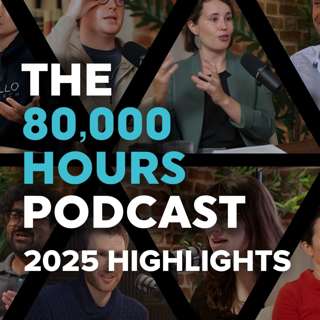
2025 Highlight-o-thon: Oops! All Bests

2025 Highlight-o-thon: Oops! All Bests

It’s that magical time of year once again — highlightapalooza! Stick around for one top bit from each episode we recorded this year, including:

  • Kyle Fish explaining how Anthropic’s AI Claude descends into spiritual woo when left to talk to itself
  • Ian Dunt on why the unelected House of Lords is by far the best part of the British government
  • Sam Bowman’s strategy to get NIMBYs to love it when things get built next to their houses
  • Buck Shlegeris on how to get an AI model that wants to seize control to accidentally help you foil its plans

…as well as 18 other top observations and arguments from the past year of the show.

Links to learn more, video, and full transcript: https://80k.info/best25

It's been another year of living through history, whether we asked for it or not. Luisa and Rob will be back in 2026 to help you make sense of whatever comes next — as Earth continues its indifferent journey through the cosmos, now accompanied by AI systems that can summarise our meetings and generate adequate birthday messages for colleagues we barely know.

Chapters:

  • Cold open (00:00:00)
  • Rob's intro (00:02:35)
  • Helen Toner on whether we're racing China to build AGI (00:03:43)
  • Hugh White on what he'd say to Americans (00:06:09)
  • Buck Shlegeris on convincing AI models they've already escaped (00:12:09)
  • Paul Scharre on a personal experience in Afghanistan that influenced his views on autonomous weapons (00:15:10)
  • Ian Dunt on how unelected septuagenarians are the heroes of UK governance (00:19:06)
  • Beth Barnes on AI companies being locally reasonable, but globally reckless (00:24:27)
  • Tyler Whitmer on one thing the California and Delaware attorneys general forced on the OpenAI for-profit as part of their restructure (00:28:02)
  • Toby Ord on whether rich people will get access to AGI first (00:30:13)
  • Andrew Snyder-Beattie on how the worst biorisks are defence dominant (00:34:24)
  • Eileen Yam on the most eye-watering gaps in opinions about AI between experts and the US public (00:39:41)
  • Will MacAskill on what a century of history crammed into a decade might feel like (00:44:07)
  • Kyle Fish on what happens when two instances of Claude are left to interact with each other (00:49:08)
  • Sam Bowman on where the Not In My Back Yard movement actually has a point (00:56:29)
  • Neel Nanda on how mechanistic interpretability is trying to be the biology of AI (01:03:12)
  • Tom Davidson on the potential to install secret AI loyalties at a very early stage (01:07:19)
  • Luisa and Rob discussing how medicine doesn't take the health burden of pregnancy seriously enough (01:10:53)
  • Marius Hobbhahn on why scheming is a very natural path for AI models — and people (01:16:23)
  • Holden Karnofsky on lessons for AI regulation drawn from successful farm animal welfare advocacy (01:21:29)
  • Allan Dafoe on how AGI is an inescapable idea but one we have to define well (01:26:19)
  • Ryan Greenblatt on the most likely ways for AI to take over (01:29:35)
  • Updates Daniel Kokotajlo has made to his forecasts since writing and publishing the AI 2027 scenario (01:32:47)
  • Dean Ball on why regulation invites path dependency, and that's a major problem (01:37:21)


Video and audio editing: Dominic Armstrong, Milo McGuire, Luke Monsour, and Simon Monsour
Music: CORBIT
Coordination, transcripts, and web: Katy Moore

Episoder(333)

#139 – Alan Hájek on puzzles and paradoxes in probability and expected value

#139 – Alan Hájek on puzzles and paradoxes in probability and expected value

A casino offers you a game. A coin will be tossed. If it comes up heads on the first flip you win $2. If it comes up on the second flip you win $4. If it comes up on the third you win $8, the fourth y...

28 Okt 20223h 38min
Preventing an AI-related catastrophe (Article)

Preventing an AI-related catastrophe (Article)

Today’s release is a professional reading of our new problem profile on preventing an AI-related catastrophe, written by Benjamin Hilton. We expect that there will be substantial progress in AI in t...

14 Okt 20222h 24min
#138 – Sharon Hewitt Rawlette on why pleasure and pain are the only things that intrinsically matter

#138 – Sharon Hewitt Rawlette on why pleasure and pain are the only things that intrinsically matter

What in the world is intrinsically good — good in itself even if it has no other effects? Over the millennia, people have offered many answers: joy, justice, equality, accomplishment, loving god, wisd...

30 Sep 20222h 24min
#137 – Andreas Mogensen on whether effective altruism is just for consequentialists

#137 – Andreas Mogensen on whether effective altruism is just for consequentialists

Effective altruism, in a slogan, aims to 'do the most good.' Utilitarianism, in a slogan, says we should act to 'produce the greatest good for the greatest number.' It's clear enough why utilitarians ...

8 Sep 20222h 21min

#136 – Will MacAskill on what we owe the future

#136 – Will MacAskill on what we owe the future

People who exist in the future deserve some degree of moral consideration.The future could be very big, very long, and/or very good.We can reasonably hope to influence whether people in the future exi...

15 Aug 20222h 54min
#135 – Samuel Charap on key lessons from five months of war in Ukraine

#135 – Samuel Charap on key lessons from five months of war in Ukraine

After a frenetic level of commentary during February and March, the war in Ukraine has faded into the background of our news coverage. But with the benefit of time we're in a much stronger position to...

8 Aug 202254min
#134 – Ian Morris on what big-picture history teaches us

#134 – Ian Morris on what big-picture history teaches us

Wind back 1,000 years and the moral landscape looks very different to today. Most farming societies thought slavery was natural and unobjectionable, premarital sex was an abomination, women should obe...

22 Jul 20223h 41min
#133 – Max Tegmark on how a 'put-up-or-shut-up' resolution led him to work on AI and algorithmic news selection

#133 – Max Tegmark on how a 'put-up-or-shut-up' resolution led him to work on AI and algorithmic news selection

On January 1, 2015, physicist Max Tegmark gave up something most of us love to do: complain about things without ever trying to fix them. That “put up or shut up” New Year’s resolution led to the firs...

1 Jul 20222h 57min

Populært innen Fakta

fastlegen
dine-penger-pengeradet
relasjonspodden-med-dora-thorhallsdottir-kjersti-idem
rss-strid-de-norske-borgerkrigene
foreldreradet
mikkels-paskenotter
treningspodden
rss-bisarr-historie
jakt-og-fiskepodden
rss-sunn-okonomi
sinnsyn
tomprat-med-gunnar-tjomlid
rss-kunsten-a-leve
hagespiren-podcast
rss-bak-luftfarten
ukast
fryktlos
hverdagspsyken
rss-mind-body-podden
gravid-uke-for-uke