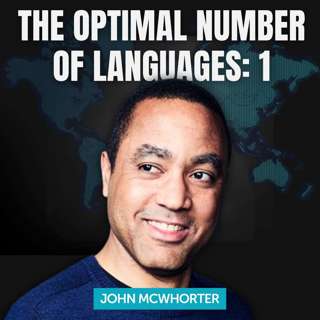

#142 Classic episode – John McWhorter on why the optimal number of languages might be one, and other provocative claims about language

#142 Classic episode – John McWhorter on why the optimal number of languages might be one, and other provocative claims about language

John McWhorter is a linguistics professor at Columbia University specialising in research on creole languages. He's also a content-producing machine, never afraid to give his frank opinion on anything and everything. On top of his academic work, he's written 22 books, produced five online university courses, hosts one and a half podcasts, and now writes a regular New York Times op-ed column.

Rebroadcast: this episode was originally released in December 2022.

YouTube video version: https://youtu.be/MEd7TT_nMJE

Links to learn more, video, and full transcript: https://80k.link/JM

We ask him what we think are the most important things everyone ought to know about linguistics, including:

  • Can you communicate faster in some languages than others, or is there some constraint that prevents that?
  • Does learning a second or third language make you smarter or not?
  • Can a language decay and get worse at communicating what people want to say?
  • If children aren't taught a language, how many generations does it take them to invent a fully fledged one of their own?
  • Did Shakespeare write in a foreign language, and if so, should we translate his plays?
  • How much does language really shape the way we think?
  • Are creoles the best languages in the world — languages that ideally we would all speak?
  • What would be the optimal number of languages globally?
  • Does trying to save dying languages do their speakers a favour, or is it more of an imposition?
  • Should we bother to teach foreign languages in UK and US schools?
  • Is it possible to save the important cultural aspects embedded in a dying language without saving the language itself?
  • Will AI models speak a language of their own in the future, one that humans can't understand but which better serves the tradeoffs AI models need to make?

We’ve also added John’s talk “Why the World Looks the Same in Any Language” to the end of this episode. So stick around after the credits!

Chapters:

  • Rob's intro (00:00:00)
  • Who's John McWhorter? (00:05:02)
  • Does learning another language make you smarter? (00:05:54)
  • Updating Shakespeare (00:07:52)
  • Should we bother teaching foreign languages in school? (00:12:09)
  • Language loss (00:16:05)
  • The optimal number of languages for humanity (00:27:57)
  • Do we reason about the world using language and words? (00:31:22)
  • Can we communicate meaningful information more quickly in some languages? (00:35:04)
  • Creole languages (00:38:48)
  • AI and the future of language (00:50:45)
  • Should we keep ums and ahs in The 80,000 Hours Podcast? (00:59:10)
  • Why the World Looks the Same in Any Language (01:02:07)

Producer: Keiran Harris
Audio mastering: Ben Cordell and Simon Monsour
Video editing: Ryan Kessler and Simon Monsour
Transcriptions: Katy Moore

Episoder(333)

#187 – Zach Weinersmith on how researching his book turned him from a space optimist into a "space bastard"

#187 – Zach Weinersmith on how researching his book turned him from a space optimist into a "space bastard"

"Earth economists, when they measure how bad the potential for exploitation is, they look at things like, how is labour mobility? How much possibility do labourers have otherwise to go somewhere else?...

14 Mai 20243h 6min

#186 – Dean Spears on why babies are born small in Uttar Pradesh, and how to save their lives

#186 – Dean Spears on why babies are born small in Uttar Pradesh, and how to save their lives

"I work in a place called Uttar Pradesh, which is a state in India with 240 million people. One in every 33 people in the whole world lives in Uttar Pradesh. It would be the fifth largest country if i...

1 Mai 20241h 18min

#185 – Lewis Bollard on the 7 most promising ways to end factory farming, and whether AI is going to be good or bad for animals

#185 – Lewis Bollard on the 7 most promising ways to end factory farming, and whether AI is going to be good or bad for animals

"The constraint right now on factory farming is how far can you push the biology of these animals? But AI could remove that constraint. It could say, 'Actually, we can push them further in these ways ...

18 Apr 20242h 33min

#184 – Zvi Mowshowitz on sleeping on sleeper agents, and the biggest AI updates since ChatGPT

#184 – Zvi Mowshowitz on sleeping on sleeper agents, and the biggest AI updates since ChatGPT

Many of you will have heard of Zvi Mowshowitz as a superhuman information-absorbing-and-processing machine — which he definitely is. As the author of the Substack Don’t Worry About the Vase, Zvi has s...

11 Apr 20243h 31min

AI governance and policy (Article)

AI governance and policy (Article)

Today’s release is a reading of our career review of AI governance and policy, written and narrated by Cody Fenwick.Advanced AI systems could have massive impacts on humanity and potentially pose glob...

28 Mar 202451min

#183 – Spencer Greenberg on causation without correlation, money and happiness, lightgassing, hype vs value, and more

#183 – Spencer Greenberg on causation without correlation, money and happiness, lightgassing, hype vs value, and more

"When a friend comes to me with a decision, and they want my thoughts on it, very rarely am I trying to give them a really specific answer, like, 'I solved your problem.' What I’m trying to do often i...

14 Mar 20242h 36min

#182 – Bob Fischer on comparing the welfare of humans, chickens, pigs, octopuses, bees, and more

#182 – Bob Fischer on comparing the welfare of humans, chickens, pigs, octopuses, bees, and more

"[One] thing is just to spend time thinking about the kinds of things animals can do and what their lives are like. Just how hard a chicken will work to get to a nest box before she lays an egg, the a...

8 Mar 20242h 21min

#181 – Laura Deming on the science that could keep us healthy in our 80s and beyond

#181 – Laura Deming on the science that could keep us healthy in our 80s and beyond

"The question I care about is: What do I want to do? Like, when I'm 80, how strong do I want to be? OK, and then if I want to be that strong, how well do my muscles have to work? OK, and then if that'...

1 Mar 20241h 37min

Populært innen Fakta

fastlegen
dine-penger-pengeradet
relasjonspodden-med-dora-thorhallsdottir-kjersti-idem
rss-strid-de-norske-borgerkrigene
foreldreradet
mikkels-paskenotter
treningspodden
rss-bisarr-historie
jakt-og-fiskepodden
rss-sunn-okonomi
sinnsyn
tomprat-med-gunnar-tjomlid
rss-kunsten-a-leve
hagespiren-podcast
rss-bak-luftfarten
ukast
fryktlos
hverdagspsyken
rss-mind-body-podden
gravid-uke-for-uke