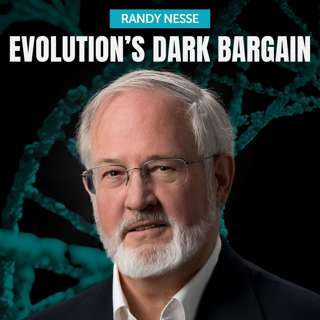

#179 Classic episode – Randy Nesse on why evolution left us so vulnerable to depression and anxiety

#179 Classic episode – Randy Nesse on why evolution left us so vulnerable to depression and anxiety

Mental health problems like depression and anxiety affect enormous numbers of people and severely interfere with their lives. By contrast, we don’t see similar levels of physical ill health in young people. At any point in time, something like 20% of young people are working through anxiety or depression that’s seriously interfering with their lives — but nowhere near 20% of people in their 20s have severe heart disease or cancer or a similar failure in a key organ of the body other than the brain.

From an evolutionary perspective, that’s to be expected, right? If your heart or lungs or legs or skin stop working properly while you’re a teenager, you’re less likely to reproduce, and the genes that cause that malfunction get weeded out of the gene pool.

So why is it that these evolutionary selective pressures seemingly fixed our bodies so that they work pretty smoothly for young people most of the time, but it feels like evolution fell asleep on the job when it comes to the brain? Why did evolution never get around to patching the most basic problems, like social anxiety, panic attacks, debilitating pessimism, or inappropriate mood swings? For that matter, why did evolution go out of its way to give us the capacity for low mood or chronic anxiety or extreme mood swings at all?

Today’s guest, Randy Nesse — a leader in the field of evolutionary psychiatry — wrote the book Good Reasons for Bad Feelings, in which he sets out to try to resolve this paradox.

Rebroadcast: This episode originally aired in February 2024.

Links to learn more, video, and full transcript: https://80k.info/rn

In the interview, host Rob Wiblin and Randy discuss the key points of the book, as well as:

  • How the evolutionary psychiatry perspective can help people appreciate that their mental health problems are often the result of a useful and important system.
  • How evolutionary pressures and dynamics lead to a wide range of different personalities, behaviours, strategies, and tradeoffs.
  • The missing intellectual foundations of psychiatry, and how an evolutionary lens could revolutionise the field.
  • How working as both an academic and a practicing psychiatrist shaped Randy’s understanding of treating mental health problems.
  • The “smoke detector principle” of why we experience so many false alarms along with true threats.
  • The origins of morality and capacity for genuine love, and why Randy thinks it’s a mistake to try to explain these from a selfish gene perspective.
  • Evolutionary theories on why we age and die.
  • And much more.

Chapters:

  • Cold Open (00:00:00)
  • Rob's Intro (00:00:55)
  • The interview begins (00:03:01)
  • The history of evolutionary medicine (00:03:56)
  • The evolutionary origin of anxiety (00:12:37)
  • Design tradeoffs, diseases, and adaptations (00:43:19)
  • The tricker case of depression (00:48:57)
  • The purpose of low mood (00:54:08)
  • Big mood swings vs barely any mood swings (01:22:41)
  • Is mental health actually getting worse? (01:33:43)
  • A general explanation for bodies breaking (01:37:27)
  • Freudianism and the origins of morality and love (01:48:53)
  • Evolutionary medicine in general (02:02:42)
  • Objections to evolutionary psychology (02:16:29)
  • How do you test evolutionary hypotheses to rule out the bad explanations? (02:23:19)
  • Striving and meaning in careers (02:25:12)
  • Why do people age and die? (02:45:16)

Producer and editor: Keiran Harris
Audio Engineering Lead: Ben Cordell
Technical editing: Dominic Armstrong
Transcriptions: Katy Moore

Episoder(333)

#169 – Paul Niehaus on whether cash transfers cause economic growth, and keeping theft to acceptable levels

#169 – Paul Niehaus on whether cash transfers cause economic growth, and keeping theft to acceptable levels

"One of our earliest supporters and a dear friend of mine, Mark Lampert, once said to me, “The way I think about it is, imagine that this money were already in the hands of people living in poverty. I...

26 Okt 20231h 47min

#168 – Ian Morris on whether deep history says we're heading for an intelligence explosion

#168 – Ian Morris on whether deep history says we're heading for an intelligence explosion

"If we carry on looking at these industrialised economies, not thinking about what it is they're actually doing and what the potential of this is, you can make an argument that, yes, rates of growth a...

23 Okt 20232h 43min

#167 – Seren Kell on the research gaps holding back alternative proteins from mass adoption

#167 – Seren Kell on the research gaps holding back alternative proteins from mass adoption

"There have been literally thousands of years of breeding and living with animals to optimise these kinds of problems. But because we're just so early on with alternative proteins and there's so much ...

18 Okt 20231h 54min

#166 – Tantum Collins on what he’s learned as an AI policy insider at the White House, DeepMind and elsewhere

#166 – Tantum Collins on what he’s learned as an AI policy insider at the White House, DeepMind and elsewhere

"If you and I and 100 other people were on the first ship that was going to go settle Mars, and were going to build a human civilisation, and we have to decide what that government looks like, and we ...

12 Okt 20233h 8min

#165 – Anders Sandberg on war in space, whether civilisations age, and the best things possible in our universe

#165 – Anders Sandberg on war in space, whether civilisations age, and the best things possible in our universe

"Now, the really interesting question is: How much is there an attacker-versus-defender advantage in this kind of advanced future? Right now, if somebody's sitting on Mars and you're going to war agai...

6 Okt 20232h 48min

#164 – Kevin Esvelt on cults that want to kill everyone, stealth vs wildfire pandemics, and how he felt inventing gene drives

#164 – Kevin Esvelt on cults that want to kill everyone, stealth vs wildfire pandemics, and how he felt inventing gene drives

"Imagine a fast-spreading respiratory HIV. It sweeps around the world. Almost nobody has symptoms. Nobody notices until years later, when the first people who are infected begin to succumb. They might...

2 Okt 20233h 3min

Great power conflict (Article)

Great power conflict (Article)

Today’s release is a reading of our Great power conflict problem profile, written and narrated by Stephen Clare.If you want to check out the links, footnotes and figures in today’s article, you can fi...

22 Sep 20231h 19min

#163 – Toby Ord on the perils of maximising the good that you do

#163 – Toby Ord on the perils of maximising the good that you do

Effective altruism is associated with the slogan "do the most good." On one level, this has to be unobjectionable: What could be bad about helping people more and more?But in today's interview, Toby O...

8 Sep 20233h 7min

Populært innen Fakta

fastlegen
dine-penger-pengeradet
relasjonspodden-med-dora-thorhallsdottir-kjersti-idem
foreldreradet
treningspodden
rss-strid-de-norske-borgerkrigene
mikkels-paskenotter
rss-bisarr-historie
jakt-og-fiskepodden
rss-sunn-okonomi
sinnsyn
rss-kunsten-a-leve
hverdagspsyken
tomprat-med-gunnar-tjomlid
rss-bak-luftfarten
fryktlos
ukast
rss-mind-body-podden
level-up-med-anniken-binz
rss-kull