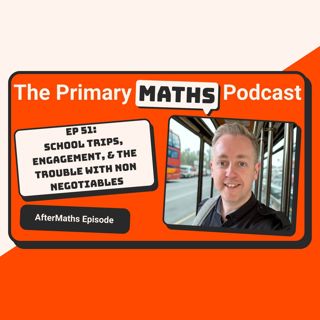

AfterMaths: School Trips, Maths Engagement and the Trouble with Non Negotiables

AfterMaths: School Trips, Maths Engagement and the Trouble with Non Negotiables

In this week’s Aftermaths episode, Jon and Becky reflect on what can get lost when pace, coverage and efficiency become the main drivers of lesson planning.

The conversation begins with a light hearted look at memorable school trips, from soggy outdoor museums to luxury coaches that were wildly unsuited to Year 6 energy. From there, the discussion turns to something more serious: how tightly prescribed lesson structures and non negotiables can squeeze out curiosity, autonomy and meaningful thinking for both teachers and pupils.

Jon shares reflections on recent classroom visits and raises questions about identikit lessons, box ticking and whether every lesson really needs the same checklist of features. Becky explores how these pressures can limit opportunities to truly know pupils and respond to them as individuals.

Following last week’s episode, Jon also unpacks a lively LinkedIn discussion about engagement. He reflects on comments that challenge engagement as a proxy for learning and introduces a more nuanced view, distinguishing between behavioural, emotional and cognitive engagement. The episode explores what engagement really looks like in maths lessons, from pupils talking, noticing patterns and making connections, to experiencing those moments where ideas suddenly fall into place.

In Maths of Life, Becky explores the relationship between dance, music and number, explaining why dancers often count in eights while musicians tend to work in fours, and what this reveals about memory, chunking and structure.

The episode closes with research in 60 seconds ish, where Jon summarises a newly published meta analysis on gamification in mathematics education. The research suggests that while gamification can boost motivation, it works best when it emphasises cooperation, mastery and feedback rather than competition, points or leaderboards. Engagement, the study suggests, is often poorly defined and difficult to measure.

If you have a memorable school trip story or want to join the conversation about engagement and lesson design, you can get in touch at primarymathspodcast@twinkl.co.uk.

You can read the research discussed in this episode here:

https://link.springer.com/article/10.1007/s10648-025-10108-1

As ever, thank you for listening. If you’re enjoying the podcast, please consider subscribing, leaving a review, or sharing the episode with a colleague.

Denne episoden er hentet fra en åpen RSS-feed og er ikke publisert av Podme. Den kan derfor inneholde annonser.

Episoder(90)

Is the maths attainment gap getting wider?

Is the maths attainment gap getting wider?

Why do some pupils seem to thrive in maths while others struggle to access the same lesson?Jon and Becky discuss the latest PISA findings and the widening gap between higher and lower attainers, befor...

18 Sep 38min
How Big Is the Universe? | AfterMaths Summer Special

How Big Is the Universe? | AfterMaths Summer Special

How can the universe be 13.8 billion years old but the observable universe be around 93 billion light years across?In this AfterMaths Summer Special, Jon is joined by primary science specialist Sarah ...

4 Sep 42min
Can Maths Help You Win at Games?

Can Maths Help You Win at Games?

Can maths help you win at games?In this AfterMaths Summer Special, Jon and Becky explore the line between luck and strategy — and whether understanding the maths behind a game can actually give you an...

28 Aug 25min
Can Maths Predict the Future?

Can Maths Predict the Future?

Can maths really predict the future?We can predict the return of a comet decades in advance, but tomorrow's weather can still catch us completely by surprise. In this AfterMaths Summer Special, Jon an...

24 Aug 26min
The Maths of Getting Away: Routes, Queues & Google Maps

The Maths of Getting Away: Routes, Queues & Google Maps

Podcast Show NotesWhat makes a route the best route? The shortest distance? The quickest journey? The cheapest option? Or simply whichever one Google tells you to take?In this AfterMaths Summer Specia...

21 Aug 31min
Who Decided How Long a Metre Is? AfterMaths Summer Special 3

Who Decided How Long a Metre Is? AfterMaths Summer Special 3

Who decided how long a metre should be? Why is a mile 1,760 yards? And what connects the French Revolution, an expedition from Dunkirk to Barcelona and the speed of light?In this AfterMaths Summer Spe...

7 Aug 22min
The Probability Problems That Make Your Brain Hurt - AfterMaths Summer Special 2 2026

The Probability Problems That Make Your Brain Hurt - AfterMaths Summer Special 2 2026

Probability often feels as though it should be intuitive, right up until the mathematics tells us that our instincts are completely wrong.In this AfterMaths Summer Special, Jon and Becky explore the s...

31 Jul 30min
Why Do Summer Holidays Feel Shorter As We Get Older? Summer Special 1 2026

Why Do Summer Holidays Feel Shorter As We Get Older? Summer Special 1 2026

Why did the six-week summer holiday feel endless when we were children, yet now seems to disappear almost as soon as it begins?In the first of the 2026 Aftermaths Summer Specials, Jon and Becky explor...

28 Jul 29min

Populært innen Fakta

fastlegen
dine-penger-pengeradet
relasjonspodden-med-dora-thorhallsdottir-kjersti-idem
rss-strid
treningspodden
foreldreradet
rss-bisarr-historie
jakt-og-fiskepodden
rss-orjasater
hverdagspsyken
rss-kunsten-a-leve
takk-og-lov-med-anine-kierulf
sinnsyn
mikkels-paskenotter
rss-impressions-2
gravid-uke-for-uke
psykt-interessant
tomprat-med-gunnar-tjomlid
fryktlos
level-up-med-anniken-binz