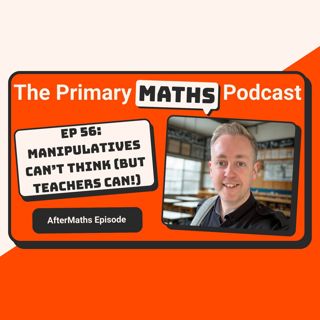

AfterMaths: Manipulatives Can't Think (But Teachers Can!)

AfterMaths: Manipulatives Can't Think (But Teachers Can!)

Episode 56 of The Primary Maths Podcast focuses on manipulatives in primary maths and asks a simple but important question: do manipulatives automatically lead to mathematical thinking? Jon and Becky reflect on a recent lesson about commutativity where children were building arrays with cubes but describing the task as “making it with cubes” rather than explaining the structure behind three multiplied by four being equal to four multiplied by three. This opens up a wider discussion about the CPA approach, the difference between doing and thinking, and the importance of questioning to help children notice mathematical structure rather than follow procedures.

The episode includes a listener question from Priya, a maths lead who has invested in new manipulatives but is finding that they are sitting unused or being used without clear purpose. Jon and Becky discuss how CPD can help teachers understand what each manipulative is designed to reveal, including the difference between base ten equipment and Cuisenaire rods, and how to move beyond a tick-box approach to concrete resources.

In Maths of Life, Becky explores the mathematics behind Lego, including the 0.002mm manufacturing tolerance of each brick, the 3,700 different brick shapes, the 915,103,765 possible combinations of six identical 2x4 bricks, and the approximate 1:40 scale of Lego minifigures. The conversation highlights how building blocks can be used to explore arrays, ratios, scale and structure in the classroom.

Jon also shares a research summary on maths anxiety among UK primary teachers, based on a recent cross-national study highlighted by Dr Thomas Hunt. While overall levels of maths anxiety are relatively low, UK generalist primary teachers report higher anxiety about maths and teaching maths than colleagues in some other countries, raising important questions about confidence and professional development.

The episode concludes with a short maths magic segment that demonstrates how algebraic structure sits behind a simple number trick and how manipulatives can be used to make that structure visible.

Jon also references his new Substack article responding to the Education White Paper and its implications for SEND and early numeracy, which you can read here: https://substack.com/@joncripwell.

You can join the ongoing discussion on LinkedIn at https://www.linkedin.com/in/joncripwell/.

-

Next week features an interview with Hannah Allison on Storybook Maths, followed by an Aftermaths episode exploring whether teaching structures genuinely support professional judgement or risk becoming scripts.

Denne episoden er hentet fra en åpen RSS-feed og er ikke publisert av Podme. Den kan derfor inneholde annonser.

Episoder(90)

Is the maths attainment gap getting wider?

Is the maths attainment gap getting wider?

Why do some pupils seem to thrive in maths while others struggle to access the same lesson?Jon and Becky discuss the latest PISA findings and the widening gap between higher and lower attainers, befor...

18 Sep 38min
How Big Is the Universe? | AfterMaths Summer Special

How Big Is the Universe? | AfterMaths Summer Special

How can the universe be 13.8 billion years old but the observable universe be around 93 billion light years across?In this AfterMaths Summer Special, Jon is joined by primary science specialist Sarah ...

4 Sep 42min
Can Maths Help You Win at Games?

Can Maths Help You Win at Games?

Can maths help you win at games?In this AfterMaths Summer Special, Jon and Becky explore the line between luck and strategy — and whether understanding the maths behind a game can actually give you an...

28 Aug 25min
Can Maths Predict the Future?

Can Maths Predict the Future?

Can maths really predict the future?We can predict the return of a comet decades in advance, but tomorrow's weather can still catch us completely by surprise. In this AfterMaths Summer Special, Jon an...

24 Aug 26min

The Maths of Getting Away: Routes, Queues & Google Maps

The Maths of Getting Away: Routes, Queues & Google Maps

Podcast Show NotesWhat makes a route the best route? The shortest distance? The quickest journey? The cheapest option? Or simply whichever one Google tells you to take?In this AfterMaths Summer Specia...

21 Aug 31min
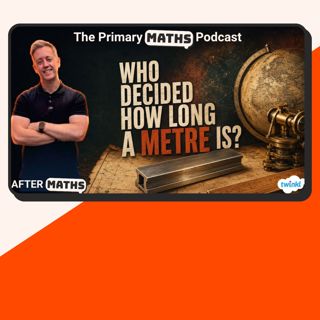
Who Decided How Long a Metre Is? AfterMaths Summer Special 3

Who Decided How Long a Metre Is? AfterMaths Summer Special 3

Who decided how long a metre should be? Why is a mile 1,760 yards? And what connects the French Revolution, an expedition from Dunkirk to Barcelona and the speed of light?In this AfterMaths Summer Spe...

7 Aug 22min
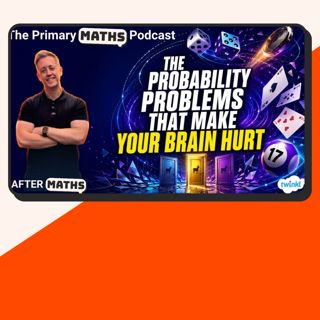
The Probability Problems That Make Your Brain Hurt - AfterMaths Summer Special 2 2026

The Probability Problems That Make Your Brain Hurt - AfterMaths Summer Special 2 2026

Probability often feels as though it should be intuitive, right up until the mathematics tells us that our instincts are completely wrong.In this AfterMaths Summer Special, Jon and Becky explore the s...

31 Jul 30min
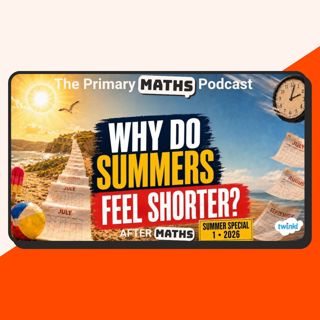
Why Do Summer Holidays Feel Shorter As We Get Older? Summer Special 1 2026

Why Do Summer Holidays Feel Shorter As We Get Older? Summer Special 1 2026

Why did the six-week summer holiday feel endless when we were children, yet now seems to disappear almost as soon as it begins?In the first of the 2026 Aftermaths Summer Specials, Jon and Becky explor...

28 Jul 29min

Populært innen Fakta

fastlegen
dine-penger-pengeradet
relasjonspodden-med-dora-thorhallsdottir-kjersti-idem
rss-strid
treningspodden
foreldreradet
rss-bisarr-historie
jakt-og-fiskepodden
rss-orjasater
hverdagspsyken
rss-kunsten-a-leve
takk-og-lov-med-anine-kierulf
sinnsyn
mikkels-paskenotter
rss-impressions-2
gravid-uke-for-uke
psykt-interessant
tomprat-med-gunnar-tjomlid
fryktlos
level-up-med-anniken-binz