
S9 Ep15: What's next for Ukraine: Reconstruction

S9 Ep15: What's next for Ukraine: Reconstruction

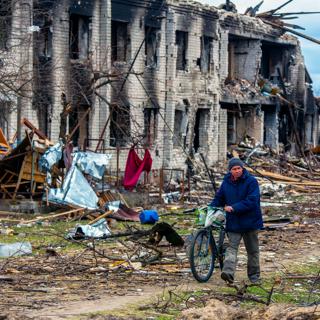
Ukraine's cities were failing long before the Russian invasion began. Kyiv and Lviv ranked among the 40 most congested cities in the world, yet neither makes the top 100 by population. Ninety per cent of Ukraine's housing stock was built before 1990. Its urban infrastructure was designed for a Soviet economy and never properly adapted for the one that followed. So when reconstruction begins, the question is not simply how to repair what was there: it is whether repairing what was there is the right goal.

Edward Glaeser of Harvard, Martina Kirchberger of Trinity College Dublin, and Andrii Parkhomenko of the University of Southern California argue that the most instructive precedent is not post-USSR Warsaw, or postwar Berlin, it is postwar Tokyo. Firebombed into ruin, Tokyo rebuilt in a way that was strikingly decentralised: master plans quickly abandoned, local communities empowered to combine small lots through land readjustment, and figure it out from the bottom up. Before the war, Ukraine's economic activity was already shifting away from heavy industry and the east, towards services and the west. Reconstruction that concentrates investment where the damage is greatest, rather than where people want to build a new life, would repair the buildings and miss the point.

The research behind this episode:

Glaeser, Edward L., Martina Kirchberger, and Andrii Parkhomenko. 2025. "Rebuilding Ukraine's Cities: Maximizing Benefits and Minimizing Costs." Economic Policy: Papers on European and Global Issues, special issue: "What's Next for Ukraine?"

To cite this episode:

Phillips, Tim. 2026, "What's Next for Ukraine: Reconstruction." Economic Policy: Papers on European and Global Issues (podcast).

Assign this as extra listening: the citation above is formatted and ready for a reading list or VLE.

About the guests

Edward Glaeser is Fred and Eleanor Glimp Professor of Economics at Harvard University and a Research Associate of the National Bureau of Economic Research. He is one of the world's leading urban economists, with a research agenda spanning cities, housing markets, economic growth, and governance.

Martina Kirchberger is a CEPR Research Affiliate and Assistant Professor in Economics at Trinity College Dublin. Her research focuses on structural transformation, urban economics, and development in low- and middle-income countries.

Andrii Parkhomenko is Assistant Professor of Real Estate at the USC Marshall School of Business and a researcher at the Kyiv School of Economics. His work centers on urban and spatial economics, with a particular focus on housing markets and city growth.

Research cited in this episode

Ukraine Rapid Damage and Needs Assessment, World Bank Group, European Commission, and UN, 2024. The source of the physical damage figure cited in this episode: approximately $175 billion by the end of 2024, with estimates for end-2025 likely exceeding $200 billion. Some independent projections cited by Glaeser run to $500 billion or above.

The concept of investing-in-investing, referenced by Kirchberger, originates in work by Paul Collier on how resource-rich developing countries can scale up capital investment effectively. It refers to the prior investments in institutions, skills, and capacity that must be made before large-scale capital flows can be productively absorbed. The implication for Ukraine: there is work to do now, before reconstruction begins at scale.

The Tokyo land readjustment model, which Glaeser cited as the most instructive reconstruction precedent, allowed owners of small fragmented lots to pool their land, redevelop it jointly, and receive a share of the new property in exchange for their stake in the old. It enabled large-scale urban reconstruction without central expropriation, and without waiting for government direction. The mechanism remains in active use in Japanese urban planning.

The Solidere reconstruction of central Beirut was raised as a cautionary counterexample: a centralised, top-down rebuild that produced a high-end commercial district with questionable benefit to ordinary Lebanese, and which substantially enriched its private shareholders. The contrast with Tokyo's decentralised model is the episode's sharpest illustration of what reconstruction can and cannot achieve when organised from above.

More in the "What's Next for Ukraine?" series

This episode is the second in a three-part series based on papers presented at the inaugural Economic Policy winter conference, Paris, December 2025.

Episode 1: Yuriy Gorodnichenko and Maurice Obstfeld on the investment and financing challenge: $40 billion a year, debt restructuring as a prerequisite for private capital, and why the number is more achievable than it sounds.

Episode 3: Demobilisation and the labour market: getting soldiers back into work without breaking the economy that kept the country going.

Related reading on VoxEU

Rebuilding cities in Ukraine: A VoxEU column on the urban reconstruction challenge, including the spatial decisions that will shape how Ukraine's cities develop in the decades after the war.

A blueprint for the reconstruction of Ukraine: A comprehensive VoxEU overview of the reconstruction architecture: what institutions are needed, how international financing can be coordinated, and what the sequencing of investment should look like.

Completing Ukraine's reconstruction architecture: On the remaining gaps in the international framework for financing and coordinating Ukraine's rebuild, and what needs to happen before reconstruction can begin at the required scale.

Lessons for rebuilding Ukraine from economic recoveries after natural disasters: What the evidence from post-disaster reconstruction in other countries tells us about what works, what fails, and how quickly economies can return to their pre-shock trajectories.

Denne episoden er hentet fra en åpen RSS-feed og er ikke publisert av Podme. Den kan derfor inneholde annonser.

Episoder(482)

S9 Ep55: Loosening inheritance law

S9 Ep55: Loosening inheritance law

In most of the world you do not get to choose who inherits your money. Across continental Europe, Latin America, and countries governed by Islamic law, a minimum share of your estate will be reserved ...

18 Sep 25min

S9 Ep54: Does sacking the manager work?

S9 Ep54: Does sacking the manager work?

Your football team keeps losing. The season is slipping away. One thing can be changed by Friday, and the crowd is already singing about it: sack the manager.Jan van Ours (Erasmus School of Economics,...

11 Sep 18min

S9 Ep53: Lessons from Populism in Latin America

S9 Ep53: Lessons from Populism in Latin America

The new episode of VoxTalks Economics traces the effects of South Americans populism, left and right. Alejandro Werner (Georgetown Americas Institute) is one of the authors of a new paper that traces ...

4 Sep 33min

S9 Ep52: The Dollar Anchor Is Slipping

S9 Ep52: The Dollar Anchor Is Slipping

April 2025: Liberation Day. President Trump announces sweeping new tariffs. And then, the dollar did something a safe haven currency is not supposed to do: it fell.Tarek Hassan (Boston University, CEP...

2 Sep 26min

S9 Ep51: Fiscal Populism and Monetary Policy

S9 Ep51: Fiscal Populism and Monetary Policy

There is a saying in Spanish: get burned by hot milk, and the sight of a cow makes you cry. New research implies that, decades after a populist government leaves office, the central bank it once tried...

28 Aug 16min

S9 Ep50: Tariffs, Uncertainty, and the Exchange Rate

S9 Ep50: Tariffs, Uncertainty, and the Exchange Rate

Textbook economics says a tariff should strengthen a country's currency. Since the start of 2025, as US tariffs rose ... and the dollar fell.In the first of four episodes of Voxtalks based on papers p...

26 Aug 24min

S9 Ep49: Combatting sexual harassment in the military

S9 Ep49: Combatting sexual harassment in the military

Norwegian conscripts arrive at boot camp straight out of school. They are assigned at random to a shared room and they live in it for the next eight weeks. Whatever the culture of that room turns out ...

21 Aug 21min

S9 Ep48: What price to save Japan's ghost towns?

S9 Ep48: What price to save Japan's ghost towns?

In the oldest Japanese municipalities, close to half the residents are already over 65. As young people move to cities, the retailers close, then the clinics, then the bus that used to reach the next ...

14 Aug 18min

Populært innen Business og økonomi

stopp-verden
dine-penger-pengeradet
rss-penger-polser-og-politikk
e24-podden
rss-borsmorgen-okonominyhetene
rss-pa-konto
rss-skravla-gar
pengepodden-2
lederpodden
livet-pa-veien-med-jan-erik-larssen
tid-er-penger-en-podcast-med-peter-warren
stormkast-med-valebrokk-stordalen
pengesnakk
utbytte
rss-orjasater
morgenkaffen-med-finansavisen
finansredaksjonen
liberal-halvtime
rss-markedspuls-2
rss-fa-makro